How a person actually picks a lawyer in the first ninety seconds
A legal client is almost never casual. They are choosing a personal injury attorney because they were rear-ended on Central Expressway on Tuesday, or choosing a family lawyer because divorce papers arrived Friday, or choosing a tax lawyer because the IRS letter is dated this month. The emotional state is fear plus time pressure, and the time pressure is the conversion blocker.
The five questions a legal visitor needs answered before they will pick up the phone are: do you handle my specific kind of case, have you actually won cases like mine, who is going to be my lawyer (not my intake clerk), how fast can I talk to a real attorney, and what does this cost or how does the fee work. The site that answers those five questions above the fold gets the consultation. The site that buries any of them behind a generic contact form loses to the next listed firm on the search results page.
The mobile context is heavier in legal than in most service categories. Pew Research reports that ninety-seven percent of American adults own a cellphone and ninety-one percent own a smartphone (Pew Research, 2024). Personal injury searches in particular happen disproportionately on phones, often from the scene of the accident, often in the emergency room waiting area, often in a car with an adjuster on the other line. A site that needs desktop-grade scrolling to surface a phone number is a site that loses signed cases.
State Bar advertising rules are the unique constraint and the unique advantage
Every other industry page on this site talks about regulation as a layer the site has to respect. For law firm sites, regulation is the dominant constraint. In Texas, Part VII of the Texas Disciplinary Rules of Professional Conduct governs everything a lawyer publishes about their services, including the firm website, every landing page, every social-media bio, and every paid advertisement (State Bar of Texas, Texas Disciplinary Rules of Professional Conduct, Rules 7.01 through 7.05). The American Bar Association Model Rules 7.1 through 7.3, which most other states adopt with minor variation, set a similar floor at the federal level (American Bar Association, Model Rules of Professional Conduct, Rule 7.1).
The rules are stricter than most lawyers realize. Rule 7.02 forbids false or misleading communication about the lawyer or the lawyer's services, which means the marketing copy that reads as energetic in other categories (best, top-rated, number one) is a disciplinary risk in legal unless it is backed by a verifiable third-party source and dated. Rule 7.04 requires that any communication about a lawyer's services identify at least one lawyer responsible for the content, by name. Rule 7.03 restricts solicitation in specific ways that affect contact-form copy, lead-magnet copy, and follow-up email sequences.
The right way to think about this is not as a compliance tax. It is as a positioning advantage. The settlement-mill firms that flood paid search with template copy frequently violate these rules in small but cumulative ways, and a site that visibly takes the rules seriously, with a named responsible attorney in the footer, dated and sourced credentials, and accurate practice descriptions, reads as more credible to the exact buyer who is choosing between firms. The architecture I publish below treats the advertising notice as a trust signal, not as fine print.
What goes wrong on most law firm websites
Five failure patterns I see in nearly every legal site audit I run, in roughly descending order of cost.
First, the settlement-mill template look. The firm pays for a templated legal-vertical site from a vendor that ships hundreds of nearly identical sites per year. The hero is a stock photograph of a courthouse or a gavel, the headline is a generic adjective string (aggressive, experienced, trusted), and the bio pages all read like LinkedIn profiles. The buyer comparing three firms on a phone in a parking lot cannot tell the firms apart, so they pick the one with the most reviews. Templated does not mean cheap. It means interchangeable.
Second, false specificity. The firm lists fifteen practice areas on the homepage to capture every search query, but the attorneys actually focus on three. A buyer searching for a specific case type lands on the page, sees their case type listed, calls in, and discovers in the consultation that the firm does not actually take the case. The buyer feels deceived, the firm feels frustrated, and a paid click was burned. Listing only what you actually take, and being explicit about what you refer out, converts better and generates fewer no-fit calls.
Third, the missing or minimized advertising notice. The Bar notice is required, so the firm includes it, but in eight-point gray text at the very bottom of the footer where no buyer will read it. Treating the notice as fine print rather than as a trust signal sends the wrong message to the buyer who is doing risk-math on you.
Fourth, ego-led bio pages. Every attorney bio leads with twelve paragraphs of academic and professional history, and buries the actual answer to the buyer's question (what kinds of cases have you handled, what were the outcomes, what is your style, can I work with you) under the chronology. Buyers reading bios want a thesis, not a CV. The fix is to lead with practice focus, name two or three representative outcomes (when ethically allowed), and let the credential list serve as evidence rather than as headline.
Fifth, slow on mobile. Core Web Vitals is a confirmed Google ranking input as part of the page experience update (Google Search Central, 2021), and legal is one of the most competitive paid-search categories in the country, which means organic local pack visibility is disproportionately valuable. A firm with a slow site is paying more per click on Google Ads than a competitor with a fast site, every single day. The performance difference shows up as both lost ad budget and lost organic position.
What converts legal traffic
First, an above-the-fold answer to the case-fit question. For personal injury, that means the practice areas listed plainly, with named case types underneath each (rear-end collisions, commercial vehicle, premises liability), along with a same-business-day attorney callback offer. For family law, it means the practice areas listed with the specific situations underneath (contested divorce, custody modification, prenuptial agreement), and a clear path to schedule a consultation. The buyer should know within fifteen seconds whether the firm handles their case.
Second, a verdicts and outcomes section, written within the rules. Texas Rule 7.02 and ABA Rule 7.1 both require that claims about prior results be presented accurately and without misleading implication. The architecture I use is a verdicts ledger: each entry names the dollar amount, the county, the year, the case type, and a one-sentence operational arc, with a disclaimer that prior results do not guarantee a similar outcome. This treats the rule as a feature. The ledger reads as substantive precisely because it is dated and sourced.
Third, headline copy that uses the customer's actual search language, not internal legal jargon. “Hit by a drunk driver in Dallas County” and “Slip and fall at a Dallas grocery store” are not weak headlines. They are the exact phrases the customer typed into Google, and they are phrases Google rewards. Decorative headlines that read like a luxury watch ad are the wrong choice for this vertical. The longer reference on how Google scores local intent for DFW service businesses is Local SEO for Dallas Service Businesses.
Fourth, named attorneys with named contact paths. The bio page leads with practice focus and representative outcomes, then the credentials. Each attorney has a direct phone number, a direct email, and a calendar link if appropriate, surfaced in the bio rather than buried in a generic contact form. Buyers want to talk to a person; the site that makes that obvious wins the call.
Fifth, multi-office disambiguation when relevant. Firms with three offices need three separate location pages, each with a unique map, a unique direct phone, named attorneys assigned to that office, and substantive copy about the county and the courthouses that office serves. Templated location pages with a city name swapped trigger Google's doorway-page filter and demote the entire site (Google Search Central, 2024). A firm with three real location pages outperforms a firm with twelve fake ones.
Sixth, accessibility as a floor, not a feature. Web Content Accessibility Guidelines 2.2 (W3C, 2023) is the published accessibility standard, and legal is one of the most frequently litigated industries for ADA web access claims. Building to WCAG 2.2 AA from the start is cheaper than retrofitting after a demand letter, and the firms that get targeted are most often the firms whose own sites visibly fail the standard.
What signals the buyer is actually reading
Legal trust signals are stricter than in most categories because the buyer is risk-averse and the regulatory frame requires accuracy. The signals that matter most, in descending order of weight.
Board certification, when the attorney holds it. In Texas, a Texas Board of Legal Specialization certification in a specific area (personal injury trial law, family law, tax law) is a meaningful credential because fewer than ten percent of Texas attorneys hold one in any given area. If the firm has a board-certified attorney, the certification should be visible in the hero, not buried in the bio.
Year-stamped peer recognition. Super Lawyers, Best Lawyers, Texas Monthly, Martindale-Hubbell. Each one is allowed under Rule 7.02 if the recognition is real, the year is named, and the methodology is accurate. Year-stamping matters: a “Super Lawyers 2018” badge is honest; a generic “Super Lawyers” badge with no year is misleading and arguably violates Rule 7.02.
The named responsible attorney in the footer, with bar number and office of record. This satisfies Texas Rule 7.04 and reads as a trust signal at the same time. Treating the notice as a feature, in legible type next to the office address, signals confidence rather than apologetic compliance.
Real reviews on Google, Avvo, and Justia, with responses from named attorneys. Quantity matters but velocity and response quality matter more. Generic responses copy-pasted across every review hurt rather than help; a genuine two-line reply that names the case type and thanks the client outperforms a wall of identical responses.
Bilingual content where the client base supports it. For DFW personal injury and family law practices, a Spanish- language toggle, an explicit bilingual-staff promise, and intake forms in both languages reads as a real commitment rather than as a marketing veneer. The conversion lift in markets where Spanish-speaking clients form a meaningful share of intake is substantial.
What buyers do not read as trust: stock courthouse photography, generic adjectives (aggressive, dedicated, passionate), and unverifiable superlatives. The Bar rules police the latter; the buyer's skepticism polices the rest.
The personal injury law design brief
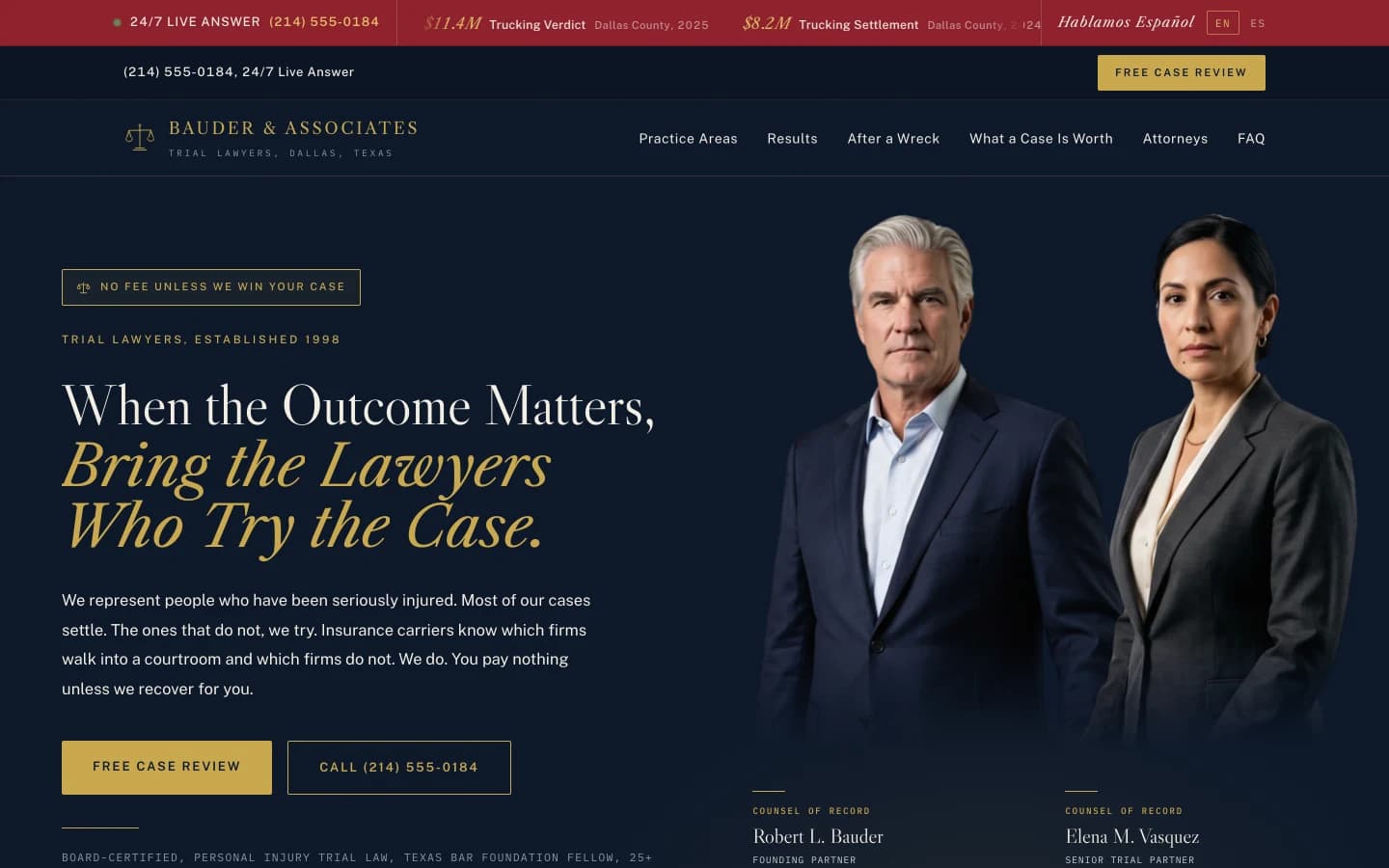
I have published an editorial-grade design brief for a Dallas personal injury law practice as part of the design-briefs series. The brief is not a template. It is a thesis on what a modern personal injury site should be, written in enough detail that any competent engineer could ship from it.
The brief covers a 24/7 bilingual urgent strip with a verdicts ticker, an above-the-fold intake with a same-business-day attorney callback in the partner's first-person voice, a verdicts ledger that names the dollar amount and the county and the operational arc of every case, eight practice-area cards that read like briefs rather than like keyword stuffing, a settlement-mill positioning headline backed by board certification, year-stamped peer recognition, four contact channels with a bilingual human-not-bot commitment, three offices with three direct numbers, and a State Bar of Texas advertising notice that names the responsible attorney by name in legible type. It is the architecture that signs cases the same business day.
The same architectural depth applies to family law, tax law, criminal defense, and business law practices. The trust signals shift (the certifications differ, the verdicts ledger becomes a representative-matters list when verdicts cannot be named, the urgent strip flexes from a 24/7 callback to a consultation booking), but the underlying principles hold: case-fit answer, accurate outcomes, named attorneys, fast performance, accessible design, visible compliance.
For service verticals where the regulatory frame is licensing rather than advertising rules, the cousin architecture lives on the trades and HVAC page, where TACLA license numbers and EPA Section 608 certification play the role that the State Bar advertising notice plays here.
Common questions
What buyers ask before signing
Next step
If your firm is ready for a real site, the first step is a 30-minute call.
I do not run pressure sales. The first call is diagnostic. The goal is to confirm whether a custom build is even the right call for your firm, what scope of engagement makes sense, what the State Bar review timing looks like on both sides, and whether the practice areas align with the kind of work I do. If the project is not a fit, I will say so and recommend a better path. If you want a fast first read on what your current site is leaving on the table, run a free Pathlight scan against your live URL before the call.
Sources
- 1.State Bar of Texas. (2024). Texas Disciplinary Rules of Professional Conduct, Part VII (Information About Legal Services), Rules 7.01 through 7.05. https://www.texasbar.com/AM/Template.cfm?Section=Texas_Disciplinary_Rules_of_Professional_Conduct
- 2.American Bar Association. (2024). Model Rules of Professional Conduct, Rule 7.1: Communications Concerning a Lawyer's Services. https://www.americanbar.org/groups/professional_responsibility/publications/model_rules_of_professional_conduct/
- 3.Clio. (2024). Legal Trends Report 2024: practice economics and client behavior. https://www.clio.com/resources/legal-trends/
- 4.Pew Research Center. (2024). Mobile Fact Sheet. https://www.pewresearch.org/internet/fact-sheet/mobile/
- 5.Google Search Central. (2021). Page experience update: Core Web Vitals as a ranking signal. https://developers.google.com/search/blog/2021/04/more-details-page-experience
- 6.W3C. (2023). Web Content Accessibility Guidelines (WCAG) 2.2. https://www.w3.org/TR/WCAG22/
Author
Joshua Jones runs DBJ Technologies, a solo studio building websites and applications for service businesses across the Dallas-Fort Worth metro. Last reviewed May 6, 2026.