The File Speaks
An injury victim in the first hour after a Central Expressway wreck does not need a founder bio. She needs an intake form, a real attorney calling back the same day, and proof the firm has tried cases in her county. Bauder & Associates is that proof, built: a scroll-driven anatomy of one $8.2 million case told from its own docket, a filterable eighteen-matter verdicts ledger, the contingency arithmetic no firm publishes, a statute-of-limitations clock, and every surface of the site in English and Spanish, because in this market Hablamos Español is not a footer line, it is a trial partner.
The Client Is Reading This from the ER Parking Lot
Nobody comparison-shops a trial lawyer calmly. The visitor this site is built for has one good arm, one tab open, and an adjuster already calling her husband for a recorded statement. The site's job is to be believable faster than the carrier is friendly, and everything about how personal injury firms actually market works against that: undated "millions recovered" tallies, badge walls with no years, stock gavel photography, and a chatbot wearing a paralegal's name.
The brief's answer is a firm that argues the way it litigates: from the record. Bauder & Associates is the fictional Dallas firm this demonstrator builds, a two-partner trial shop established 1998, board-certified, deliberately small, and allergic to the settlement-mill patterns the rest of the category ships. Every claim on the site is either a number you can add up, a credential you can verify against the State Bar, or a commitment specific enough to be falsifiable: a licensed attorney, not a paralegal, calls back the same business day.
The Identity: Navy Courtroom, Cream File, Gold for Money and Deadlines
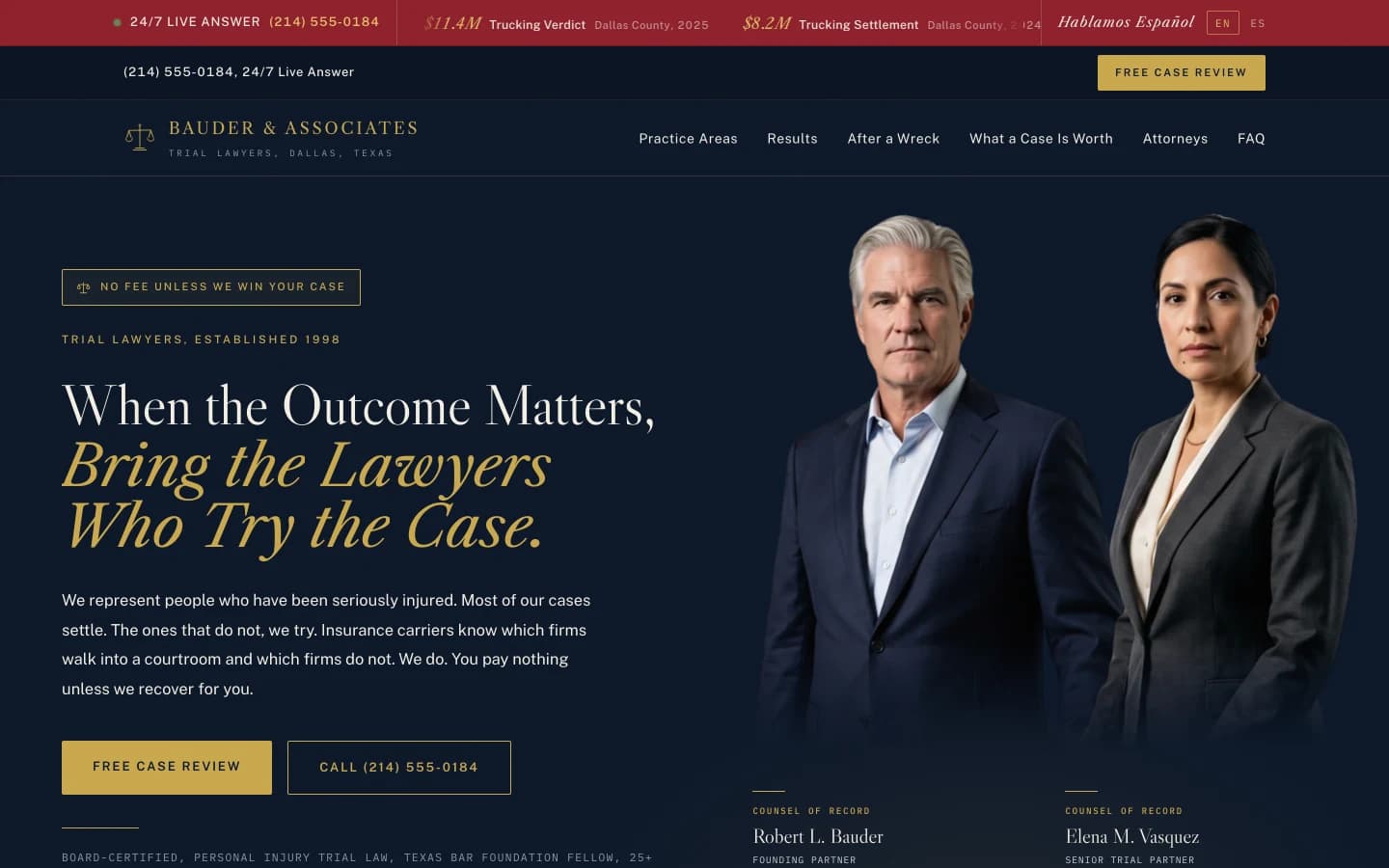
Four typographic registers carry the whole site. Libre Caslon, the typeface of American law, is the counsel voice: the Display cut argues the headlines and verdict figures at size, the Text cut carries the smaller headings, the amounts, and the letters from clients. Public Sans, the United States government's own forms typeface, is the plain-language voice that explains without hedging. And IBM Plex Mono is the record register: every dollar amount, date, docket line, statute citation, and disclosure label is set in mono, so numbers read as entries in a file rather than marketing claims. Dark navy sections are the courtroom; cream and paper sections are the file; gold is rationed to what is load-bearing, money, deadlines, and the way to reach the firm; goldenrod belongs to the exhibit stickers alone, the tags a litigator inks and presses onto deposition exhibits, which here label the photography. Client testimonials are shown as letters from the file on handled paper, the FAQ reads as an examination transcript with Q. and A. markers that become P. and R. in Spanish, and nothing on the site fades in for decoration: display lines are entered into the record with a left-to-right sweep, words in the hero surface whole out of an overflow mask, and the carrier's figure rolls between positions instead of teleporting.
The mark is a beam balance drawn in eight strokes, generated from a single script and emitted to the favicon and every inline instance. Its animation is the thesis in one gesture: the beam never swings, it weighs, a slow near-equilibrium sway. The urgent strip at the very top of every page carries a live ticker of six recent results with the county and year on each, a green-pulsing 24/7 line, and the language toggle, so the three things a panicked visitor needs, proof, a phone number, and her own language, are on screen before the page finishes loading.
The Signature: The Anatomy of an $8.2 Million Recovery
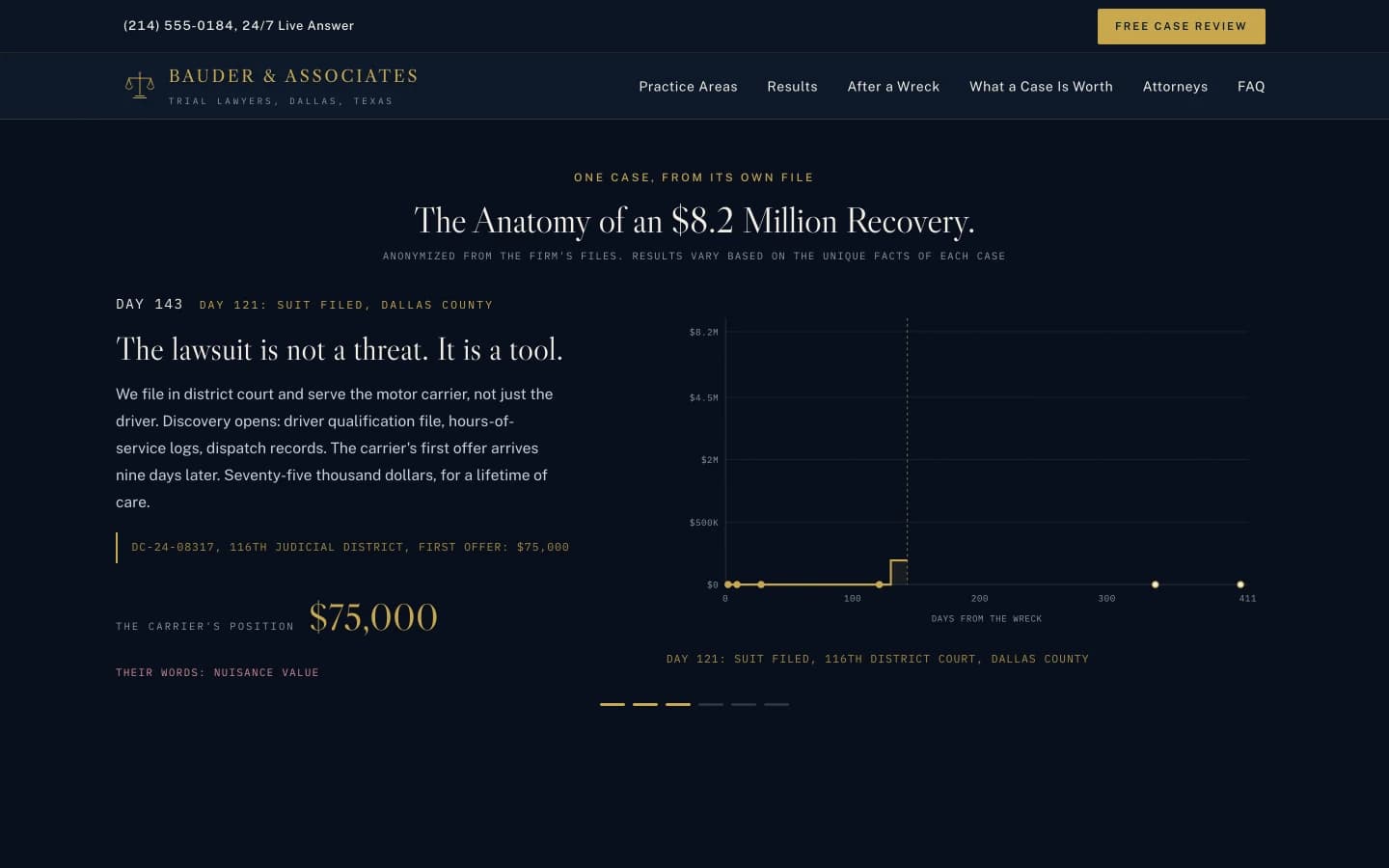
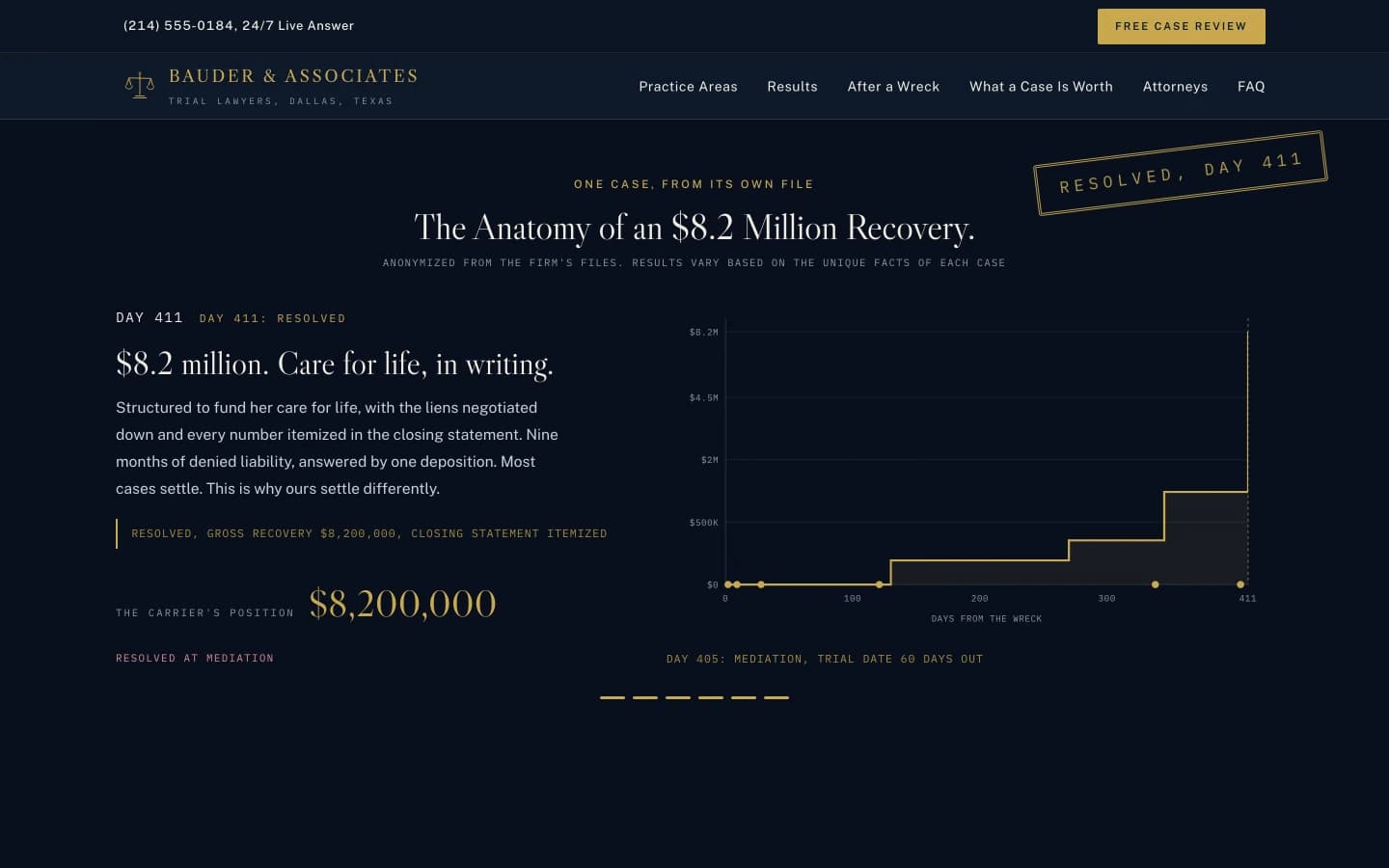
Ask what a trial firm actually sells and the answer is leverage built through procedure, which no website in this category has ever shown. So the homepage's signature scroll piece shows it: one case, anonymized from the firm's files, told as its own docket. As the visitor scrolls, a day counter runs from 1 to 411, six phases swap through the left column, and a chart draws the only line that matters, the carrier's settlement position, as a stepped gold staircase: $0 through nine months of denied liability, $75,000 nine days after suit is filed, $1.1 million one week after the safety director admits the hours-of-service violation on video, $8.2 million at mediation with a trial date sixty days out.
The chart's dollar scale is square-root so the early insults stay visible against the final number, and the gridlines are labeled with their true values so the compression is honest. Docket events light along the day axis as the sweep passes, preservation letters day two, the ECM imaged day nine, surveillance video copied before its thirty-day deletion, and a mono readout narrates each one. At day 411 a double-bordered stamp imprints over the section like a clerk closing a file. The whole sequence is authored in the DOM at its final state, so without JavaScript, or with reduced motion, the page simply shows the finished chart and the resolution: the honesty survives the interactivity being taken away.
The Record: Eighteen Matters You Can Add Up
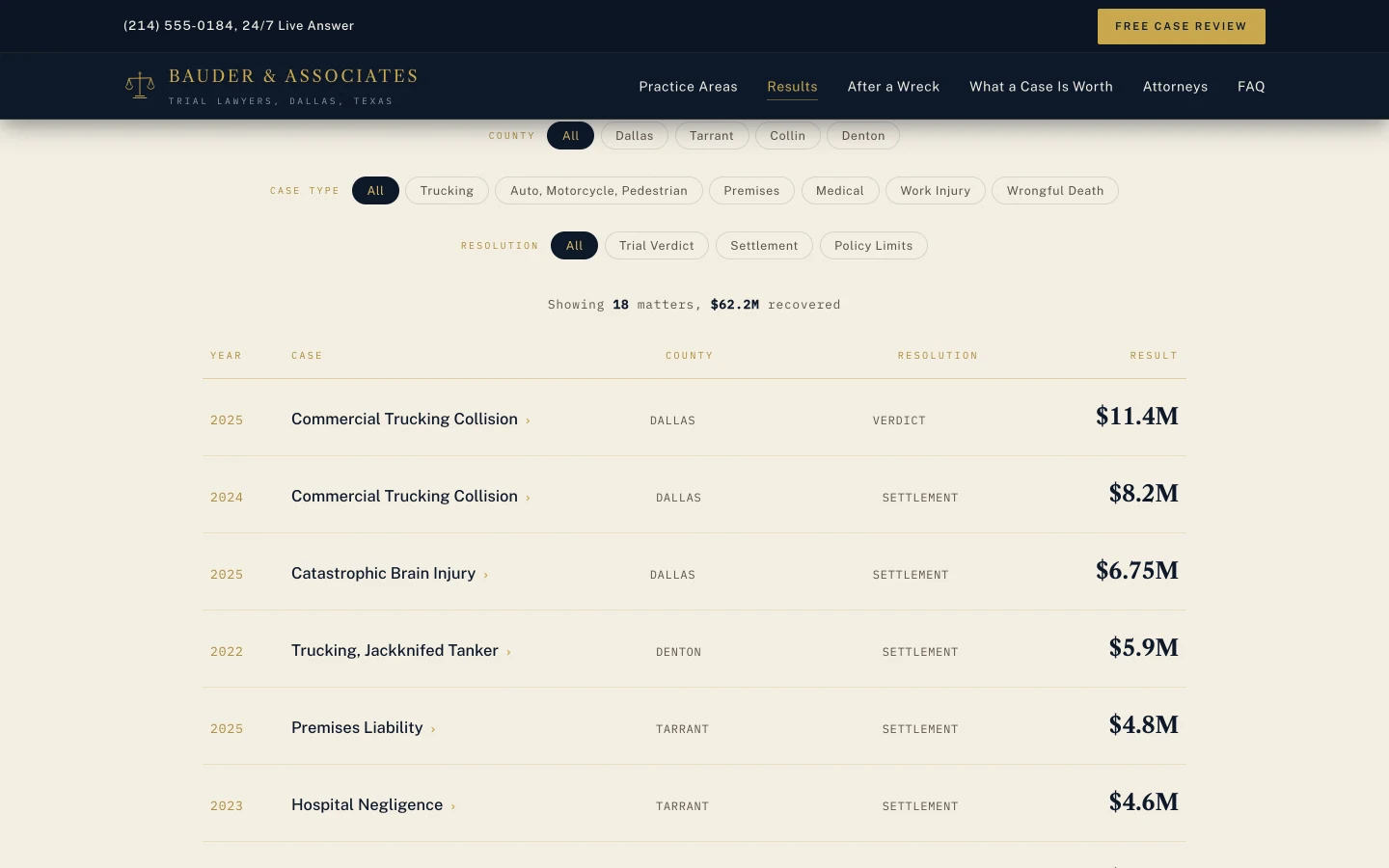
A lifetime tally proves nothing, so the results page is a ledger instead: eighteen matters, 2020 to 2025, each with the year, county, resolution type, and amount, filterable by all three axes with a live recomputing total. Filter to Dallas County trucking and the summary reads two matters, $19.6 million; clear it and the page adds back to $62.2 million, a figure the visitor can verify by adding the column. Every row expands to a two-sentence operational arc that names what the firm did, the empty-chair defense beaten at trial, the corporate representative deposition that surfaced two ignored incident reports, because what moved the number is the product.
The Texas Bar disclosure sits above the ledger in body weight, not buried under it in eight-point gray, and the page ends by disclosing what the amounts are: gross recoveries, before fees, expenses, and liens, with a link to the page that publishes exactly that arithmetic. Three of the eighteen are trial verdicts, and the ledger says so, because the whole site's argument is that the other fifteen settled well for precisely that reason.
What a Case Is Worth: The Arithmetic Nobody Publishes
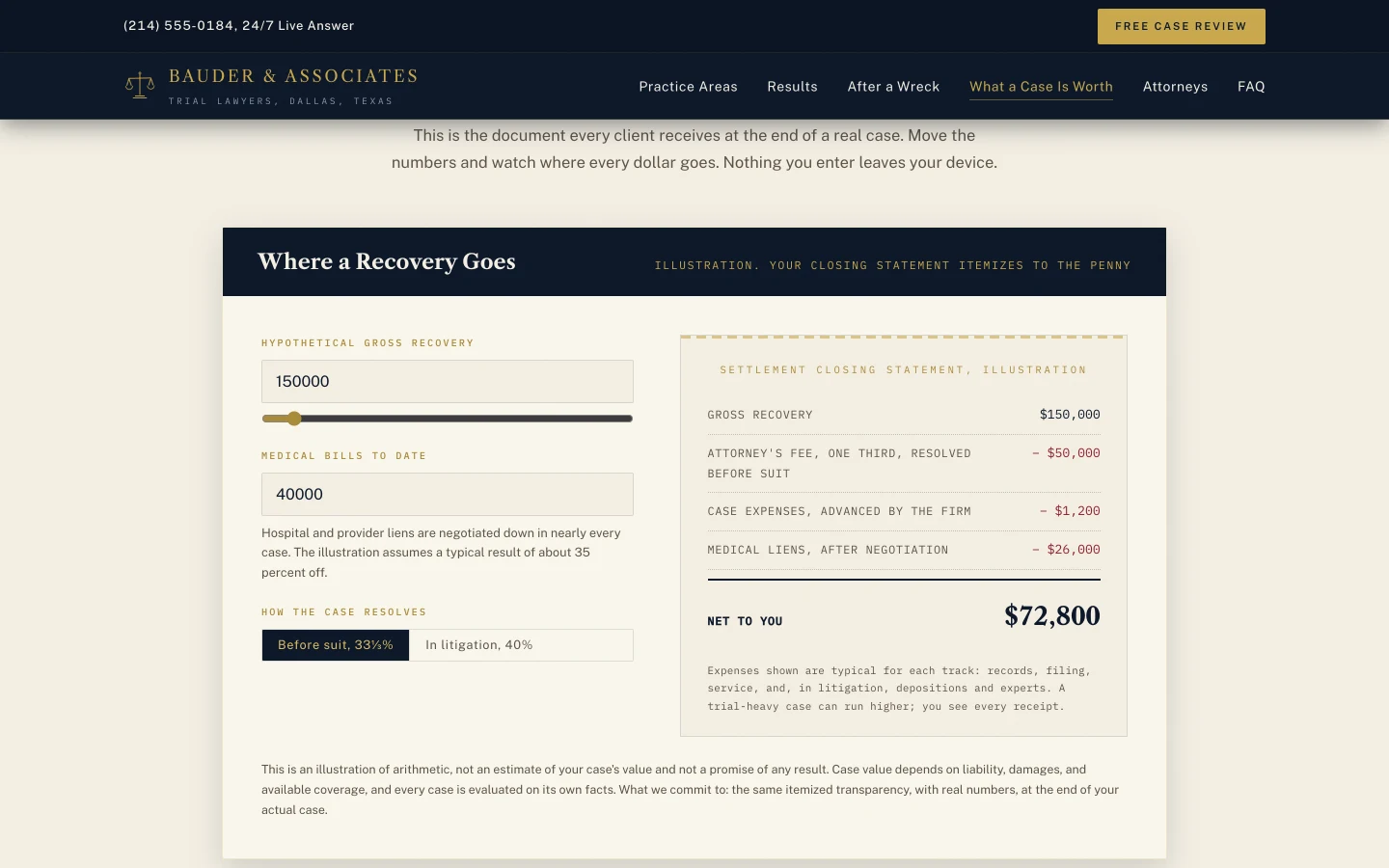
Every firm says "no fee unless we win." This page publishes the rest of the sentence: one third before suit, forty percent in litigation, zero if there is no recovery, and then hands the visitor the instrument no firm has ever handed a prospect, a closing-statement simulator. Enter a hypothetical recovery and your medical bills, pick the track, and read the same itemized document a real client receives at the end of a real case: gross recovery, fee, advanced expenses, liens after negotiation, net to you. When the bills overwhelm what a capped recovery can carry, the tool says so and explains that lien negotiation is exactly where that case is won.
The page is honest in both directions. It describes the three kinds of Texas damages including how rare exemplary damages actually are, names comparative fault as something that moves value down, and closes with the switching-counsel rule most clients never learn: changing firms does not double the fee. The dare underneath the whole page is the positioning: ask any firm you interview to match this arithmetic in writing.
After a Wreck: The Protocol and the Clock
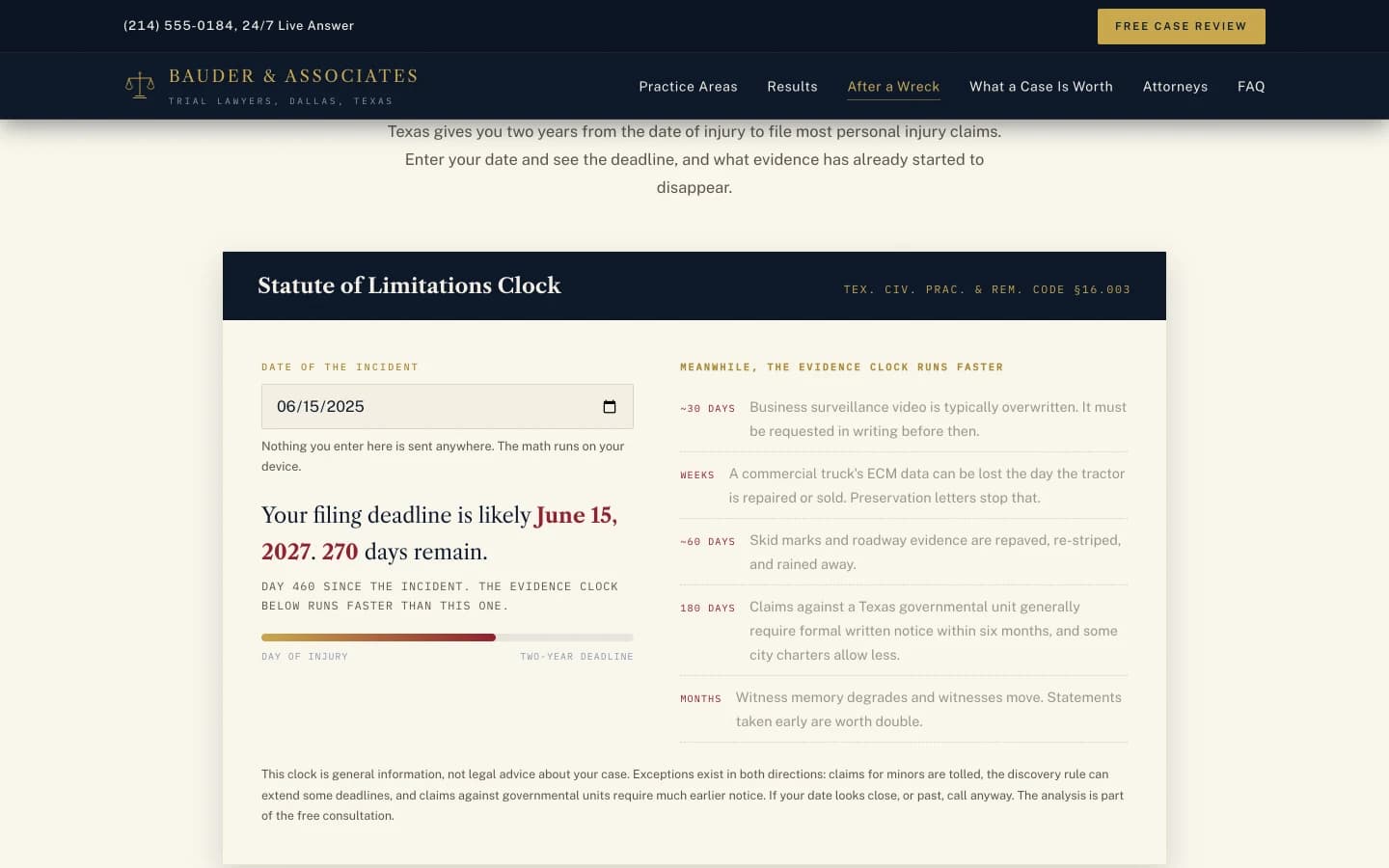
The After a Wreck page is the lead magnet rebuilt as an actual service: seven steps in strict order, each carrying a mono "why" line that names the operational reason, a warning block about the adjuster's first call written in the second person, and a print stylesheet so the checklist survives on paper. Below it sits the statute clock: enter the incident date and the page computes the two-year Texas filing deadline, the days remaining, and, more usefully, which evidence has already expired, because surveillance video dies at thirty days while the statute takes two years. The tool states its own limits, tolling for minors, the discovery rule, the six-month governmental notice trap, and the same computation runs quietly inside the intake form, so a visitor who types their date sees their deadline before they ever submit.
Attorneys You Can Verify Before You Call
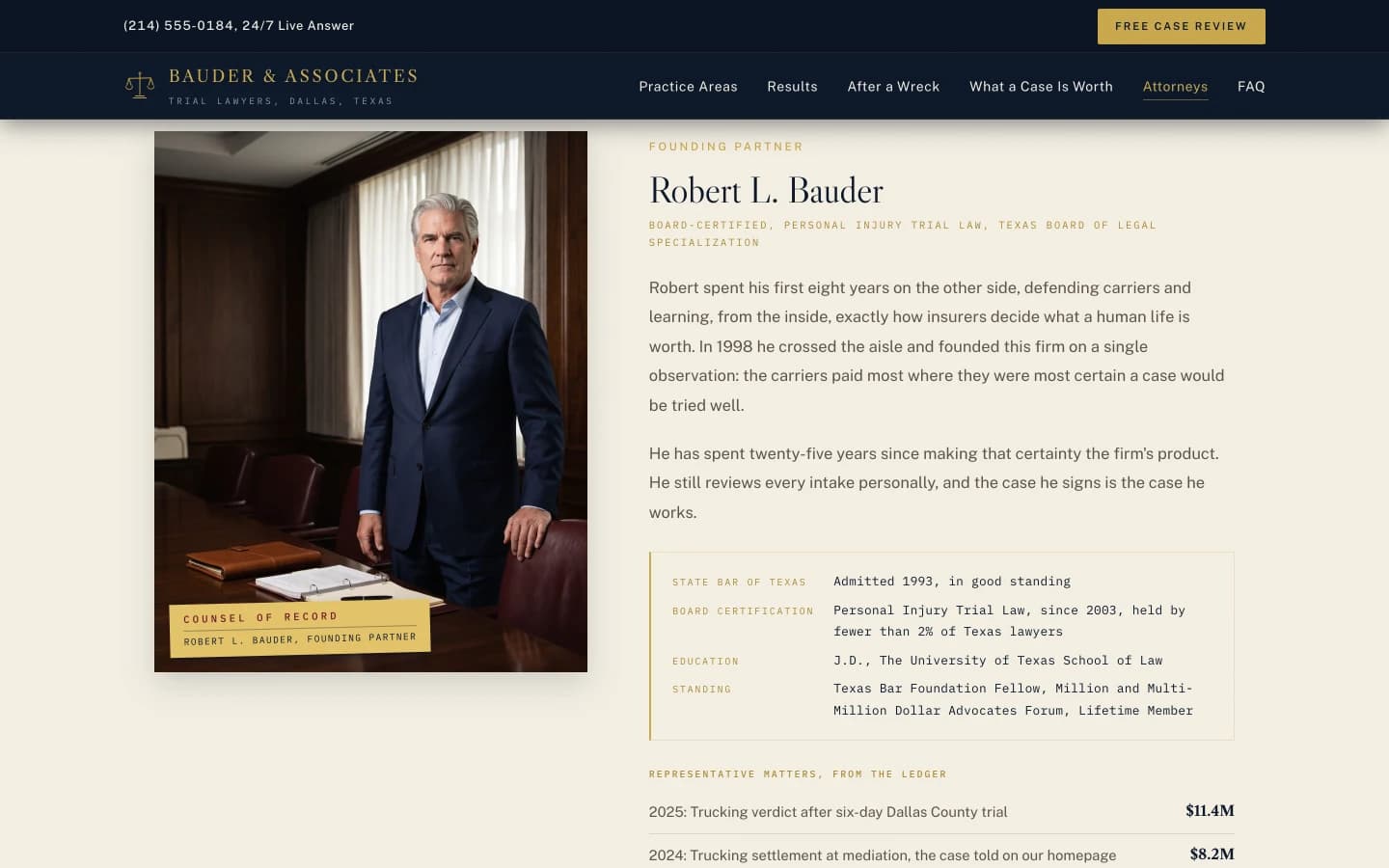
Two trial partners, profiled the way a skeptical client actually vets a lawyer: a mono credential block with bar admission, board certification, education, and standing, followed by representative matters that link back to the same ledger the results page publishes, so the site never tells the same story two different ways. Robert L. Bauder's bio leads with the uncomfortable fact that makes the rest credible, eight years defending carriers before crossing the aisle. Elena M. Vasquez, former Dallas County felony prosecutor, sixty-plus verdicts, carries the firm's second thesis: she tries cases in Spanish personally, in the same courtroom.
The pledge sits between the profiles as a signed blockquote, we are deliberately small, the lawyer who signs your case is the lawyer who tries it, and the team section behind it deliberately has no stock photos: a retired DPS crash reconstructionist, a legal nurse consultant, and a bilingual intake desk, described by what they do to a file rather than by headshots the visitor would rightly distrust.
En Español, All of It
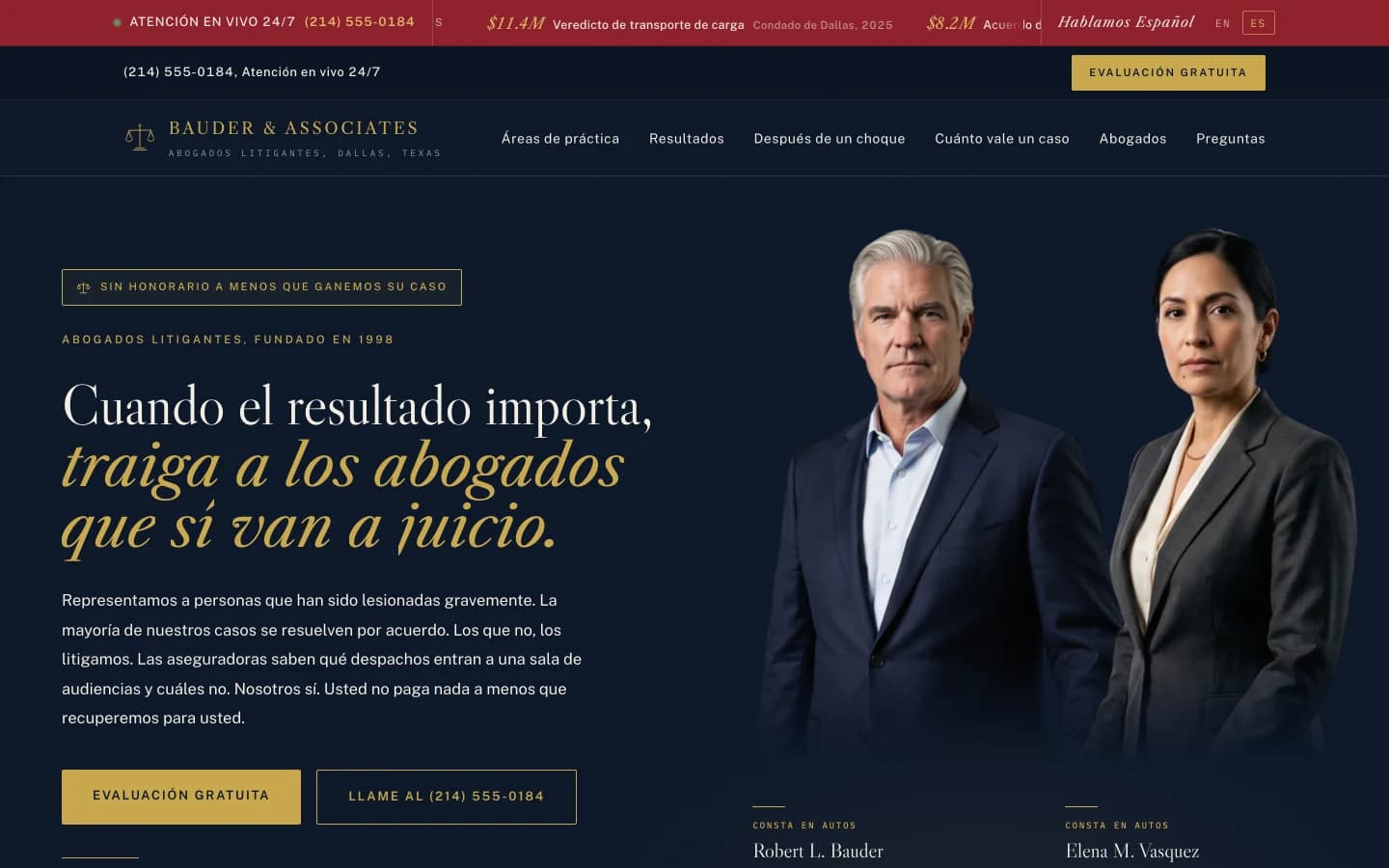
Half the people who could need this firm run their lives in Spanish, and the category's standard answer is a "Hablamos Español" footer line attached to an English-only site. Here the toggle in the urgent strip, or tapping the words Hablamos Español themselves, swaps every surface: all eight pages, the anatomy sequence's six phases, the statute clock's verdicts, the closing-statement labels, the form placeholders, the page titles, the image alt text. The choice persists across pages and visits.
The Spanish is written for the client, not translated at her, in the plain register a trial partner uses with juries, and the FAQ answers the question the carriers quietly price into their offers: immigration status generally is not admissible in a Texas injury case, and fear of asking is worth money to the other side. That answer existing on the page, in both languages, is the brief's sharpest single argument.
Four Channels, Three Offices, One Metroplex
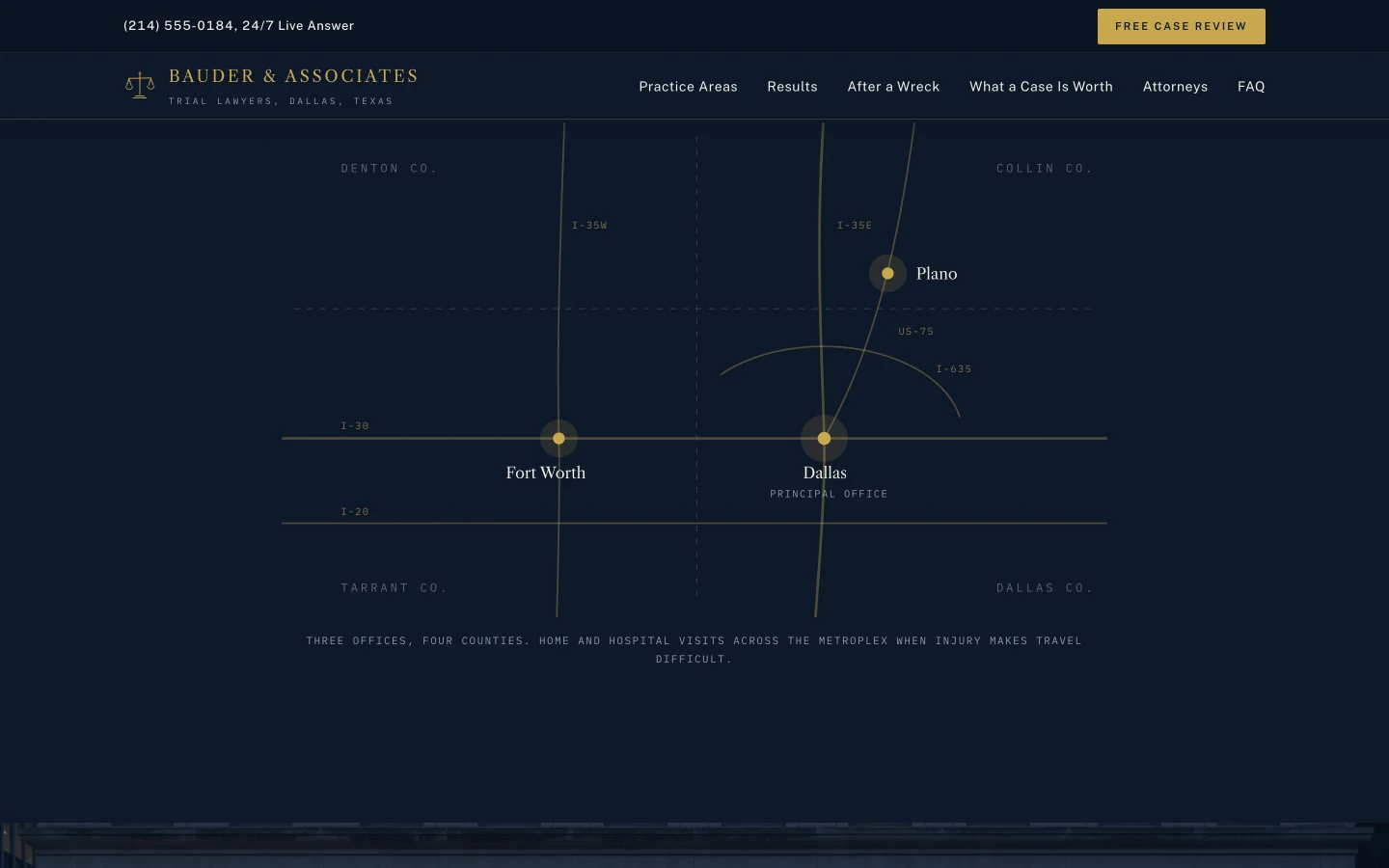
The free case review page assumes its reader has one good arm: call, text, form, or email, each with an explicit operational commitment, and a "what happens next" timeline that puts the firm's promises on a clock, intake read by a person within the hour, a licensed attorney the same business day, preservation letters the day the engagement is signed. The offices render as a hand-drawn schematic of the metroplex, gold hairline highways over dashed county lines, one pin per office, which quietly proves the same geography the ledger's county column claims. The incident-date field shows the visitor their own statute deadline inline, before they ever submit.
Compliance as Design, Not Fine Print
The State Bar of Texas advertising rules govern every marketing sentence a Texas firm publishes, and most firms treat that as a burial problem. Bauder renders compliance in the site's own typographic registers: the results-vary disclosure sits above the ledger in body weight, the anatomy sequence carries its anonymization line directly under its title, the recognition of what amounts mean, gross, before fees, is stated where the amounts are, and the footer names Robert L. Bauder personally as the responsible attorney, keeps the not-certified-in-every-area admission in normal type, and anchors the principal office address in four separate places. The "Website by DBJ Technologies" credit closes the disclosure column, where a serious firm credits the engineering studio that built the infrastructure underneath.
That is the whole brief in one habit: the category's standard moves, hidden disclaimers, undated badges, unverifiable tallies, all inverted into structure. A firm that publishes its record, its arithmetic, its deadlines, and its disclosures is making one continuous argument, and it is the same argument it makes to juries: check the file.
Build It For Real
Want this architecture, executed for your practice?
I build the version of this that ships. Designed end to end, launched on production grade infrastructure, with the surfaces above tuned to your actual book of business.