Mail and the Phone Line
The two channels a small business actually runs on both sit outside every CRM it has ever bought. Why the mailbox is mirrored rather than replaced, why the phone screen inverts the default instead of maintaining a blocklist, and why nothing in either half is ever allowed to decide on its own.
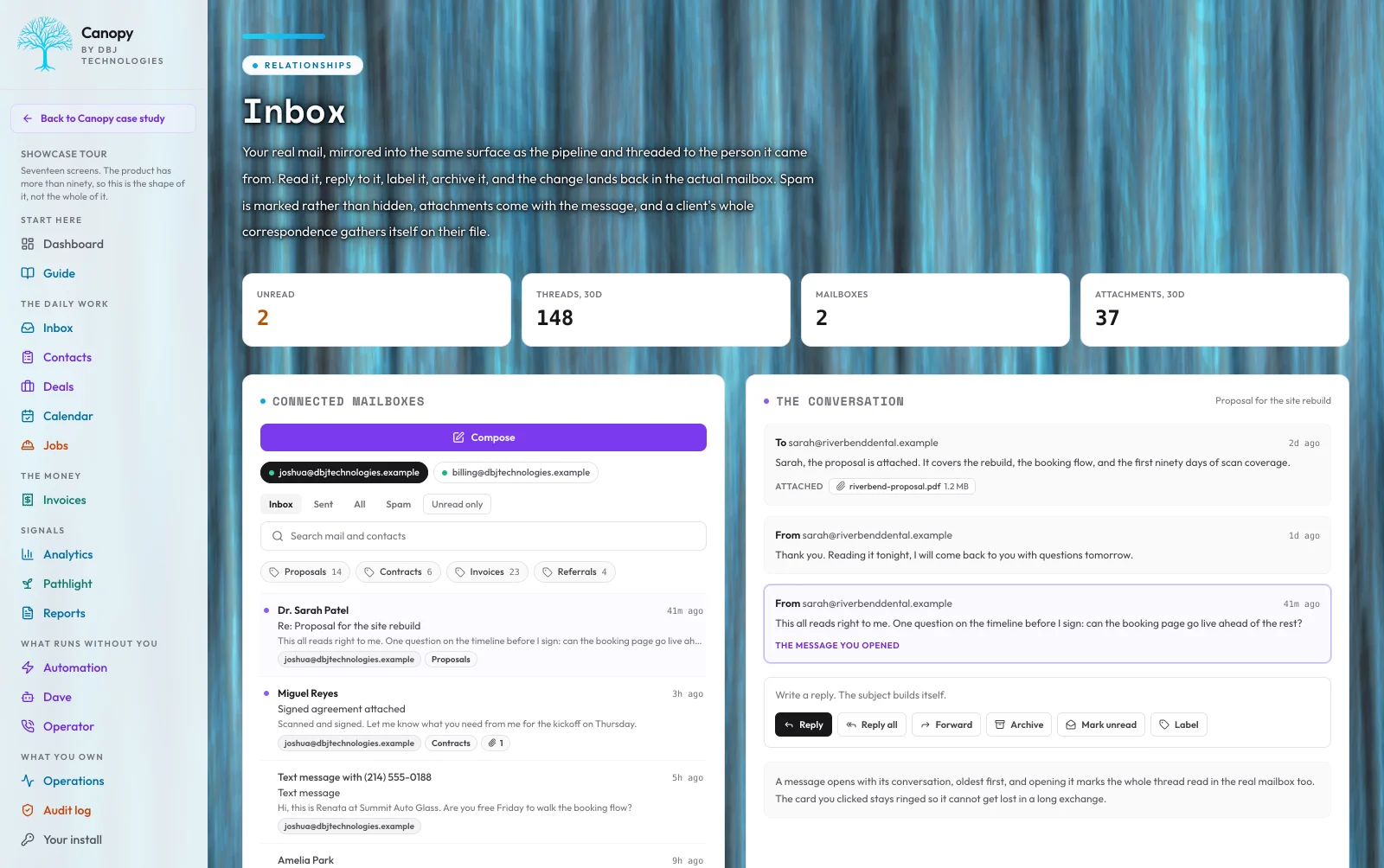
The question underneath this section: what is a system of record actually worth when the two channels the business runs on both sit outside it. Every small business I have worked with runs on email and the telephone. The CRM is where the follow-up is supposed to live. But the thread that explains the follow-up lives in a mail client, the call that started the whole relationship lives in a phone that keeps no record of it, and the CRM ends up holding a one-line summary of a conversation nobody can go back and read. The operator compensates by keeping the real history in their own head and in their own inbox, and the CRM quietly degrades into a list of names with stale notes attached. Then the operator stops trusting it, which means they stop updating it, which makes it less trustworthy still. That spiral is the single most common way I have seen a small-business CRM die, and it is not a feature gap. It is a boundary problem. The system of record stops at the edge of the two systems where the record is actually being made. The obvious answer is to pull the mailbox inside: make Canopy the mail client, and the boundary disappears. I built a version of that thinking and rejected it, for two reasons that both fall on the buyer. The first is habit. An operator has spent years in a mail client they are fast in, with their own filing, their own shortcuts, their phone set up the way they like it, and asking them to abandon that in order to get a CRM benefit is a trade most people decline within a week. A tool that has to win an argument with muscle memory every morning loses. The second reason is the one that actually decided it. If Canopy is the mailbox, then the buyer's mail is inside my software, and the ownership claim this whole case study rests on gets weaker rather than stronger. Their correspondence should not become a thing they can only read through a product I built. So the mechanism is a mirror, not a replacement. The real mail account stays the real mail account. Canopy holds a synchronized copy of it, and the synchronization runs both directions for the things that matter: marking a message read in Canopy marks it read in the actual mailbox, so an operator who works a morning inside the CRM does not then find the same forty messages waiting unread in their phone at lunch. Reading in one place is reading. That sounds small. It is the difference between a mirror somebody uses and a mirror they abandon after a week because it doubles their work instead of holding it. What the mirror buys is the join. Every message threads to the person it came from, so the correspondence and the deal and the invoice and the job are all on one file rather than in four systems that agree by coincidence. A client's whole history gathers itself by domain, which is the part that matters more than it sounds: mail that arrived before the contact record existed still shows up on that contact, because the gathering keys on the address rather than on a link somebody remembered to make at the time. In practice most of the correspondence with a client predates the moment they became a record. A design that only shows mail sent after the record was created shows the operator the least interesting half of the relationship and tells them the file is complete. Spam is marked rather than hidden, and that is a deliberate inversion of what a mail client does. A filter that hides is optimizing for the common case, which is that the buried message was junk. But the reason a person goes looking through spam at all is the uncommon case: the one real message a filter got wrong, usually from a new client whose domain has no sending history, which is exactly the profile of a first inbound inquiry. Hiding that message costs a customer. Marking it costs a moment of visual noise. I would rather pay the noise every day than the customer once. Attachments arrive with the message rather than being fetched on demand, so a quote somebody sent in March is on the file in March. The honest exclusion on the mail half: Canopy is not a mail client and does not try to become one. It is a CRM that can see the correspondence. If the buyer wants filters, rules, aliases, signatures and the rest of what a mature mail client does, they should keep using the mature mail client, which is precisely why the mirror does not ask them to stop. The phone is the harder half, because the problem there is adversarial rather than structural. A small business publishes its number, and within a month that number is on lists, and the phone rings all day with dialers. The standard answer is to block the numbers as they come. That answer never converges, and it is worth being precise about why: an automated dialer spoofs a fresh caller ID on every single call, so each block lands on a number that was never real and will never call again. The operator does the work of maintaining a blocklist forever and the volume does not move. I watched that play out before I built anything, which is how I knew the feature to build was not a better blocklist. So the default is inverted. Instead of maintaining a list of who cannot get through, the install maintains the knowledge of who is already known, and known numbers ring straight through without hearing anything at all. A client who has been called before, or who is on the file, experiences an ordinary phone line. Everybody else has to prove they are a person, say who they are, and say what they are calling about. A dialer will not do any of that, because doing it costs more than the call is worth to whoever is running it, and the economics of the attack are what the screen is actually aimed at. The operator's phone then rings with a one-line summary of who is calling and why, spoken as the call connects, so the decision to pick up is made with information rather than with a number.
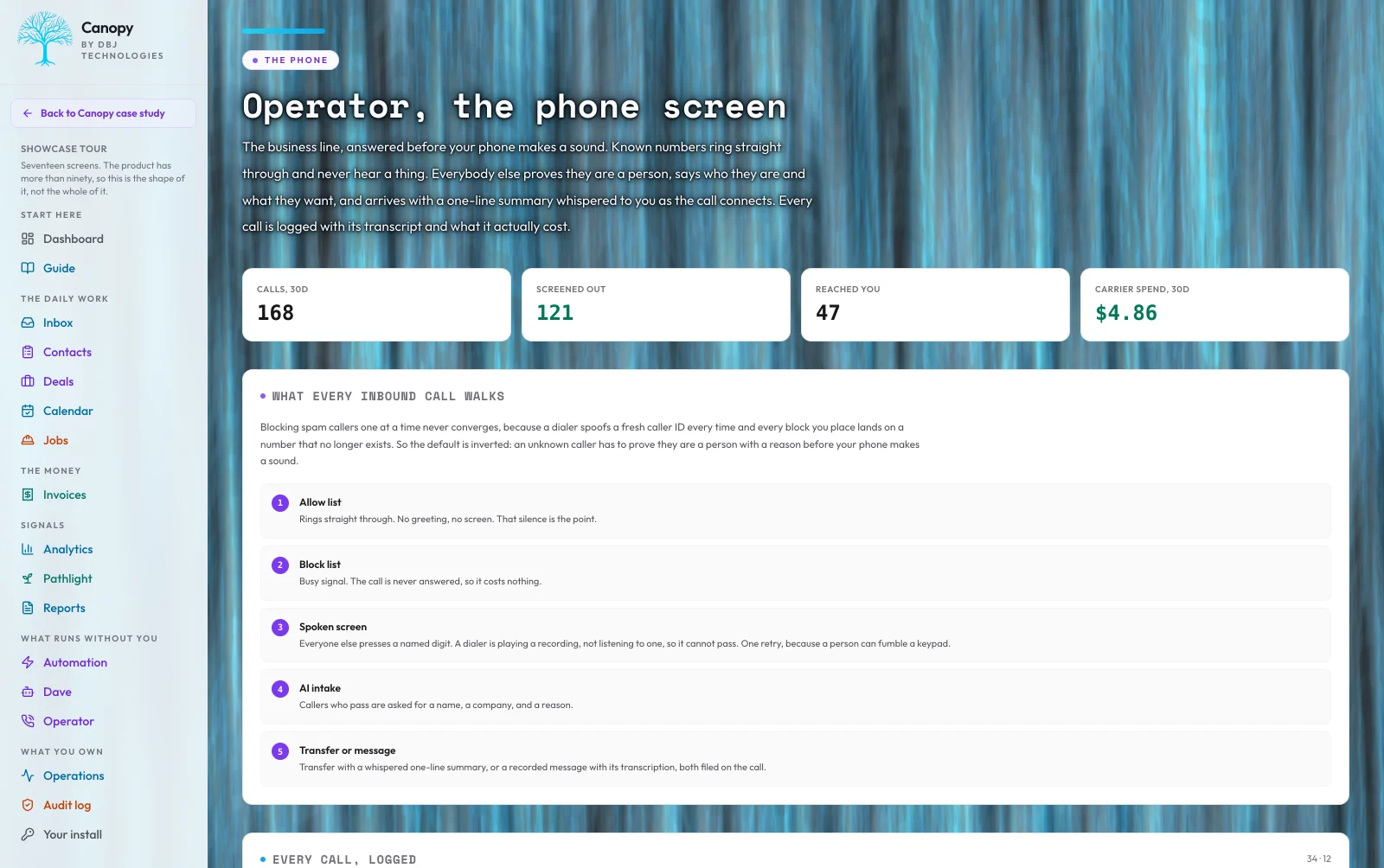
Nothing auto-blocks, ever, and that constraint cost me the most attractive-looking feature in the whole area. A screen that learns and starts refusing callers on its own would cut the remaining noise further. It would also, on some unknown morning, silently drop a real client, and the client would get no signal that it happened. They would simply believe they called and nobody answered, and they would call the competitor instead, and the buyer would never learn the call existed. A defense whose failures are invisible to the person it failed is worse than a slightly noisier defense whose failures are visible. So the screen filters and summarizes and it never decides. The second constraint is that the screen fails open. If it is switched off, if a dependency is down, if anything in the path errors, calls forward straight through unscreened. A broken screen behaves exactly like not having one, which means the worst outcome of any failure in this system is the phone the buyer had before I built it. I would rather ship the version where a bad day means unfiltered ringing than the version where a bad day means a dead line, and those genuinely are the two options; there is no third design where a broken screen is still a good screen. Every call is logged with its transcript and with what the carrier actually billed, which closes the same loop the mail mirror closes. The call that started the relationship is now on the file, readable, months later, by somebody who was not on it. The cost of the phone line is a number in the same dashboard as every other number rather than a statement that arrives separately. And the screening decisions are attributable, so the question 'did anybody call us on the fourteenth' has an answer that does not depend on whose phone it was. The operational consequence the buyer feels is that the CRM stops being a thing they have to maintain in parallel with reality. The follow-up, the thread that explains it, and the call that started it are on one file, put there by the work itself rather than by somebody remembering to file it. The operator does not have to choose between working fast in the tools they know and keeping the record honest, because the record is assembled from those tools rather than in competition with them. That is the only version of a CRM I have ever seen a small business actually keep using in year two.