Momlife in Dallas
A family-activities publication for Dallas-Fort Worth, built for an audience that already existed and had nowhere permanent to live. The work was to turn a stream of Instagram stories into a searchable, structured library: ninety-seven individual place pages spanning twenty-four cities, eleven long-form guides, a running events calendar, and a full Spanish edition. The editorial standard is the thing that makes it work. Every place on the site was visited first, so the pages carry shade notes, bathroom truth and whether the thing is actually free, which is the information a parent needs and the information a press release never contains.
An Instagram audience of more than ten thousand DFW families, finally with somewhere permanent to send them. A story about a splash pad disappears in a day; the same visit written up as a place page answers that search for years. Ninety-seven of those pages, each with the details a parent actually needs before loading the car.
The Client
Momlife in Dallas is a Dallas-Fort Worth family-activities publication written by a local mom who goes to the places first. Free splash pads, dollar zoo days, indoor play areas that rescue a hundred-degree afternoon, seasonal festivals worth loading up the car for. By the time I was brought in, the audience already existed: more than ten thousand DFW families following along on Instagram. The reputation was real and the recommendations were trusted. What did not exist was anywhere for that trust to accumulate.
An Audience Living On Rented Land
Instagram is very good at reaching people today and very bad at reaching them next summer. A story about a splash pad is gone in twenty-four hours. A reel about a pumpkin patch surfaces for whoever the algorithm decides, once, and is then effectively unfindable. Meanwhile the searches never stop: parents type 'free splash pads near me,' 'indoor play areas Plano,' 'things to do with kids in Rockwall' every single week, all year, forever. All of that demand was landing on aggregator sites and stale listicles written by people who had never been to any of these places, while the person who had actually been to all of them had no page to rank. The audience was renting attention on a platform instead of owning an asset.
The Goal
Build a permanent home for work that was already being done. Not a link-in-bio page and not a blog, but a structured publication where every place visited becomes a page that answers a real search for years afterward, where the guides do the work of the listicles but honestly, and where a growing library compounds instead of evaporating. The Instagram following becomes the launch audience rather than the whole business.
The Place Page As The Unit Of Work
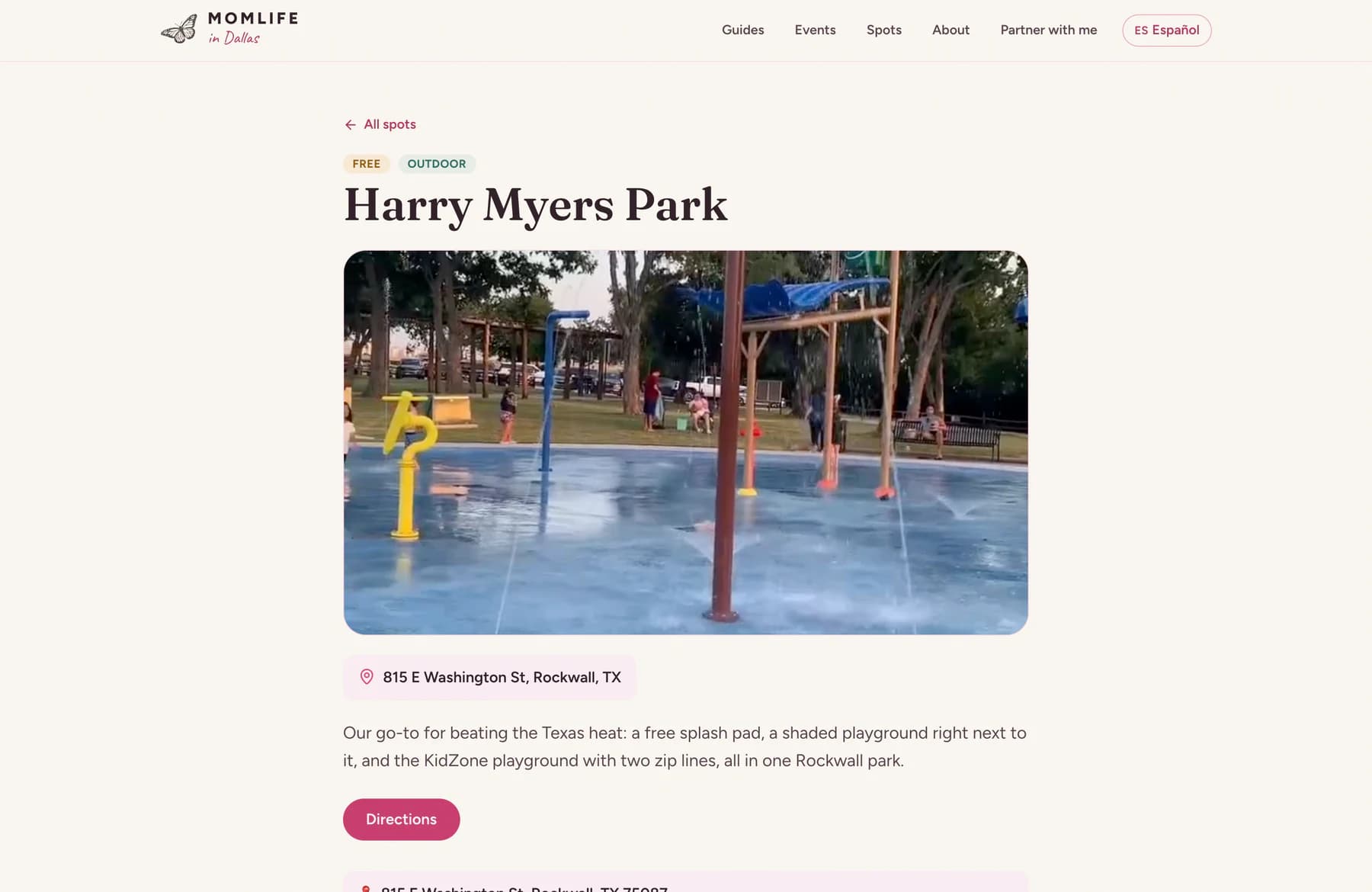
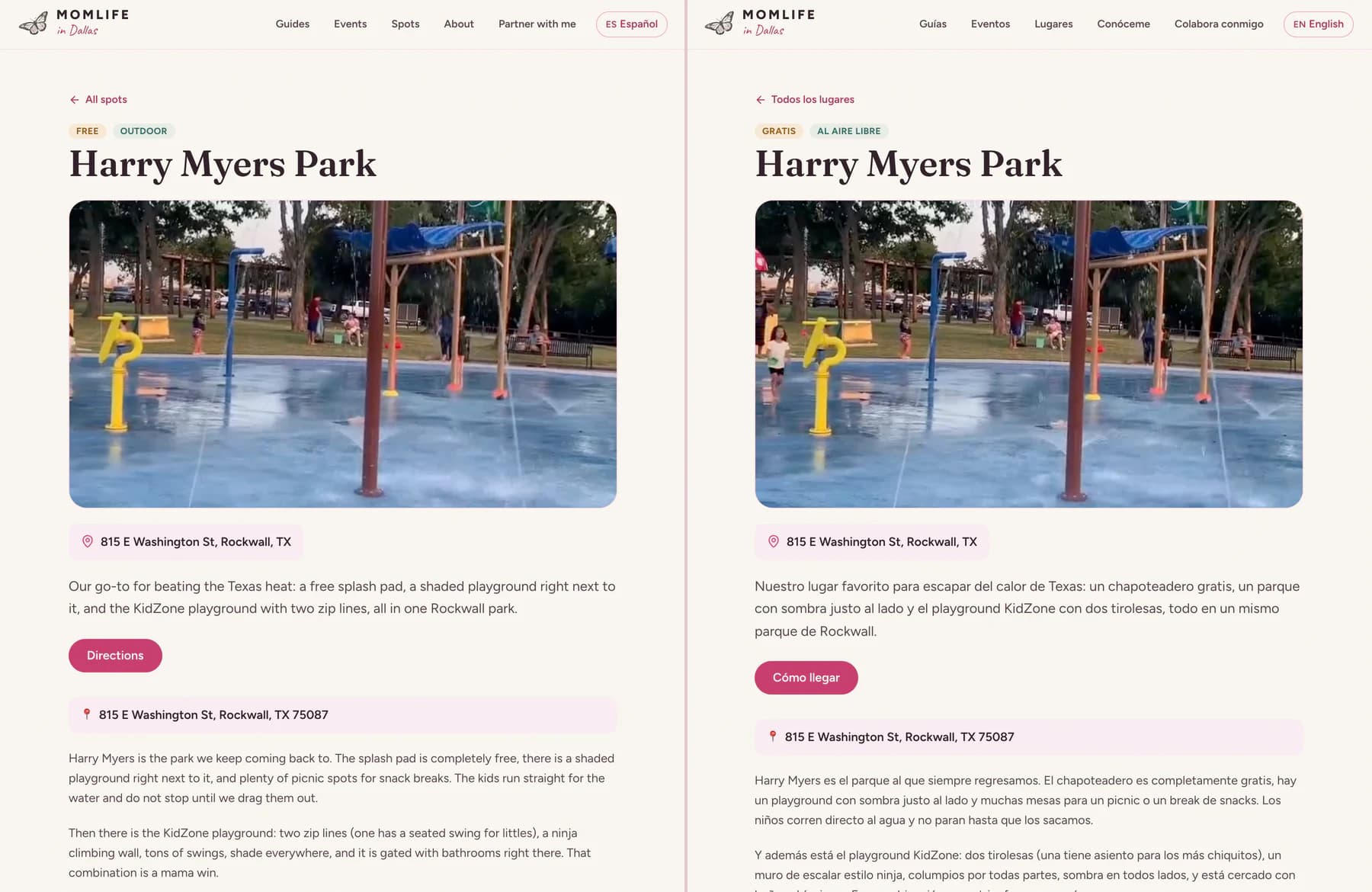
The architecture treats a single place as the atom. Ninety-seven of them, called spots on the site itself, each with its own URL, its own page, and its own Place structured data carrying a real postal address so search engines and AI assistants can read what it is and where. Harry Myers Park in Rockwall, PlayGrand Adventures in Grand Prairie, the Perot Museum in Dallas, Casey's Clubhouse in Grapevine, a panaderia in Garland. They span twenty-four cities across the metroplex, clustered where the author actually spends her weeks rather than spread evenly for the sake of a coverage map. Each page carries the specifics a parent needs before committing an afternoon: whether there is shade, whether the bathrooms are usable, whether the free thing is genuinely free. That level of detail is only available to someone who went, which is exactly why an aggregator cannot compete with it.
Finding One Place Among Ninety-Seven
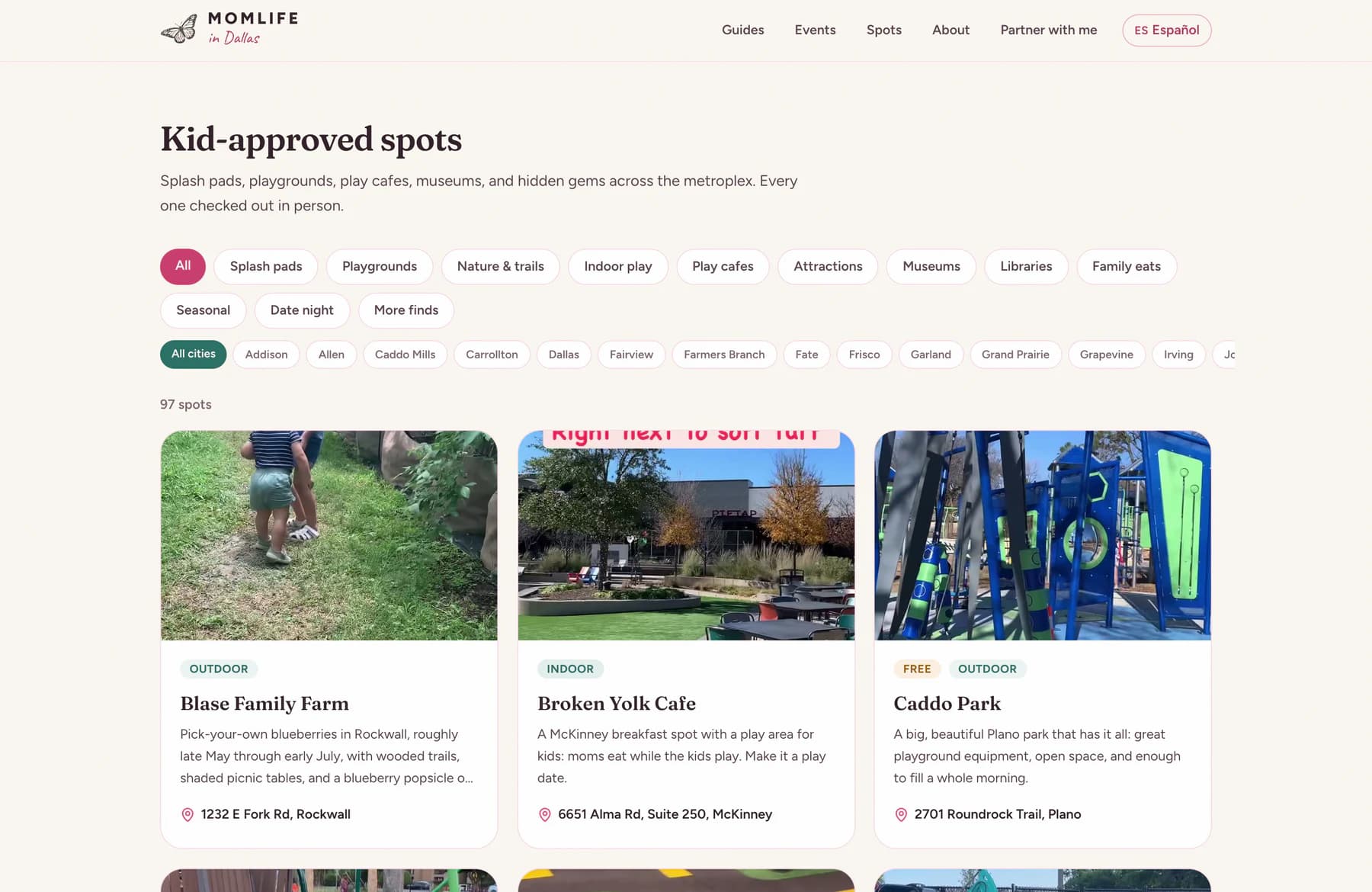
A library only works if a parent can get to the one page they need, and the search that brought them in is rarely the one they finish with. So the place index is a browse rather than a list: twelve category facets covering splash pads, playgrounds, nature trails, indoor play, play cafes, attractions, museums, libraries, family eats, seasonal, date night and a catch-all for the finds that fit nowhere else, crossed with a filter for every one of the twenty-four cities. Pick a category and a city and the ninety-seven narrow to the handful worth an afternoon. The counts that describe the library are read from the library rather than typed into the page, so the home page can promise thirty-three free spots or six events on the calendar right now and still be telling the truth next month. A number a human has to remember to update is a number that is quietly wrong most of the time.
Guides That Earn The Search
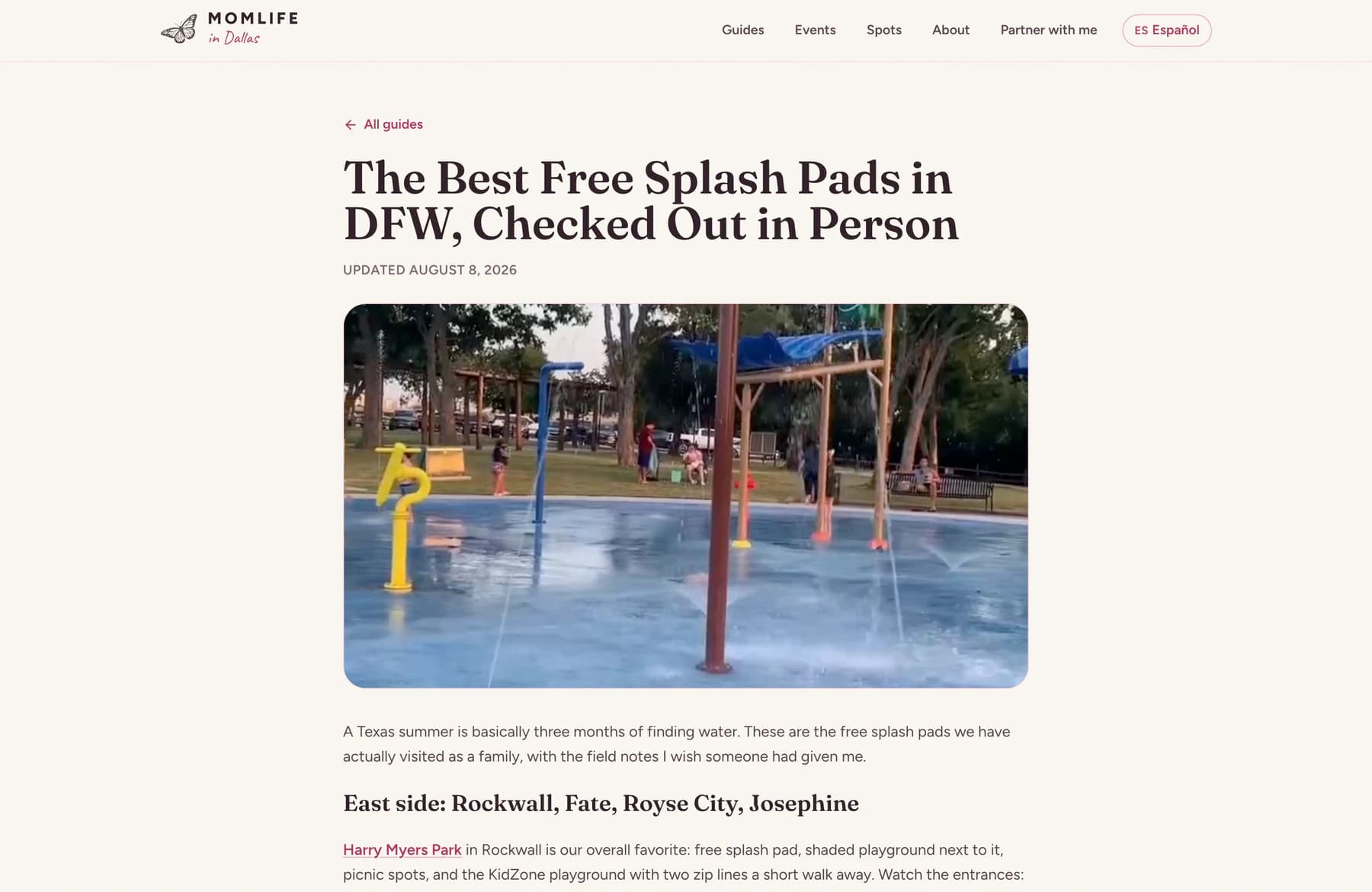
Above the place pages sit eleven long-form guides, each aimed at a search a DFW parent runs on a schedule: free splash pads, free indoor play areas, dollar days at the Dallas Zoo, restaurants where kids can play while you eat, berry picking, pumpkin patches, Christmas with kids, indoor playgrounds in Plano. These are the queries the internet answers worst, because the listicles that rank for them are assembled from other listicles. Here each guide is built on top of the place pages underneath it, so the recommendation and the evidence for it live on the same site, and a reader can go from 'which splash pads are free' straight to the specific park with the shade notes. The guides carry a visible update date at the top, and the same date in the machine-readable markup underneath, because a seasonal guide that has quietly rotted is worse than no guide.
A Calendar That Has To Stay True
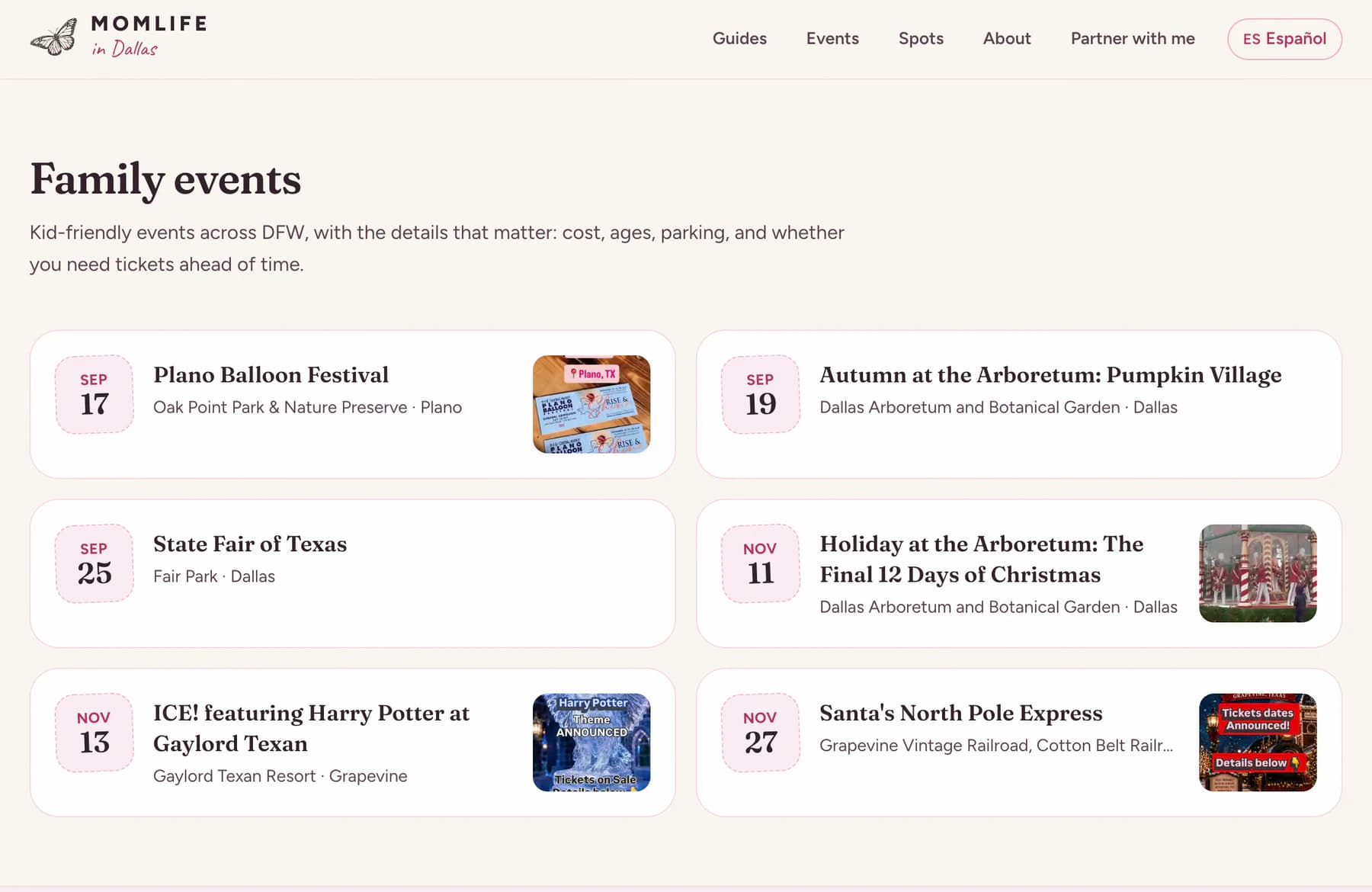
Family events are the highest-intent thing on the site and the fastest to go stale, so the events surface is dated and finite rather than an evergreen dump. Balloon festivals, pumpkin villages, the State Fair, holiday programming, each with its venue, its city, its dates and its ticket terms carried in markup a search engine can read. The design decision that matters is what happens when an event passes: it leaves. A listing that quietly keeps promoting last October is the fastest way to lose a reader who drove somewhere on your word.
Built In English And Spanish
Dallas-Fort Worth is bilingual and family plans get made in both languages, so the publication ships a full Spanish edition rather than a translate widget: its own routes, its own copy, its own navigation, and the same guides, places and events underneath. Every one of the ninety-seven places has a Spanish page, so the sitemap carries exactly twice what the English edition alone would. A Spanish-speaking parent gets the same shade notes and the same honest answer about whether the splash pad costs anything.
A Publication, Not A Brochure
The site is built to be run, not just launched. New places get added after they are visited, guides get revisited each season, and the events calendar turns over continuously. The monetization surfaces are built into the structure rather than bolted on: a partner page for businesses that want to reach DFW families, a creator code carried inside the one guide that argues about whether the product is worth buying and discloses the arrangement in plain language on the page, and a newsletter that promises one short weekend plan every Thursday and turns a search visitor into someone who comes back without going through a platform first. The point of owning the asset is that every one of those paths belongs to the publication instead of to a feed.
The Result
An audience that lived entirely on someone else's platform now has a property it owns. Ninety-seven places, eleven guides and a live events calendar across twenty-four DFW cities, in two languages, each page structured so search engines and AI assistants can read exactly what it describes. The work the author was already doing, going to the places and telling the truth about them, now accumulates instead of scrolling away.
The technical decisions behind this build.
Next.js
A publication whose value is search visibility needs pages that arrive rendered, fast, and crawlable. Server rendering with static generation for a library of place and guide pages means every one of them is a real document a crawler and an AI assistant can read, not an empty shell waiting on JavaScript.
Structured Data, One Type Per Content Type
Every place page carries Place markup with a real PostalAddress, every guide carries Article markup with the same update date the reader sees, and every event carries Event markup with its dates, its venue and its ticket terms. It is the difference between a page that mentions a park and a page a search engine understands to BE about a specific park at a specific address, which is what makes it eligible for the local and assistant surfaces where these questions actually get asked.
Content Architecture
Places are the atoms, guides are the compositions, events are the dated layer. Keeping those three as distinct types with distinct routes is what lets a guide cite the places beneath it, lets an expired event disappear cleanly, and lets the library grow without turning into an undifferentiated blog.
Bilingual Editions
A parallel Spanish edition served from the same content model rather than a separate site, so a new place or guide does not have to be built twice and the two editions cannot drift apart.
Built as a publication rather than a launch: the content model and the place-page architecture first, then the guide layer that sits on top of it, then the events calendar, then the Spanish edition, and the library has kept growing since. New places get added as they get visited.