What an auto service buyer actually needs from your site
The auto service buyer arrives in a different emotional state from a legal client or a dental patient. They have heard a noise, watched a warning light come on, or had something fail outright on the way to work. They are in a hurry, they are wary of being upsold, and they are searching from a phone in a parking lot. According to Pew Research, ninety-seven percent of American adults own a cellphone and ninety-one percent own a smartphone (Pew Research, 2024). For this vertical specifically, mobile is not the dominant case. It is almost the entire case.
The four things they need to verify in those first ninety seconds are: that you are open today, that you can fix what is wrong with their car, that you are not going to take advantage of them, and that they can reach you in one tap. A site that fails any of those four checks loses to the next result in the local pack, and the driver never returns. Everything below derives from those four checks.
The Bureau of Labor Statistics tracks roughly seven hundred thousand automotive service technicians and mechanics employed nationally (U.S. Bureau of Labor Statistics, 2024), and the competition for any individual customer is brutal. The work of an auto service site is to convert a moment of stress into a booked appointment before the driver hits the back button.
What I see most auto service sites get wrong
Most independent auto shop sites make the same five mistakes, and I have seen them in every market I work with. The first is a hero image of a wrench, a generic mechanic stock photo, or a rotating carousel that buries the only thing the visitor actually wanted to read. The headline should answer the question on the visitor's mind, which is some version of can you help me today, and how fast. The first screen should answer that question without scrolling.
The second mistake is hiding the phone number. Every additional tap between a stranded driver and your shop is a tap during which they could be calling the shop next to yours. The phone number belongs in the header, in the hero, in a sticky mobile bar, and on every long page. Burying it in a contact form is a misread of how this vertical actually converts.
The third mistake is unspecific service lists. General repair tells the visitor nothing. Transmission rebuilds, state inspections, A/C recharge, and pre-purchase inspections tells them you can fix what is wrong with their car. Specific services also align with how Google interprets local intent for ranking, since the search engine matches the searcher's exact symptom or service phrase to your page content (Google Search Central, 2025).
The fourth mistake is missing or fake-feeling proof. A wall of identical five-star reviews with no names reads as suspicious. A live link to your real Google Business Profile, with the actual review count, the actual rating, and the actual recent reviews, reads as honest. ASE certifications, NAPA Auto Care affiliation, and any chamber or BBB credentials should be stated plainly with the verifying body named (ASE, 2025; NAPA Auto Care, 2025).
The fifth mistake is a contact form that demands too much. A name, a phone number, and a brief description of the problem is the maximum you need to qualify a lead. Asking for the model year, the make, the VIN, and the preferred date all in one form is how you turn a panicked driver into a bounce.
Design principles that actually convert in this vertical
The design system I use for auto service sites is built around six principles, in priority order. First, mobile is the canonical target, not a downscaled version of the desktop layout. Buttons must hit the WCAG 2.2 minimum target size of twenty-four by twenty-four CSS pixels at the absolute floor, and I default to forty-four by forty-four because the use case is one-handed in poor lighting (W3C, 2023).
Second, the call-to-action is a phone number, not a form. The form is the secondary path for customers who cannot call right now or who want to schedule for next week. The primary path is a tap-to-call button in the sticky mobile header that fires immediately. Click-to-call is a single line of HTML and it consistently outperforms every other CTA pattern in this vertical.
Third, the hero text answers the local-intent query directly. "Auto repair in Richardson, Texas" or "Honest mechanic in McKinney" are not weak headlines. They are the exact phrases the customer typed into Google and they are the phrases Google will reward. Decorative headlines that sound like a luxury watch ad are the wrong choice for this vertical. The longer reference on how Google actually scores local intent for DFW service businesses is Local SEO for Dallas Service Businesses.
Fourth, services are listed as the customer thinks about them, not as you bill them. Brakes squealing, check engine light is on, state inspection, and oil change are how the customer searches. Translating internal service codes into customer language is half of the conversion work.
Fifth, the trust block is real, named, and dated. The shop's ASE certifications, the technicians' names, the year the shop opened, the live Google rating with the live review count, and a handful of recent reviews quoted with the reviewer's real first name. Every shortcut on this section reads as defensive, which is the opposite of trustworthy.
Sixth, the page loads fast. The performance target on a real auto service site is a Lighthouse score in the high nineties on a mid-tier mobile device on a slow LTE connection. That is the baseline I ship at, and it is not optional. A twenty-second hero video is a luxury you cannot afford on a site whose user is stranded in a parking lot.
Trust signals that actually move the needle
The auto service vertical has a generational trust deficit, and customers know it. Decades of bait-and-switch jokes, hidden fees, and unnecessary upsells have made the average driver suspicious by default. The site has thirty seconds to undo that suspicion.
The trust signals that actually work in this vertical are verifiable, specific, and visible above the fold. ASE-Certified technicians, named (ASE, 2025). Affiliation badges that link to the issuing body, not floating logos with no link target (NAPA Auto Care, 2025). The shop's full physical address with a working Google Maps link and the actual hours, including the Saturday hours since auto buyers disproportionately search on weekends. A real phone number with a real area code, not a tracking number that reads as out of state.
One other piece is underrated: bilingual content where it matches the local population. Many shops in the Dallas-Fort Worth metro serve a substantial Spanish-speaking customer base, and a Spanish-language toggle costs almost nothing technically while reading as a serious commitment to the community. Star Auto runs bilingual service in person and the site reflects that.
Star Auto Service: twenty-eight years on Belt Line Road, rebuilt online
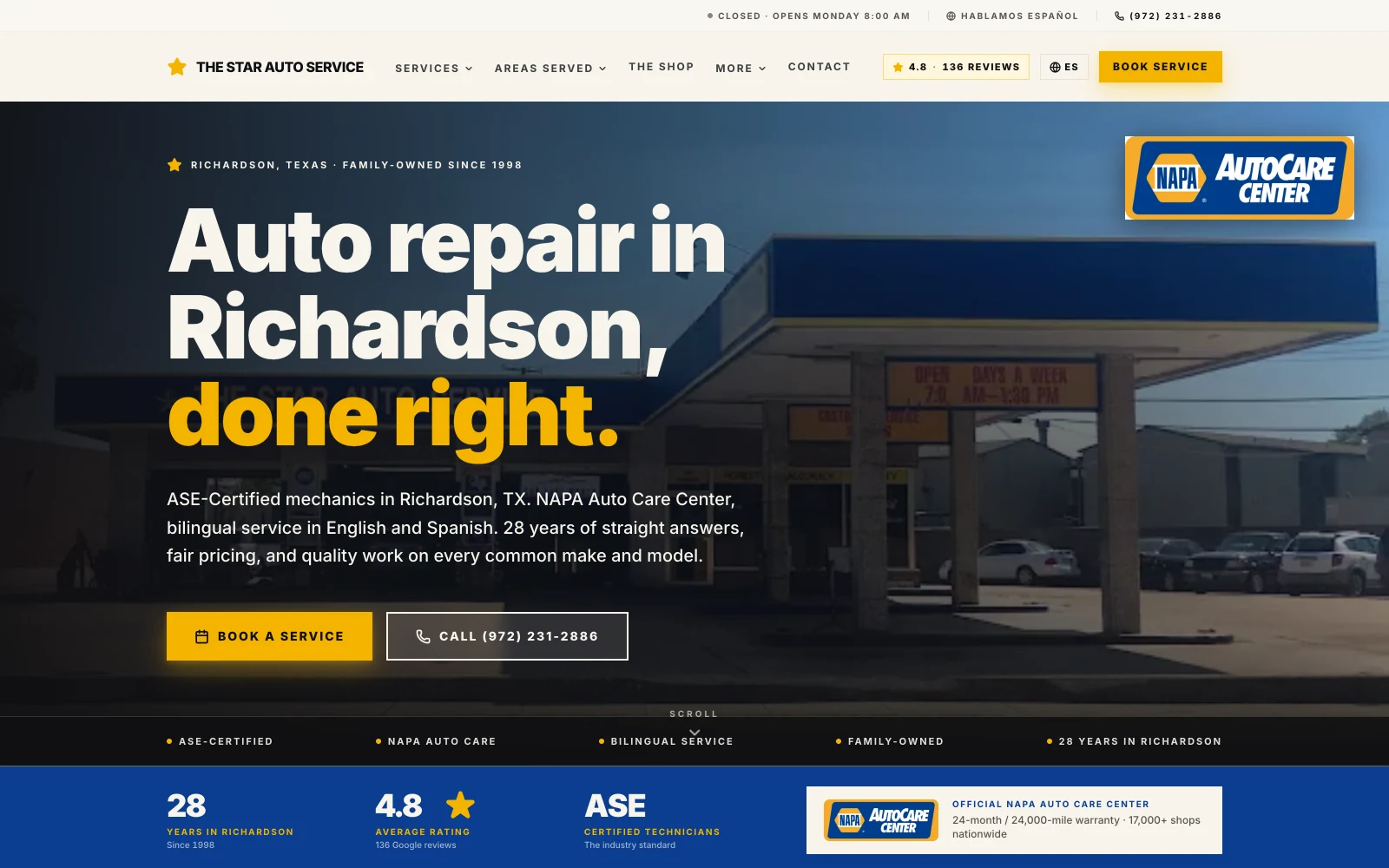
Miguel Ibarra runs Star Auto Service in Richardson, Texas. ASE-Certified technicians. NAPA Auto Care Center. Bilingual service. Twenty-eight years on the corner of Belt Line Road. A 4.5-star Google rating across one hundred thirty-six reviews, built customer by customer over decades. The shop's reputation in person was unimpeachable. The shop's reputation online did not exist.
I rebuilt the site from scratch on Next.js 16. Mobile-first hero with the location, the phone number, and the actual services listed in customer language. ASE and NAPA badges with live links to the issuing bodies. The Google rating single-sourced from one constant and kept in step with the Business Profile, rather than retyped on every page. A bilingual content layer. A sticky mobile call bar that fires in one tap. Accessibility, Best Practices and SEO all at 100 on desktop and on a throttled mid-tier phone, with performance at 99 on desktop. The site is in production today at thestarautoservice.com.
That is the level of build I am proposing for any independent or franchise auto service shop that hires me. Not a templated theme. Not a generic local-business builder. A custom Next.js application engineered for the way the auto service buyer actually behaves on a phone in a parking lot.
The same architectural depth applies to other service verticals. The trust signals shift, but the underlying principles hold: case-fit answer, accurate outcomes, named practitioners, fast performance, accessible design. The vertical-specific takes for medical and dental practices, law firms, and trades and HVAC contractors cover how those constraints change the architecture.
Common questions
What buyers ask before signing
Next step
If your shop is ready for a real site, the first step is a 30-minute call.
I do not run pressure sales. The first call is diagnostic. The goal is to confirm whether a custom build is even the right call for your shop, what scope of engagement makes sense, and what timing looks like on both sides. If the project is not a fit, I will say so and recommend a better path. If you want a fast first read on what your current site is leaving on the table, run a free Pathlight scan against your live URL before the call.
Sources
- 1.Pew Research Center. (2024). Mobile Fact Sheet. https://www.pewresearch.org/internet/fact-sheet/mobile/
- 2.U.S. Bureau of Labor Statistics. (2024). Occupational Outlook Handbook: Automotive Service Technicians and Mechanics. https://www.bls.gov/ooh/installation-maintenance-and-repair/automotive-service-technicians-and-mechanics.htm
- 3.ASE. (2025). National Institute for Automotive Service Excellence: certification overview. https://www.ase.com
- 4.NAPA Auto Care. (2025). NAPA Auto Care Center program. https://www.napaautocare.com
- 5.Google Search Central. (2025). Local search results: rankings and how Google interprets relevance. https://developers.google.com/search/docs/appearance/ranking-systems-guide
- 6.W3C. (2023). Web Content Accessibility Guidelines (WCAG) 2.2. https://www.w3.org/TR/WCAG22/
Author
Joshua Jones runs DBJ Technologies, a solo studio building websites and applications for service businesses across the Dallas-Fort Worth metro. Last reviewed May 5, 2026.