How a homeowner actually picks a contractor in a heat or cold emergency
The trades buyer is rarely shopping. For HVAC, plumbing, and electrical, the common case is a no-warning failure: the compressor that died Wednesday at three p.m., the water heater that flooded the garage, the breaker that tripped and will not reset. The emotional state is fear plus discomfort plus time pressure, and the buyer is reading the site one-handed on a phone in a hot living room while a spouse paces in the background.
The four questions a trades visitor needs answered before they will pick up the phone are: do you actually answer the phone right now, can you come today, are you a real licensed business, and roughly what does this cost. The site that answers those four questions above the fold gets the dispatch. The site that requires scrolling to find a phone number, or buries the license behind a contact form, or hides pricing entirely, loses to the next listed competitor in the local pack.
The mobile context is overwhelming. Pew Research reports that ninety-seven percent of American adults own a cellphone and ninety-one percent own a smartphone (Pew Research, 2024). Trades searches happen at the moment of failure, which means almost always on a phone, often in a degraded environment (hot, dim, anxious). A site that needs desktop-grade scrolling to surface the phone number is a site that loses dispatches.
For Dallas-Fort Worth specifically, the seasonal demand curve is steeper than in most metros. The U.S. Bureau of Labor Statistics tracks HVAC mechanic and installer demand as growing roughly nine percent through 2033, faster than the average occupation, and the heat-dome summer pattern in North Texas means a single contractor can handle multiples of the average daily call volume in July and August (U.S. Bureau of Labor Statistics, Occupational Outlook Handbook, 2024). The site is a dispatch surface, not a brand brochure.
Texas licensing, EPA refrigerant rules, and the trust signals they create
Trades work in Texas is licensed work. HVAC contractors operate under the Texas Department of Licensing and Regulation Air Conditioning and Refrigeration program, which issues TACLA (Air Conditioning and Refrigeration Contractor) licenses with required surety bonds and continuing education (Texas Department of Licensing and Regulation, 2024). Plumbers operate under the Texas State Board of Plumbing Examiners. Electricians operate under TDLR's Electricians program. Each program issues a public license number that the buyer can verify on the state's website in roughly fifteen seconds.
A site that surfaces the license number prominently in the footer and ideally also above the fold reads as a real business rather than as a fly-by-night operator. The trust differential between a site with a visible TACLA number and a site without one is one of the most measurable signals in the trades buyer's mental checklist. Treating the license as a marketing asset, not as fine print, is the design move.
The federal layer is the EPA Section 608 refrigerant handling certification. Anyone servicing equipment that contains refrigerants must be 608-certified, and the levels (Type I for small appliances, Type II for high-pressure, Type III for low-pressure, Universal for all) actually shape what the technician can legally do (U.S. Environmental Protection Agency, 2024). Sites that name which technicians hold which 608 certification levels read as more credible to buyers who know the difference, and the buyers who know are usually the buyers who have been burned before and are choosing carefully.
What goes wrong on most trades and HVAC websites
Five failure patterns I see in nearly every trades site audit, in roughly descending order of cost.
First, the buried phone number. The site has a clever hero animation, a stock photograph of a smiling technician giving a thumbs-up, and a long scroll before the phone number is reachable. The buyer with a flooded basement does not have time for any of this. Tap-to-call as the loudest element in the hero is the conversion lever in this vertical, and most trades sites bury it under marketing copy that the panicked buyer skips entirely.
Second, the “24/7 emergency service” promise that goes to voicemail at eight p.m. Either the promise is real and answered live by a human or a real after-hours dispatch service, or the promise should not be on the site. Buyers who hit a voicemail after seeing a 24/7 banner stop trusting the rest of the site immediately, and the conversion is gone for the entire repeat-customer lifetime.
Third, SEO city pills that pretend to be service-area pages. The footer lists thirty-five cities the contractor claims to serve, each linking to a templated page with the city name swapped and one paragraph of identical copy. This is a textbook doorway-page violation that gets the entire site demoted (Google Search Central, 2024). Real service-area pages, written with city-unique substance, are a meaningful asset; templated city pills are SEO debt dressed up as content. The longer reference on what actually moves the local pack is on the local SEO hub.
Fourth, no pricing transparency at all. Sites that hide every dollar amount lose to sites that publish even partial pricing, because the buyer is doing risk-math on whether the visit will end with a $5,000 estimate they cannot decline. A diagnostic-fee figure, a published service-call range, a Comfort Club membership price, or a flat-rate repair table reads as confidence. Hiding everything reads as evasive.
Fifth, slow on mobile. Core Web Vitals is a confirmed Google ranking input as part of the page experience update (Google Search Central, 2021), and trades is one of the most paid-search-saturated categories in the country. A slow site costs more per click on Google Ads and ranks worse organically, every single day. Performance is not a luxury; it is the line between a healthy dispatch board and a dead one.
What converts a panicked homeowner
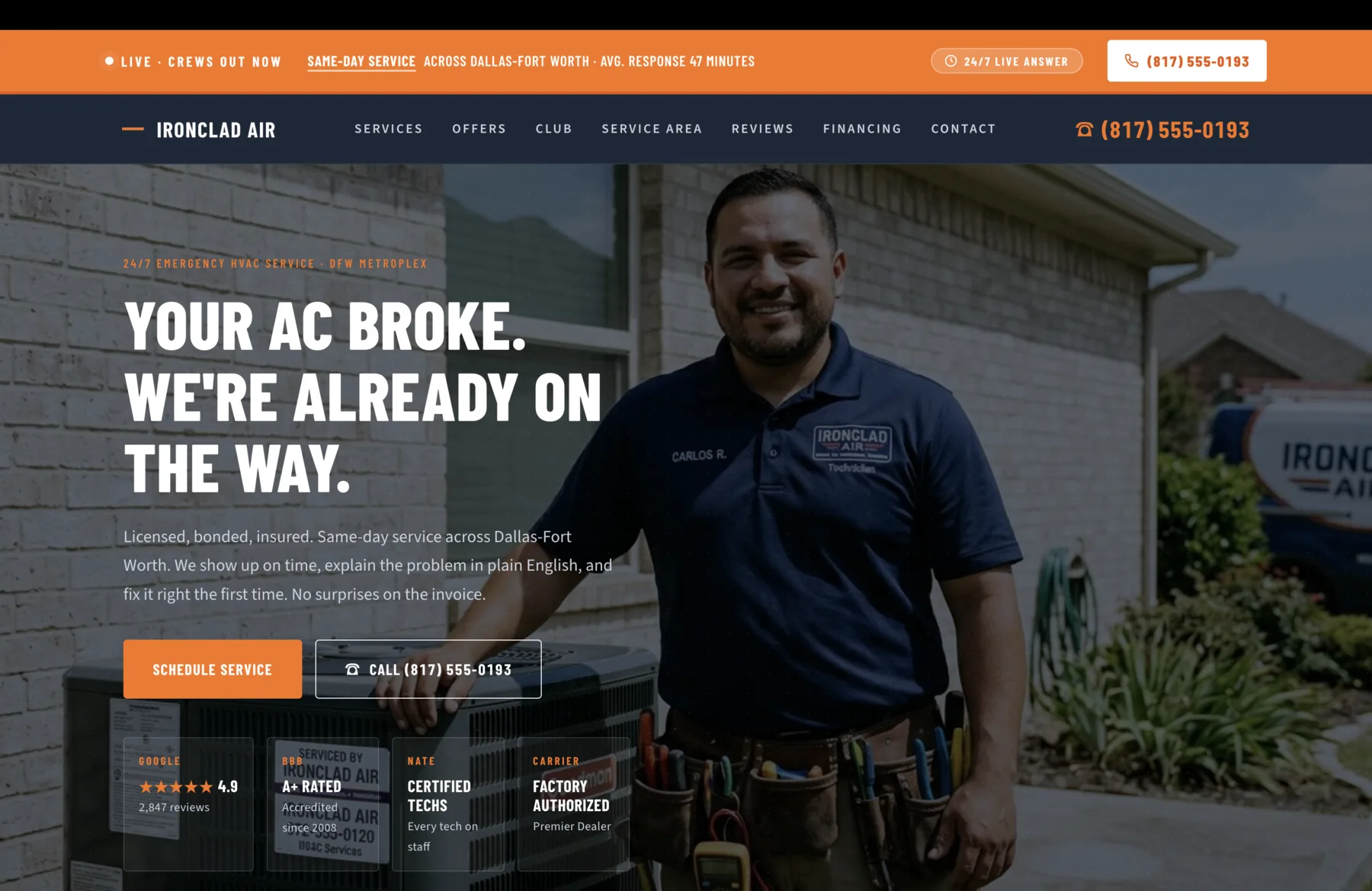
First, tap-to-call as the loudest element in the hero. Not a contact form, not a quote builder, not a clever headline first. The phone number in display type, with a tap target that is an actual phone-handle action on mobile, the area code visible, and a concrete promise next to it (live answer, average answer time under two minutes, real dispatcher rather than a call center).
Second, an honest live-answer promise. If the business actually answers twenty-four hours a day, name it explicitly with the actual coverage hours and how after-hours is staffed (in-house dispatcher, partner dispatch service, on-call rotation). If the business answers eight to six weekdays, say that and offer an after-hours form that goes to a real text message, not to a generic mailbox. Honest scope of service is a trust signal; over-promising is a corrosive one.
Third, service-area zones rather than SEO city pills. A map showing the actual coverage area, with named cities listed inside the zone, beats a list of forty city-named templated pages on every measurable axis. For a DFW HVAC contractor, the zone might be drawn around the eastern corridor (Rockwall, Heath, Forney, Rowlett) or the northern corridor (Plano, Frisco, McKinney, Allen) and listed as a real service territory rather than as a keyword-stuffed list. The vertical-specific take on this design move is consistent with what works in auto service and other DFW-corridor-specific verticals.
Fourth, a Comfort Club or maintenance membership offer surfaced as a primary path. The membership economy in trades is real: HVAC contractors with healthy maintenance memberships have predictable revenue floors that one-off repair contractors do not. The site that pitches the membership clearly, with the included services named and the price published, converts a higher share of visitors into recurring customers. ENERGY STAR maintenance program framing aligns with this: regular maintenance extends equipment life and is a buyer-friendly value pitch (ENERGY STAR, 2024).
Fifth, license and bond numbers in legible type, in the footer and in the hero strip if possible. TACLA-license- number-as-trust-signal is one of the cleanest design moves in the trades vertical because the buyer can verify the number on TDLR's website in fifteen seconds. Treating the number as a feature rather than as fine print signals confidence.
Sixth, accessibility as a floor. Web Content Accessibility Guidelines 2.2 (W3C, 2023) is the published accessibility standard, and trades is one of the increasingly litigated categories for ADA web access claims. Building to WCAG 2.2 AA from the start is cheaper than retrofitting, and the accessible site is a faster site for everyone, panicked buyer included.
What signals the buyer is actually reading
Trades trust signals are stricter than in most categories because the buyer has been burned. The signals that matter most, in descending order of weight.
The TACLA, plumbing, or electrical license number, surfaced in legible type, with the issuing-state link to verify. This is the single highest-impact trust signal in the vertical because it converts skepticism to confidence in fifteen seconds. License-as-marketing-asset.
Year-stamped customer reviews on Google Business Profile, with responses from named technicians or the owner. Quantity matters but velocity and response quality matter more. Buyers reading reviews are reading the responses as much as they are reading the reviews; a defensive response to a three-star review reads worse to future buyers than the original review did.
NATE certification (North American Technician Excellence) for HVAC, when the technicians hold it. NATE is the industry-recognized certification body for HVAC technician competence. Naming which technicians hold NATE certification, and at what level, reads as a real trust signal to buyers who know the difference. For non-NATE-certified technicians, the equivalent is naming state-licensure tiers and any manufacturer-specific certifications (Trane Comfort Specialist, Carrier Factory Authorized Dealer, Lennox Premier Dealer).
The named owner or dispatcher in the hero. Trades is a relationship business, and the buyer wants to know who they are calling. Photos of the actual owner, the actual dispatcher, and the actual lead technicians, with names underneath, beats stock photography of generic technicians on every measurable axis.
Real photographs of real trucks, real technicians, and real jobs in progress. Stock photography of perfectly clean technicians in white uniforms reads as a templated lead-gen site, not as a real local trades business. Phone-quality photos of the actual fleet, taken at the actual office, read as a hundred times more credible.
Bilingual content where the customer base supports it. For DFW trades businesses, a Spanish-language toggle and bilingual dispatch capability is a meaningful conversion lift in markets where Spanish-speaking homeowners form a substantial share of the call volume.
The HVAC contractor design brief
I have published an editorial-grade design brief for a Dallas-Fort Worth HVAC contractor as part of the design-briefs series. The brief is not a template. It is a thesis on what a modern trades site should be, written in enough detail that any competent engineer could ship from it.
The brief covers a tap-to-call phone as the loudest element in the hero, a 24/7 live-answer promise that is actually live, a Comfort Club membership offer with the included services named and the price published, regional service area zones rather than SEO city pills, multimodal contact (phone, text, form, after-hours text-to-dispatch), a TACLA license number in legible type in the footer, and a seasonal-demand-aware page architecture that flexes between emergency-call mode in July and August and consultative-replacement mode in October and February. It is the dispatch desk that fills the board in the heat dome.
The same architectural depth applies to plumbing, electrical, garage door, and pool service businesses. The license programs differ (Texas State Board of Plumbing Examiners for plumbers, TDLR Electricians for electricians, no state license for garage door or pool service in most states), but the underlying principles hold: tap-to-call hero, honest live-answer promise, named owner, license as trust signal, real photography, fast performance, accessible design.
Common questions
What buyers ask before signing
Next step
If your shop is ready for a real site, the first step is a 30-minute call.
I do not run pressure sales. The first call is diagnostic. The goal is to confirm whether a custom build is even the right call for your shop, what scope of engagement makes sense, what the seasonal-demand curve looks like for your business, and whether the integrations you depend on (ServiceTitan, Housecall Pro, Jobber, FieldEdge) will play nicely with the architecture I build. If the project is not a fit, I will say so and recommend a better path. If you want a fast first read on what your current site is leaving on the table, run a free Pathlight scan against your live URL before the call.
Sources
- 1.U.S. Bureau of Labor Statistics. (2024). Occupational Outlook Handbook: Heating, Air Conditioning, and Refrigeration Mechanics and Installers. https://www.bls.gov/ooh/installation-maintenance-and-repair/heating-air-conditioning-and-refrigeration-mechanics-and-installers.htm
- 2.Texas Department of Licensing and Regulation. (2024). Air Conditioning and Refrigeration program: TACLA license and continuing education. https://www.tdlr.texas.gov/acr/acr.htm
- 3.U.S. Environmental Protection Agency. (2024). Section 608: Stationary Refrigeration Technician Certification. https://www.epa.gov/section608
- 4.ENERGY STAR. (2024). Heating, ventilating, and air conditioning maintenance and equipment programs. https://www.energystar.gov/
- 5.Pew Research Center. (2024). Mobile Fact Sheet. https://www.pewresearch.org/internet/fact-sheet/mobile/
- 6.Google Search Central. (2021). Page experience update: Core Web Vitals as a ranking signal. https://developers.google.com/search/blog/2021/04/more-details-page-experience
Author
Joshua Jones runs DBJ Technologies, a solo studio building websites and applications for service businesses across the Dallas-Fort Worth metro. Last reviewed May 6, 2026.