A Dispatch Desk for Homes and Buildings
A homeowner whose AC died on a 105-degree August afternoon and a building manager whose rooftop unit failed on a Saturday morning both need a truck dispatched today. Most HVAC sites pretend those are different businesses on different pages. This brief proposes the nine surfaces a DFW dispatch desk needs to win both calls from one site.
Dated Coupons Activated by Phone Mention
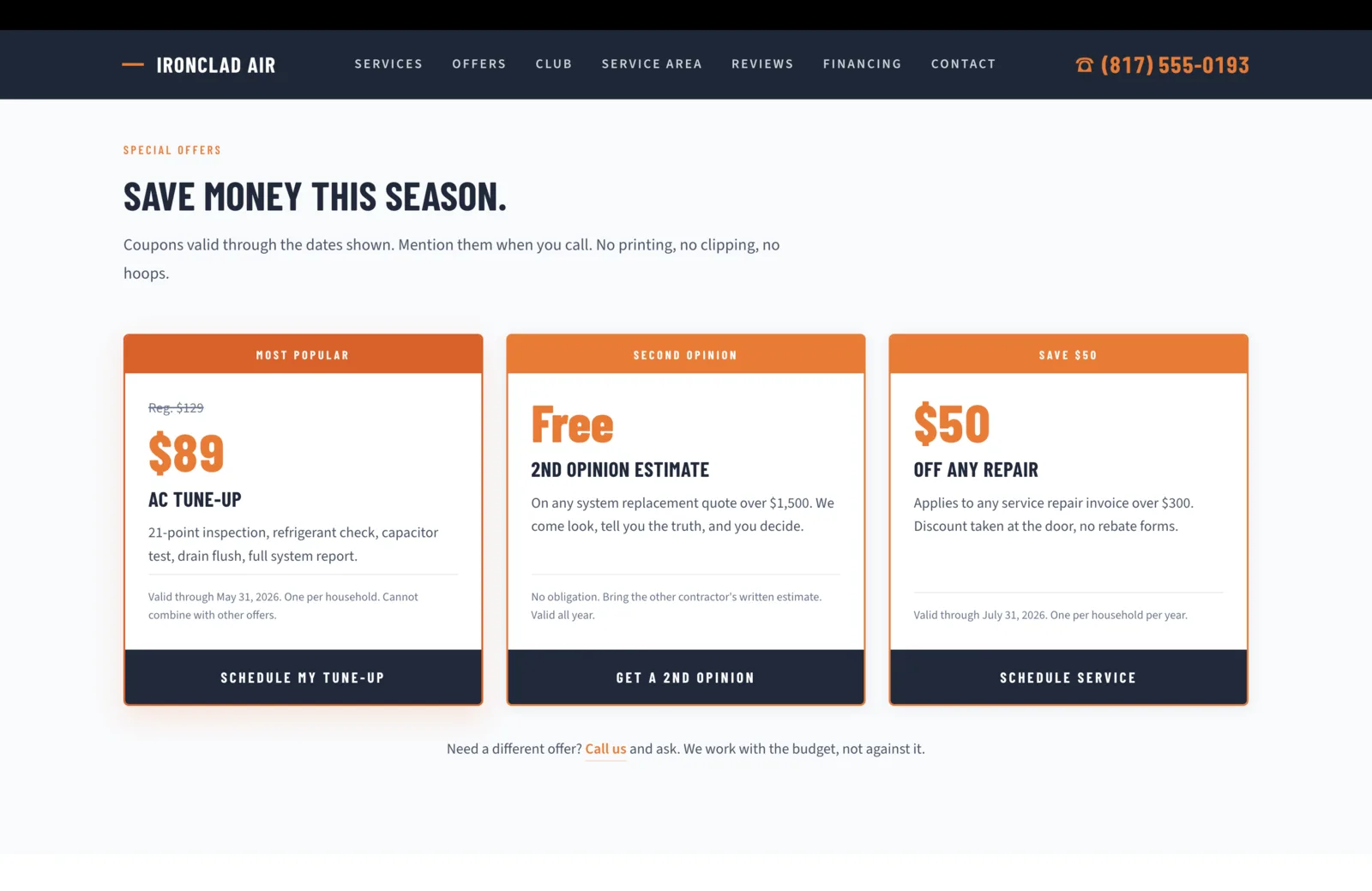
The HVAC customer reaches the offers surface with one of two questions. Either she is comparison-shopping a maintenance call against three other vans on the map, or she is staring at a $14,000 replacement quote from another contractor and wondering whether to trust it. Most HVAC sites answer both questions with the same generic banner: "Save 10% on Tune-Ups." That banner has been on the page for two years. The customer reads it as noise.
Ironclad replaces the banner with three structured offers, each shaped for a different customer psychology. The Tune-Up at $89 (down from $129) is the *acquisition* offer: a low-friction first interaction that gets a tech in the driveway and starts a service relationship. The Free Second Opinion is the *trust-rescue* offer: it converts the customer who has just been quoted a high replacement number by another contractor and is looking for a sanity check. The $50 Off Any Repair is the *gratitude* offer: a small thank-you applied at the door, no rebate form, no waiting period, that closes the customer who already decided to call.
The architectural choice underneath is the date stamp. "Valid through May 31, 2026." "Valid through July 31, 2026." Real expirations, real per-household caps, mention-on-the-phone redemption. A coupon that ends in a real date is one the customer trusts because it admits to ending. The closing line, "Need a different offer? Call us and ask. We work with the budget, not against it," is the operational permission slip that separates a contractor that will negotiate from one that hides behind printed prices. That single sentence converts the cost-conscious customer who would otherwise have called the next number on the map.
Residential and Commercial in One Truck
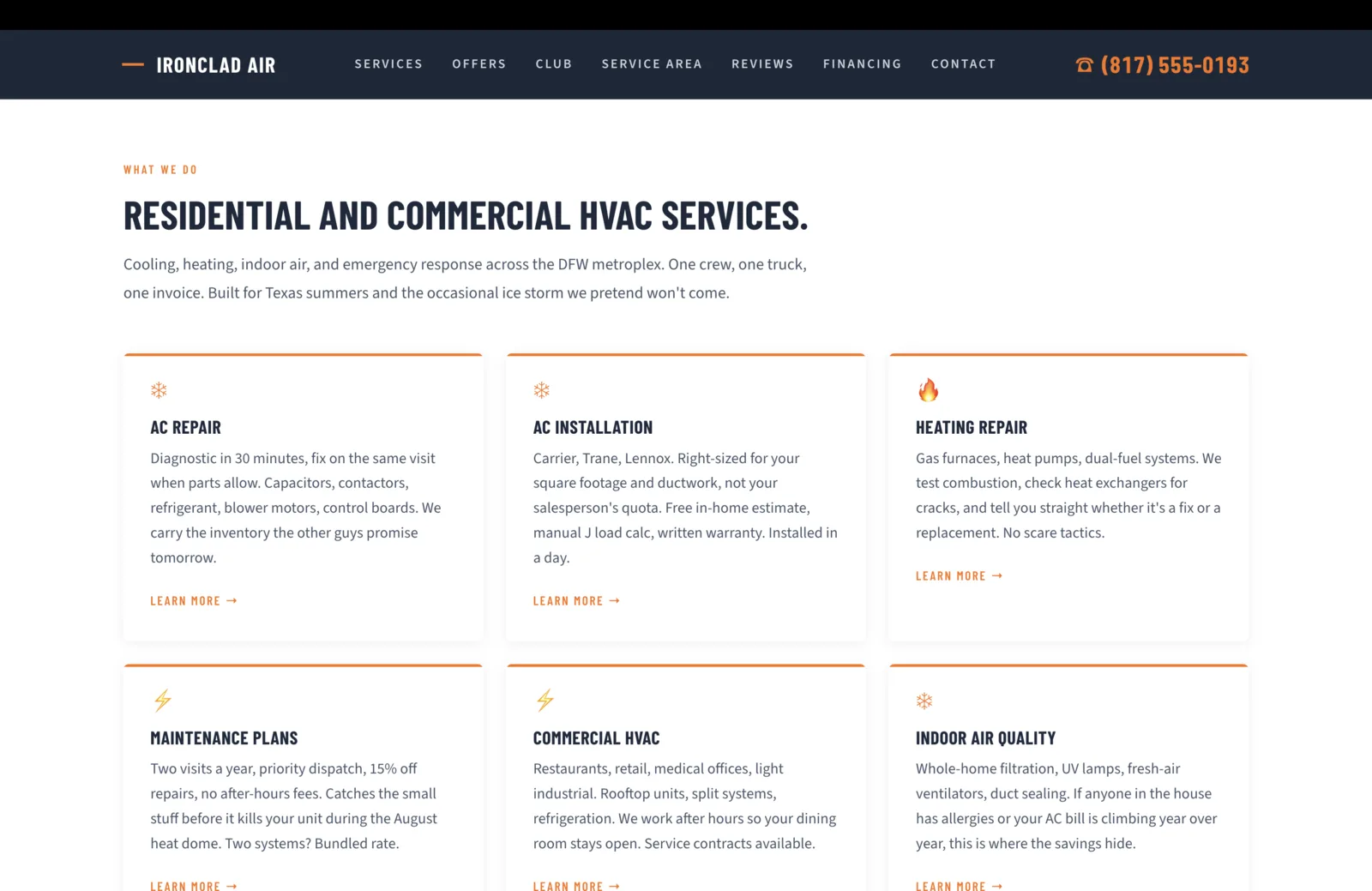
The default services page on an HVAC site is twelve unlabeled blocks of clinical jargon ("Single-stage scroll compressors with variable refrigerant flow"), each terminating in a Schedule Service button. That copy is for an installer reading a manufacturer manual, not a homeowner whose AC just stopped on a Sunday. A dispatch-driven HVAC site translates each service into the outcome the customer is buying.
So every card here pairs a service name with a one-sentence operational commitment. AC Repair is "diagnostic in 30 minutes, fix on the same visit when parts allow," because the customer wants to know how long the tech will be in her driveway. AC Installation names the three brands Carrier, Trane, Lennox, then commits to "right-sized for your square footage and ductwork, not your salesperson's quota," because that sentence is the entire complaint a homeowner has against the install industry. Heating Repair commits to "no scare tactics," because gas-furnace heat-exchanger cracks are the most-abused fear-sell in the category, and a contractor who says so out loud is the contractor the customer trusts.
The commercial card runs alongside the residential cards, not on a separate page. That structural choice is what wins the building manager who is reading the site at 7am on a Tuesday from her office, not from her kitchen. "We work after hours so your dining room stays open. Service contracts available." That sentence is the entire commercial pitch in twelve words. Restaurants, retail, medical offices, light industrial. One truck, one crew, one invoice, named at the top of the section. A residential customer who reads the same grid and notices the commercial credential takes the contractor seriously in a way that two separate pages would have undermined.
The Anti-Pressure-Sell Positioning
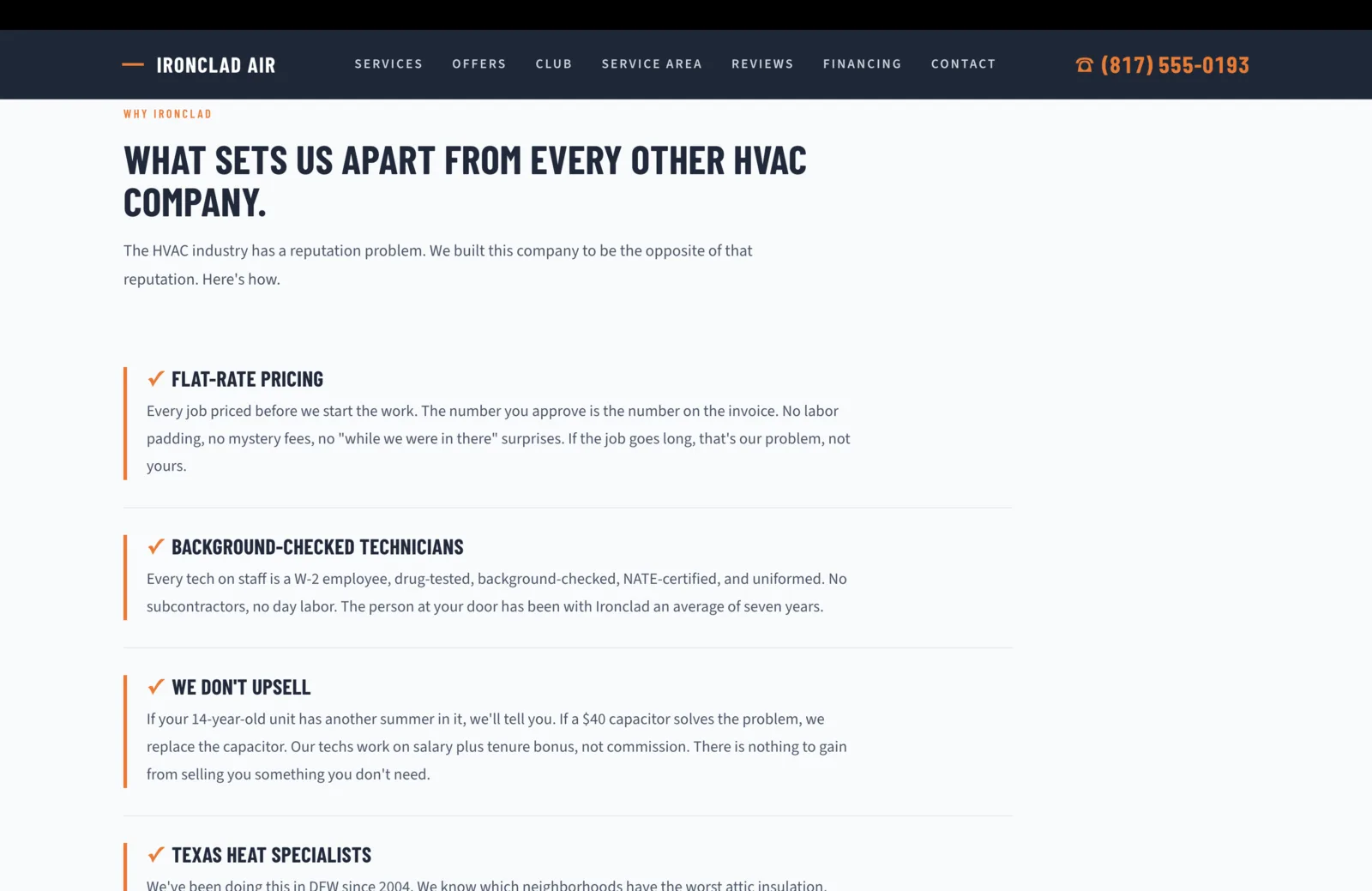
The HVAC category has a reputation problem the industry has earned and refused to address. Hidden fees, commission-driven upsells, contracted day labor at the door, "while we were in there" invoice padding. A homeowner who has been burned once by an HVAC contractor in DFW will spend the next decade calling four contractors for every estimate. The contractor who wins her business is the one who admits the category problem out loud and then names the structural fix.
So the Why section is built as a checklist of structural commitments, each phrased as the inverse of the reputation. Flat-Rate Pricing names the "while we were in there" problem and commits to "if the job goes long, that's our problem, not yours." Background-Checked Technicians names the day-labor problem and commits to W-2 employees with seven-year average tenure. We Don't Upsell names the commission problem and commits to "salary plus tenure bonus, not commission. There is nothing to gain from selling you something you don't need." Each commitment is a single paragraph, written in the customer's vocabulary, not the contractor's.
The Texas Heat Specialists row that closes the section is the geographic credential. "We know which neighborhoods have the worst attic insulation." That sentence is the kind of detail that separates a DFW-tenured operator from a national franchise that opened a Dallas branch last year. A customer in an older Highland Park bungalow with a poorly-insulated attic reads that line and registers it as a contractor who has worked her exact problem in her exact neighborhood many times before. The credential converts because it is specific enough to be unfakeable.
Same-Day Service Across the Three-Zone Metroplex
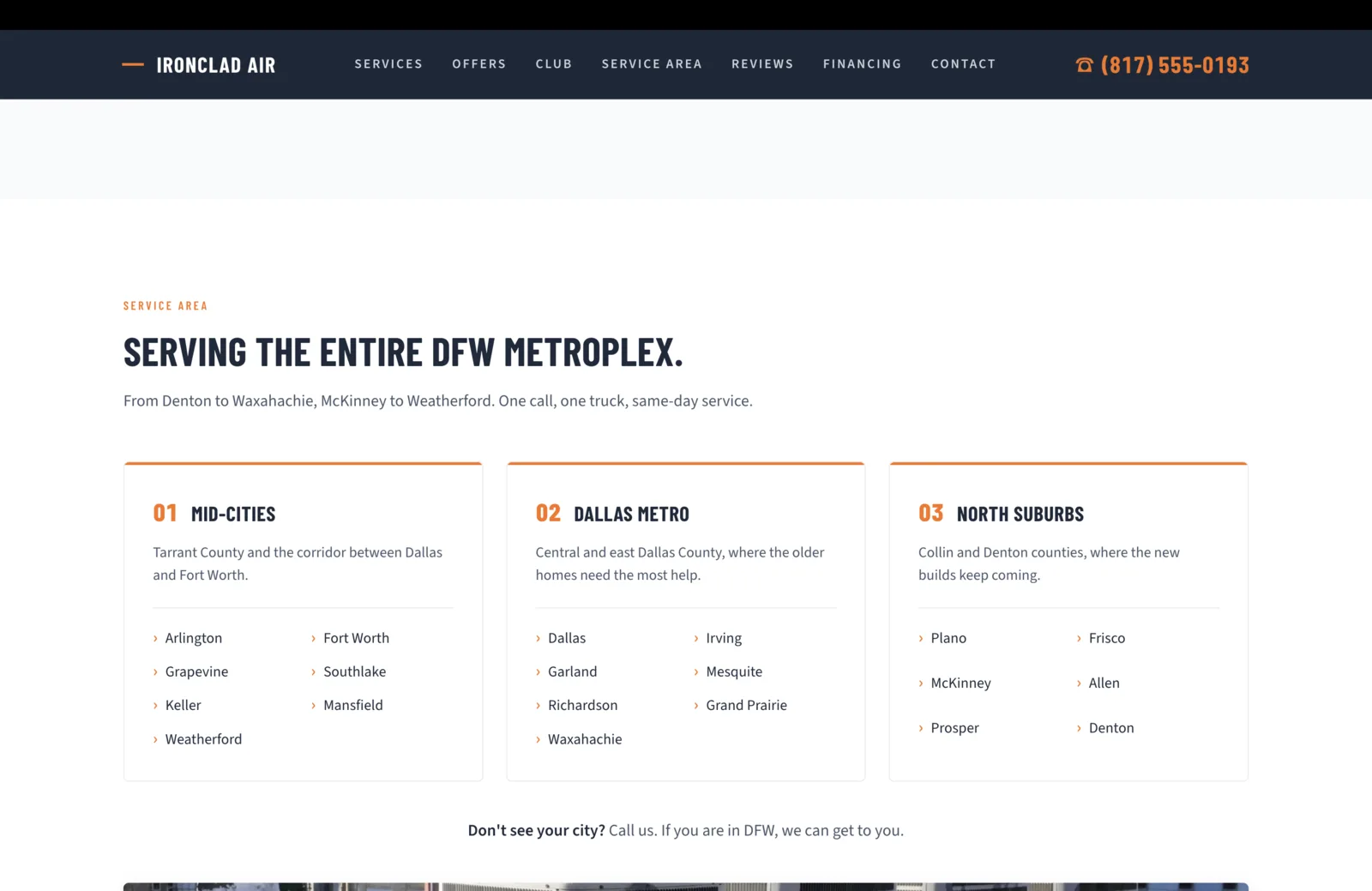
The default service-area page on an HVAC site is a 4x5 grid of city pills with no narrative, sized for SEO bait rather than customer comprehension. The customer in Plano clicks "Plano" and lands on a thinly-rewritten version of the same page she was already on, with the city name swapped in fourteen places. Google rewards the pattern, sometimes. The customer reads it as a contractor that does not actually drive a truck to any of those cities.
Ironclad replaces the SEO grid with three regional zones, each given a numeral, a name, and a short editorial description that tells the customer something true about the zone. Mid-Cities is "Tarrant County and the corridor between Dallas and Fort Worth," named with the geographic vocabulary a long-time DFW resident actually uses. Dallas Metro is "central and east Dallas County, where the older homes need the most help," which is the kind of operational note that signals familiarity with the housing stock. North Suburbs is "Collin and Denton counties, where the new builds keep coming," which addresses the Plano-Frisco-McKinney customer in her own register.
The cities listed inside each zone are short and specific, not exhaustive. Seven cities in the Mid-Cities zone, seven in Dallas Metro, six in North Suburbs. Twenty cities total. The closing line, "Don't see your city? Call us. If you are in DFW, we can get to you," is the operational permission slip that turns the zone list from a hard boundary into a soft suggestion. A customer in Cedar Hill or Lewisville reads that line and picks up the phone. A homeowner in Sherman reads it and calls anyway. The contractor that sends a truck to Sherman occasionally is not the one losing the booking from a customer in McKinney.
Five-Star Reviews Anchored On Real Technicians
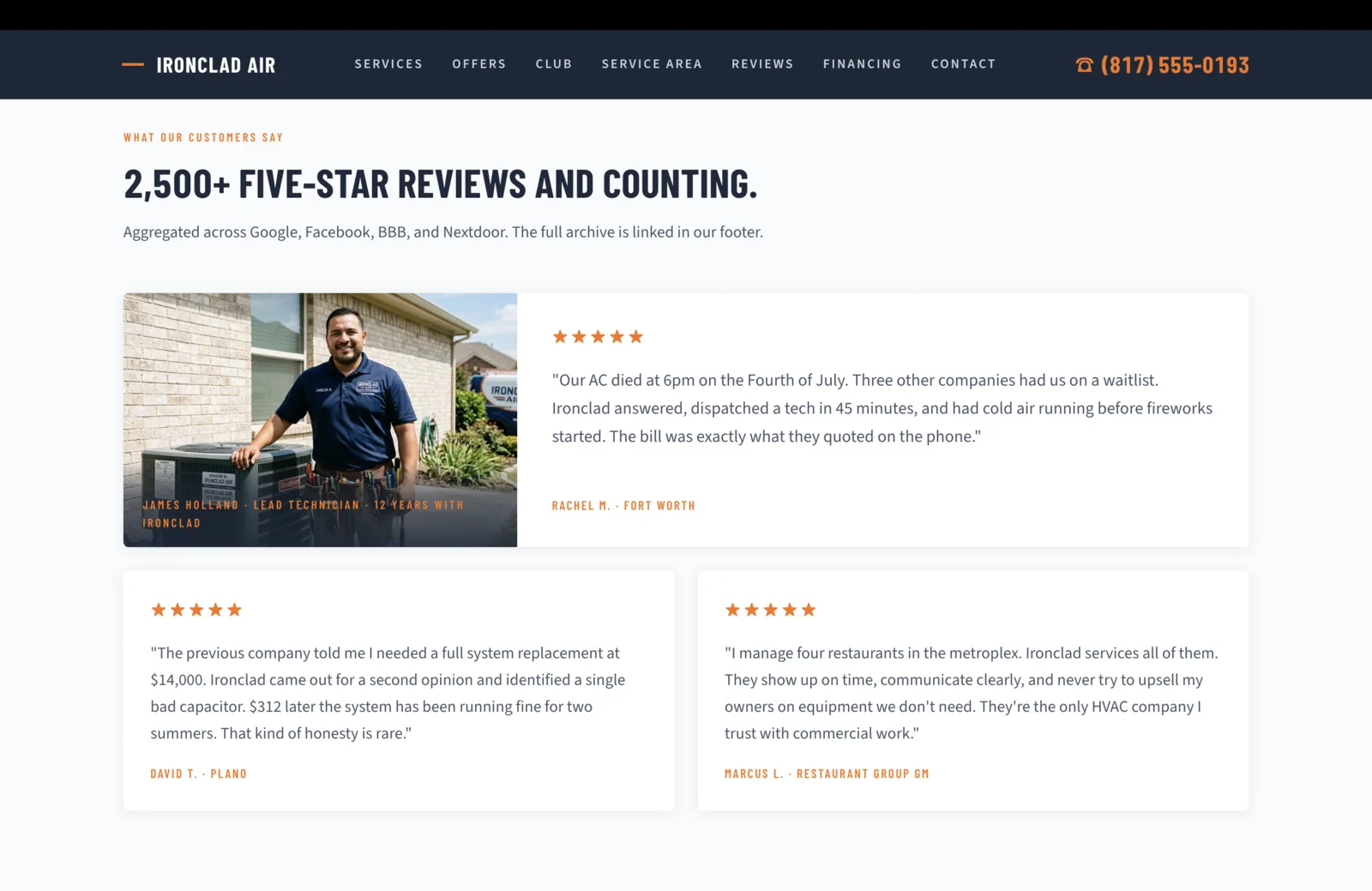
Most HVAC review sections are an aggregate-rating pill from Google with a count attached. "4.8 stars across 247 reviews." The customer registers the number and moves on. The review section that converts is the one that pairs the volume claim with substantive narratives, each tied to a real situation a customer has had.
The featured testimonial bridges the section by anchoring the review to a tenured technician. The photograph shows an Ironclad polo, a residential condenser, a brick house in DFW, paired with a caption that names the technician and his twelve-year tenure. Rachel M.'s 5pm-Fourth-of-July emergency review sits beside it. That pairing converts because it answers two questions in one card: who is going to show up, and what does showing up actually look like. A customer who reads the review knows the tech, the truck, the brick house style, and the response time, all in five seconds.
The two supporting testimonials below are deliberately different in shape. David T.'s second-opinion story addresses the $14,000-replacement-quote scenario the offers section has already named. Marcus L.'s commercial-restaurant story addresses the building-manager customer the services grid named with its commercial card. Three quotes covering three customer profiles in a single section means a homeowner in panic, a homeowner in second-opinion mode, and a commercial buyer all see their own situation reflected back at them within five seconds. The section's volume claim, "2,500-plus five-star reviews and counting," sits above three substantial paragraphs that earn it.
An Annual Membership Built for the Texas Calendar
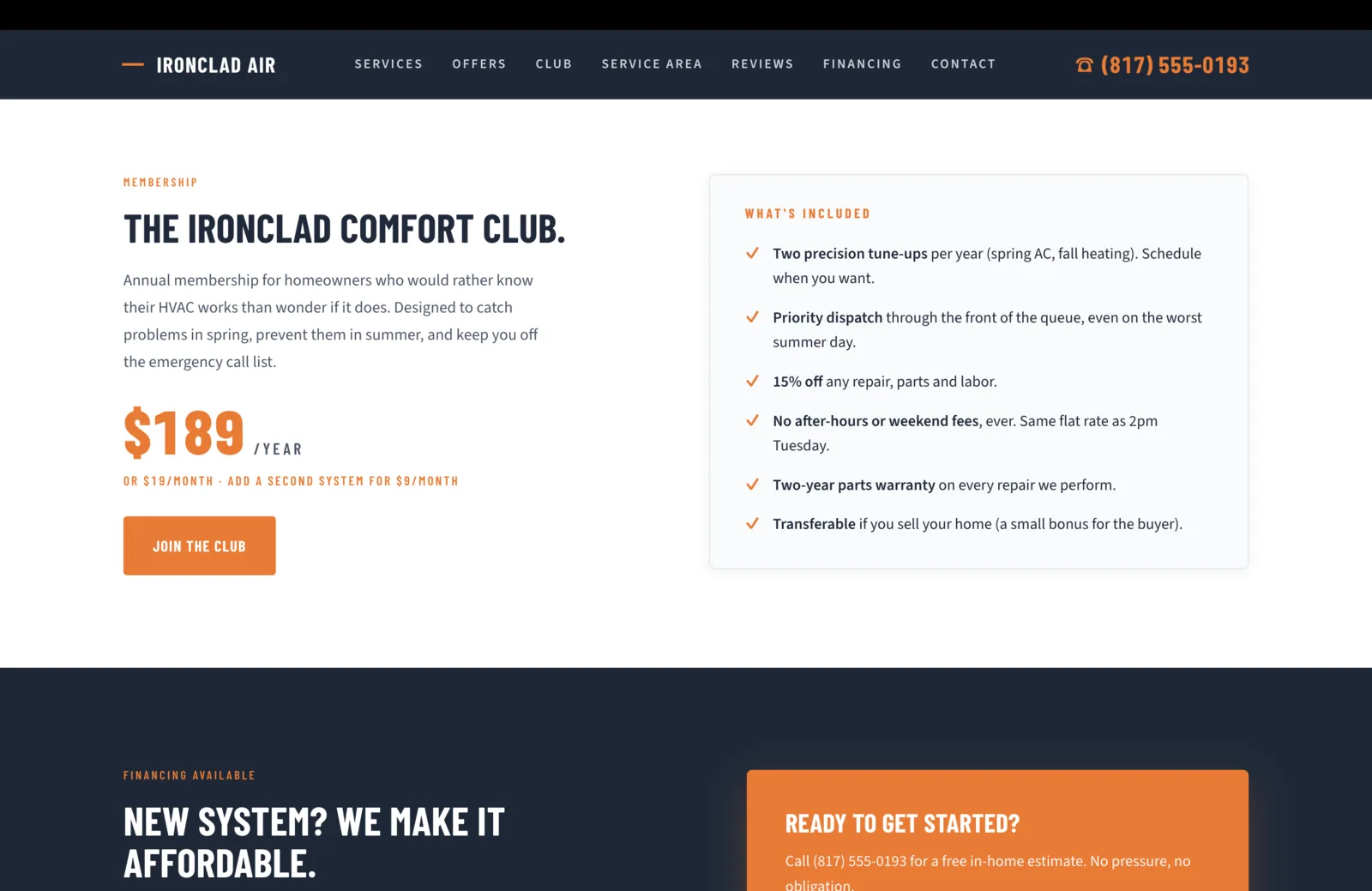
An HVAC maintenance plan is the single highest-margin recurring revenue line in the residential category, and most contractors either omit it or hide it under "ask us about a service agreement." Ironclad publishes the Comfort Club as its own destination surface with a real annual price, a real benefits checklist, and a real cancellation policy that does not require a phone call.
The benefits panel does the structural work. Two precision tune-ups a year, spring and fall, mapped to the Texas calendar. Priority dispatch "through the front of the queue, even on the worst summer day," which is the line that converts the Highland Park customer who has been third on a five-hour summer waitlist at another contractor. 15 percent off any repair, parts and labor, named in percentages not vague "savings." No after-hours or weekend fees ever, "same flat rate as 2pm Tuesday," which is the operational commitment a homeowner who has had a $400 weekend dispatch fee on another invoice notices and remembers.
The two operational details at the foot of the panel are the ones that close the customer. Two-year parts warranty on every repair we perform. Transferable if you sell your home. The first sentence guarantees the work past the first season; the second sentence makes the membership a small selling point on a real-estate listing, which means a homeowner buying a Plano spec house sees the membership as a benefit she is inheriting, not a charge she is taking on. The price ladder, $189 a year or $19 a month with a $9 second-system add-on, is calibrated for the working-family DFW homeowner. Not a luxury tier, not a discount tier, the right tier.
Zero-Percent Financing on Qualifying Installations
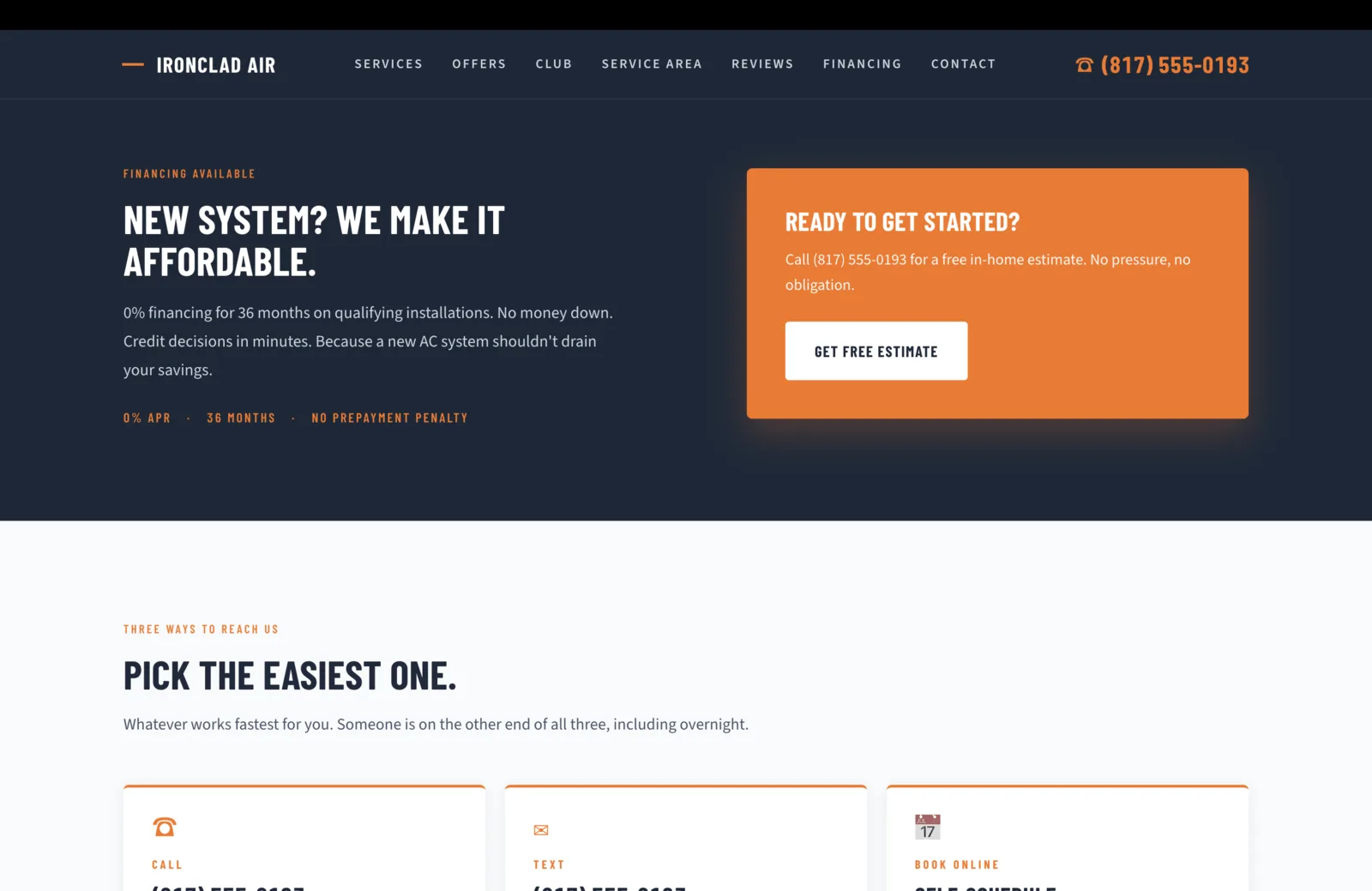
A new HVAC system in DFW is a $9,000 to $18,000 decision in 2026 dollars. The customer who was already calling four contractors for an estimate is the same customer who needs to know how to pay for the work before she will book the install. So the financing surface gets its own destination, on a deep navy field that signals weight, with a single concrete commitment.
The headline is the architectural argument. "New System? We Make It Affordable." The subhead earns it: "0 percent financing for 36 months on qualifying installations. No money down. Credit decisions in minutes." Three quantifiable promises in three sentences. The three pill row beneath, "0 percent APR, 36 Months, No Prepayment Penalty," is the same commitment in scannable form for the customer who is reading the page on her phone in the waiting room of a different appointment.
The orange CTA card on the right closes the section by collapsing the financing question into the booking question. "Ready to Get Started? Call (817) 555-0193 for a free in-home estimate. No pressure, no obligation." The customer who arrived at this section worried about the price of a replacement and walks away with a path to a free in-home estimate has been moved through the funnel without a contact form, without a CRM entry, and without a single field to type into. That path is what converts the customer who would otherwise have closed the tab and called the contractor with the bigger Yellow Pages ad.
Pick the Easiest One
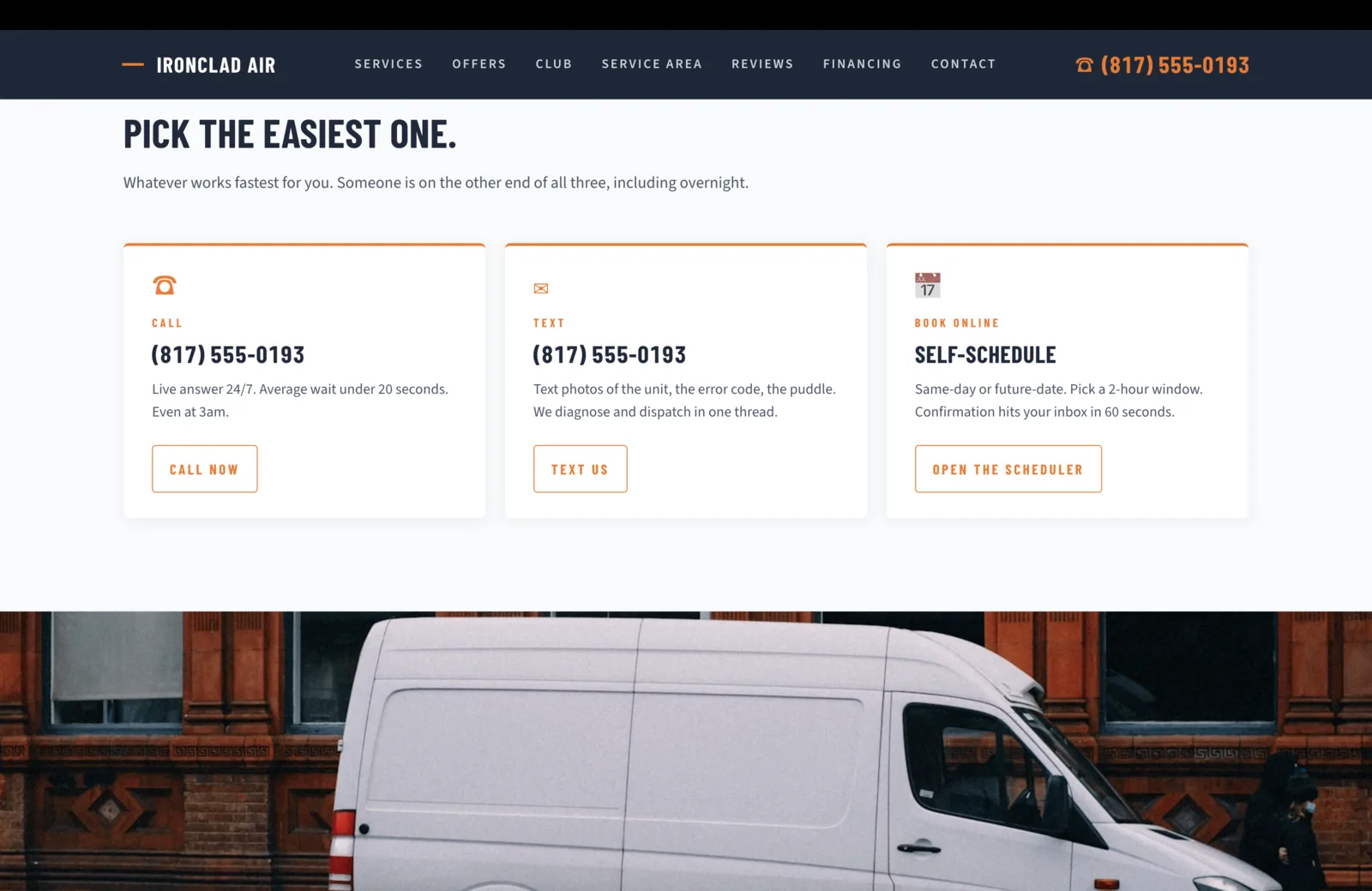
Most HVAC sites end on a contact form with seven required fields and a 24-hour callback promise. The customer with no AC in August reads "callback within 24 hours" and dials the next number on the search results page. The contact surface that converts is one that surfaces three different paths, each with a real operational commitment, and lets the customer pick the one that matches her situation.
So the surface here is three cards, each tied to a real channel. Call surfaces the phone with a "live answer 24/7, average wait under 20 seconds, even at 3am" promise that admits to a measurable response time. Text uses the same phone number with the SMS scheme so a tap from a phone opens the customer's messaging app. The text card's commitment, "text photos of the unit, the error code, the puddle. We diagnose and dispatch in one thread," is the line that wins the millennial homeowner who would rather not call. Book Online opens a self-scheduler with a real "60-second confirmation" promise, calibrated for the planner-customer who is booking next week's tune-up at lunch.
The structural commitment in the subhead, "someone is on the other end of all three, including overnight," is the operational truth that earns the section. Most multi-channel contact pages route text to an unmonitored mailbox and online bookings to a queue that someone reviews in the morning. A dispatch-driven HVAC contractor staffs all three twenty-four hours a day because the AC failure on a Sunday at 11pm is the customer who pays the highest emergency rate. A site that promises overnight response on three channels and answers all three is a site that earns the search ranking and the repeat call.
TACLA Numbers and the After-Hours Line
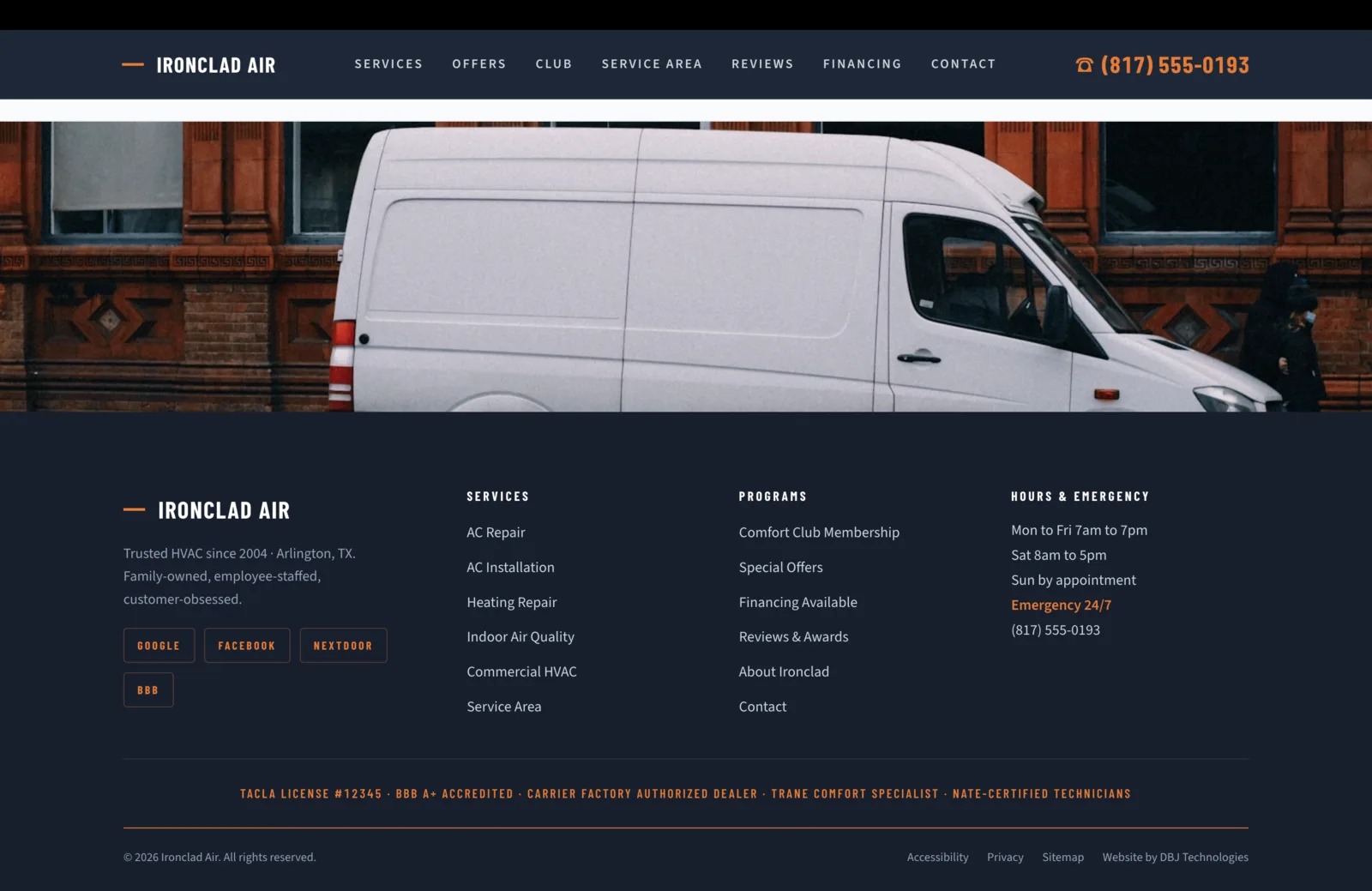
The footer is the regulator's surface and the customer's last reassurance. An HVAC contractor in Texas that does not display a TACLA license number in its footer is a contractor a careful homeowner should not call. Ironclad puts the license number in the loudest line of the orange compliance strip, paired with four manufacturer and trade credentials that the informed customer recognizes as substantive.
The compliance strip names five things. TACLA License #12345 is the Texas state credential. BBB A+ Accredited is the trust-mark a homeowner who has been burned will check first. Carrier Factory Authorized Dealer is the manufacturer credential that signals access to genuine parts and warranty support. Trane Comfort Specialist is the regional manufacturer recognition that takes years to earn. NATE-Certified Technicians is the technician-level credential the careful customer asks about by name. Five credentials, in a single orange line, in the customer's reading order: state, trust, manufacturer, manufacturer, technician.
The four-column block above carries the operational weight. Hours by day. An emergency line in orange so the customer who scrolled here in panic finds the phone number on the loudest field of the page. The review platform pills (Google, Facebook, Nextdoor, BBB) close the loop on the testimonials section higher up. The "Website by DBJ Technologies" credit sits quietly in the bottom strip, framed as a closing seal rather than a brag. This is what an HVAC dispatch desk running quietly at the top of the DFW market looks like in its footer: comprehensive, calm, and unmistakably built by someone who has read the TACLA advertising rule, the BBB accreditation standard, and the Carrier authorized dealer program in full.
Build It For Real
Want this architecture, executed for your practice?
I build the version of this that ships. Designed end to end, launched on production grade infrastructure, with the surfaces above tuned to your actual book of business.