Preconstruction
Every building is built twice. The first time decides what the second costs.
Preconstruction is where a project is actually won or lost: the estimate that holds, the switchgear ordered before it becomes the critical path, the clash caught in the model instead of above the ceiling. This page shows how we do that first build.
STA 01 Estimating
An estimate is a promise with a tolerance. We state ours.
Every number we hand you comes with the design stage it was priced from and the tolerance that stage honestly supports. Across our last 20 CMAR projects, final cost landed within 2.1% of the GMP on average, and under it on 16 of the 20.
| Design stage | Estimate type | Honest tolerance |
|---|---|---|
| Napkin / program | Order of magnitude | ± 15% |
| Concept / schematic | System-level budget | ± 10% |
| Design development | Trade-priced estimate | ± 5% |
| Construction documents | GMP / lump sum | Guaranteed |
A contractor quoting a "guaranteed" number off schematic drawings is guaranteeing you a change-order fight. Ask what stage the number was priced from. Always.
STA 02 Long-lead procurement
The schedule is usually lost at a purchasing desk, months before the site.
This is a live excerpt of the log we run on every project from the first week of preconstruction. Each item is ordered against the schedule date it protects, not against when the submittal cycle happens to finish.
| Item | Current lead | Protects | Order by |
|---|---|---|---|
| Electrical switchgear | 48-60 wks | Permanent power / commissioning | Before GMP, with owner letter of intent |
| Emergency generator | 50+ wks | Life-safety inspection | Design development |
| Air handling units | 26-34 wks | Dry-in + conditioned air for finishes | Early GMP buyout |
| Curtain wall / storefront | 20-28 wks | Building enclosure | Early GMP buyout |
| Elevators | 30-40 wks | Substantial completion | Design development |
| Roof insulation + membrane | 10-16 wks | Dry-in | GMP execution |
STA 03 Coordination + value
Clashes get resolved in the model, where they cost nothing.
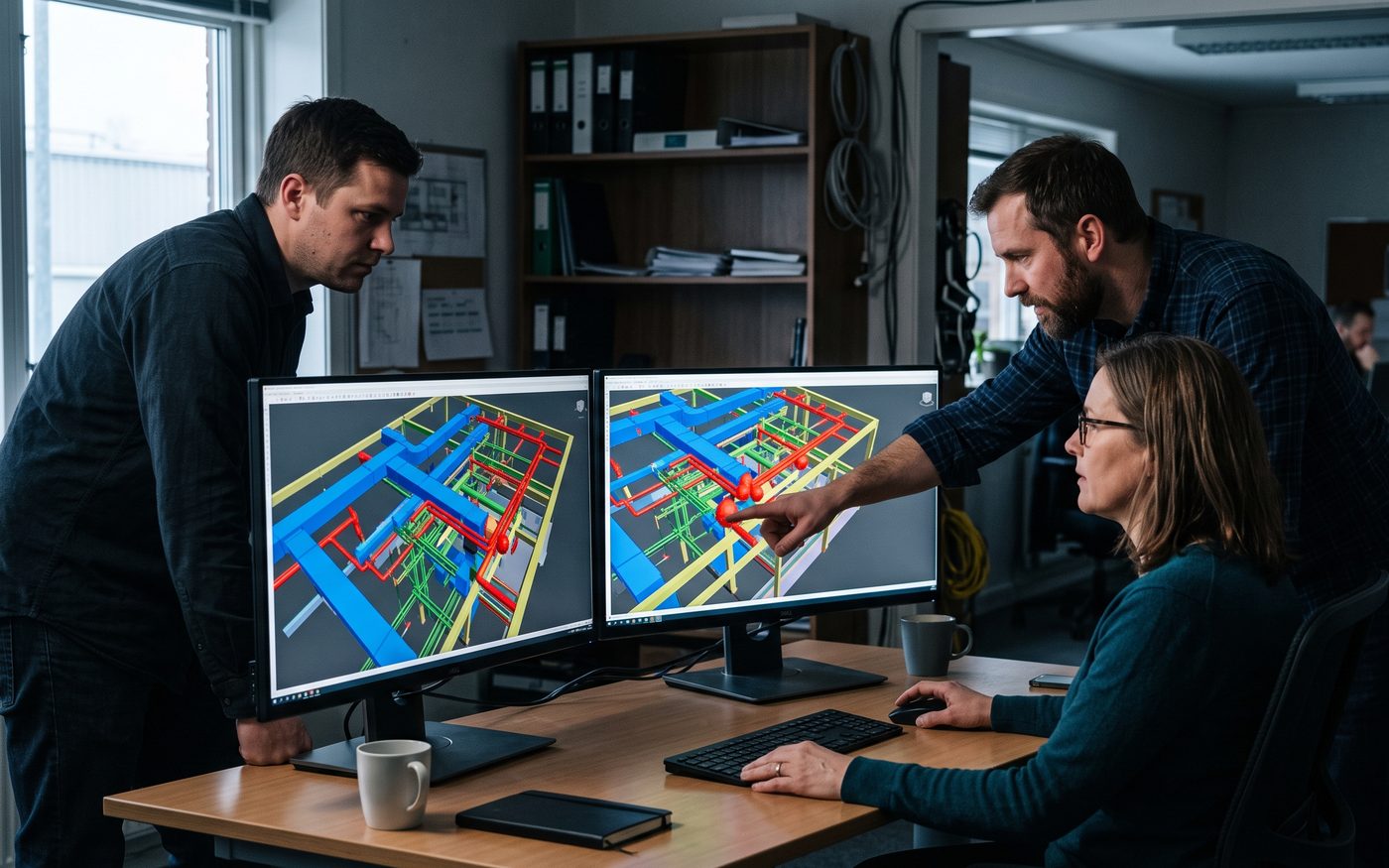
On CMAR and design-build work, mechanical, electrical, plumbing, and fire protection are modeled and clash-resolved before notice to proceed. Cedar Ridge went to the field with zero unresolved overhead clashes, which is the single biggest reason its interiors ran 23% of schedule instead of the 30% we planned.
VE is finding a smarter way to deliver the intent: a structural bay that saves steel, a mechanical routing that shortens duct runs. It is not swapping the specified roof for a thinner one and hoping nobody reads the submittal. Every VE item we propose states what changes, what is preserved, and what the tradeoff is, priced. You accept or decline each line, in writing.