Eight Minutes From Chipped Tooth to Booked Chair
A West Plano family on a Saturday morning has eight minutes between a chipped tooth and a phone call. They will check three dentist sites and dial one of them. This brief built the practice that wins that call: Ridgeview Dental, eleven surfaces deep, nine marketing pages plus a patient portal and a team console, with every price, date, and promise in writing.
The Family With Eight Minutes
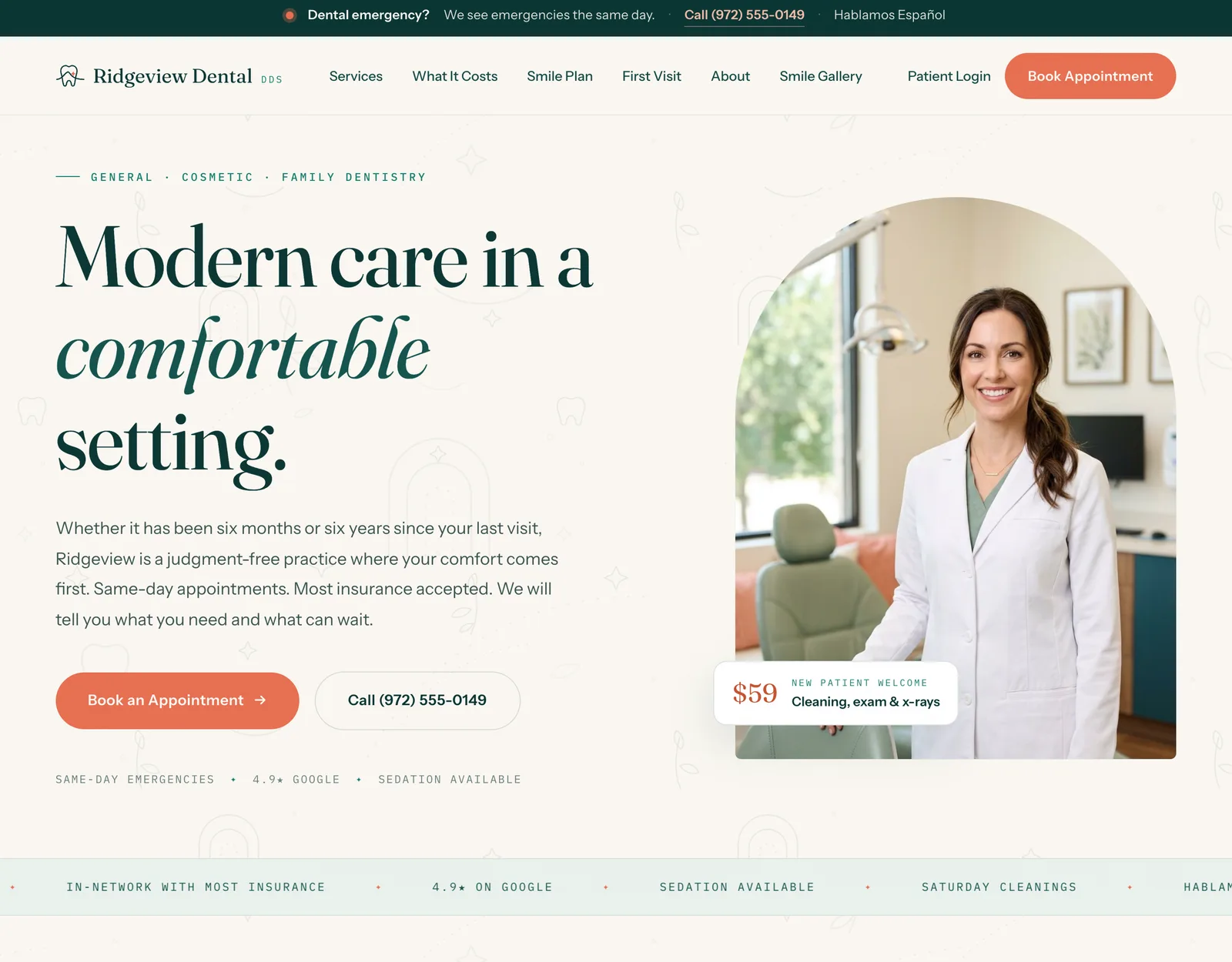
Nobody browses dental websites for pleasure. The visit happens under pressure: a tooth chips on a Tuesday, the kids' six-month cleaning is overdue, a filling that was fine last month is suddenly not. The family gives the site about eight minutes before somebody dials, and in those eight minutes they are trying to answer five questions no dental site wants to answer in public: what does it cost, do you take my insurance, can you see me soon, will it hurt, and are you the kind of office that upsells. Ridgeview Dental is the practice built to answer all five on the page.
The site takes the eight minutes literally. A fixed minute-meter rides the corner of every page, ticking from 0:00 toward 8:00 as the visitor scrolls, and it completes at the booking call-to-action, labeled "Minute 8 of 8, the part where you call." It is a signature element and a thesis statement at once: the site knows exactly how much of your attention it has earned the right to ask for, and it budgets every section against that clock.
The identity carries the same discipline. The mark is a line-drawn tooth crossed by a mountain ridgeline with a small terracotta star at the peak, the ridge of Ridgeview drawn through the one shape every patient recognizes. Fraunces carries the practice's voice, with italics reserved for genuinely human sentences; Instrument Sans explains; and IBM Plex Mono is the register of record, used for every price, date, fine-print line, and license number, so that numbers read as receipts rather than marketing. Coral appears only on things a visitor can act on: book, call, apply, claim, the emergency line. Everything else lives in porcelain, evergreen, and mist.
The Signature Instrument: The Straight Answer
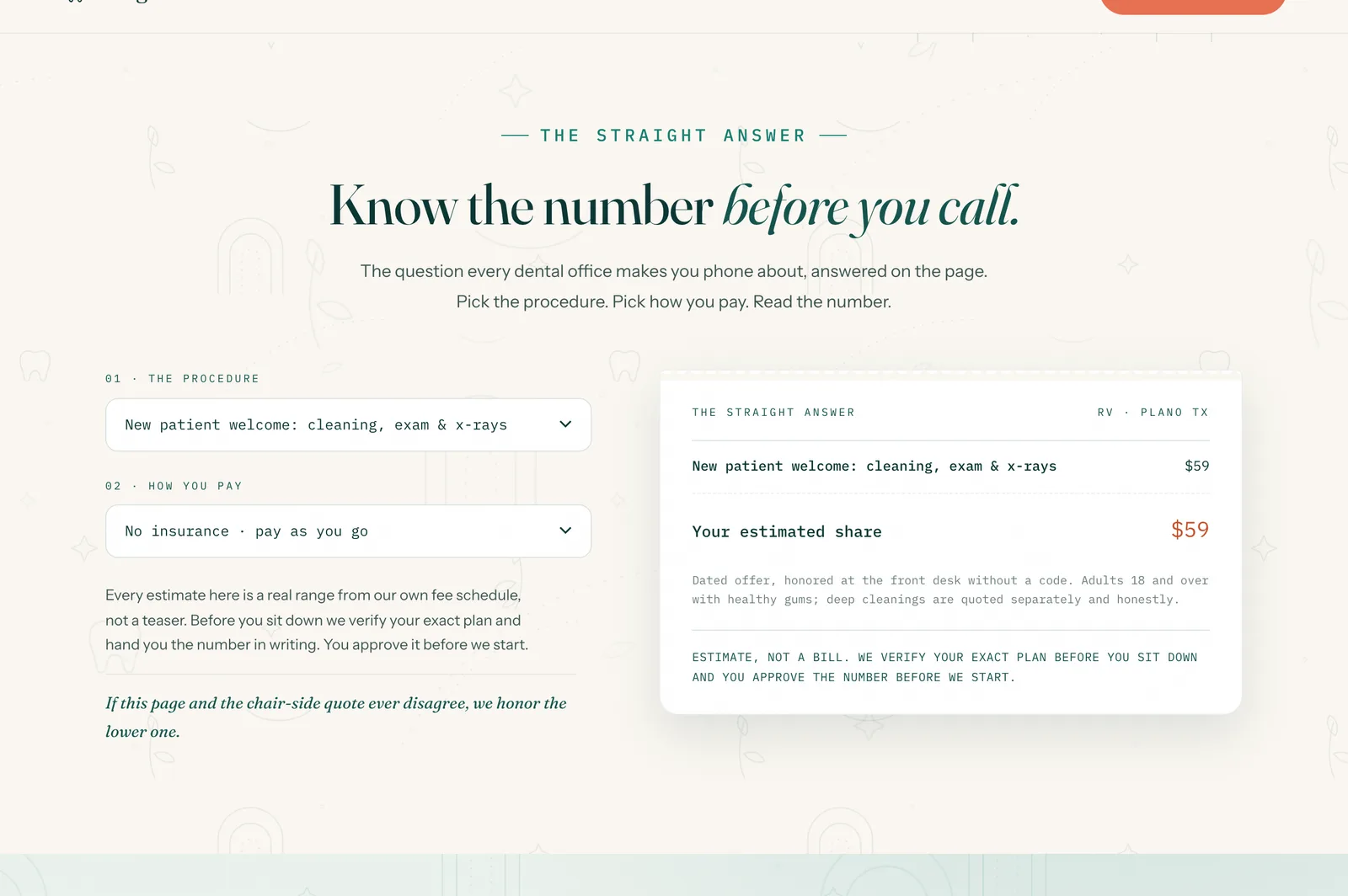
"What will this cost me" is the question every dental office makes you phone about, and the phone call is precisely what the anxious patient is avoiding. So the What It Costs page opens with an instrument instead of an essay. Pick the procedure. Pick how you pay: a named PPO carrier, cash, or the Smile Plan. Read the number, rendered as a receipt: the practice's real fee range, what a typical plan of that type pays, and the estimated share, with the annual-maximum and deductible caveats stated in fine print rather than discovered in the chair.
Two sentences make the instrument credible. The first: "Every estimate here is a real range from our own fee schedule, not a teaser." The second, set in italic because it is the practice speaking: "If this page and the chair-side quote ever disagree, we honor the lower one." That promise converts the instrument from a widget into a policy. A patient can screenshot it. A front desk has to honor it. It is the kind of sentence a practice can only publish if its fees are actually in order, which is exactly why publishing it wins the eight minutes.
Every deep link on the site understands the instrument. Each service row on the Services page carries its published range and lands here with the right procedure preselected, so "how much is a crown" is never more than one click from a written answer.
Chairs That Opened Up
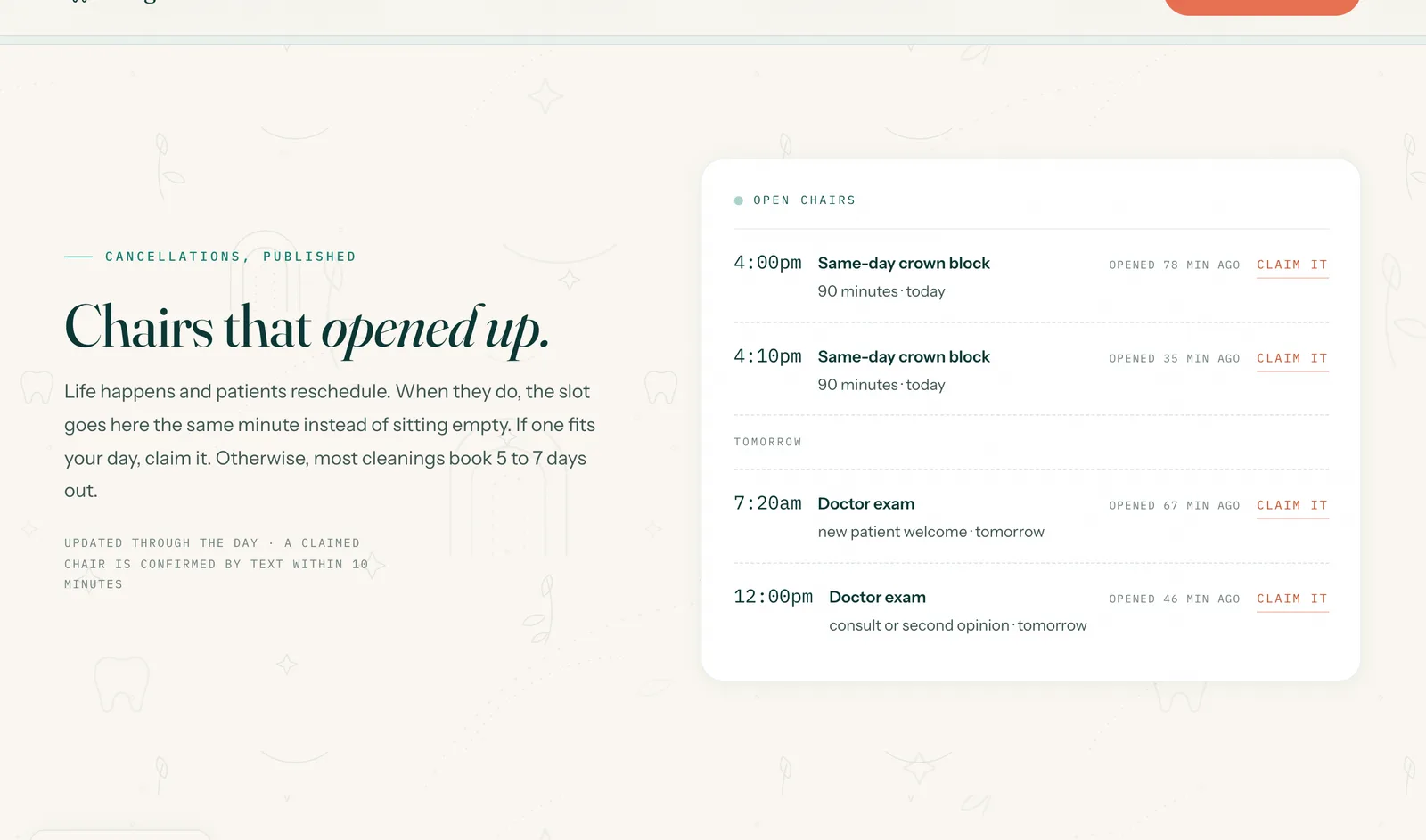
Every practice has cancellations, and almost every practice lets them die in the schedule while the website says "call for availability." Ridgeview publishes them. The home page carries a live board of chairs that opened up today: the time, the kind of appointment, how long ago the slot opened, and a claim link on every row. The board seeds itself from the office's real hours, marks cancellations the same minute they happen, and tells the visitor plainly that a claimed chair is confirmed by text within ten minutes.
The board earns its place on the home page because it converts the site's hardest visitor: the person who wants an appointment this week and assumes there are none. A published cancellation is proof of the opposite, with a timestamp. And because the same board is fed from the team console's publisher switch, the marketing site and the front desk can never disagree about what is actually open, which is the kind of operational honesty the rest of the site keeps promising in prose.
Services With Faces and Numbers
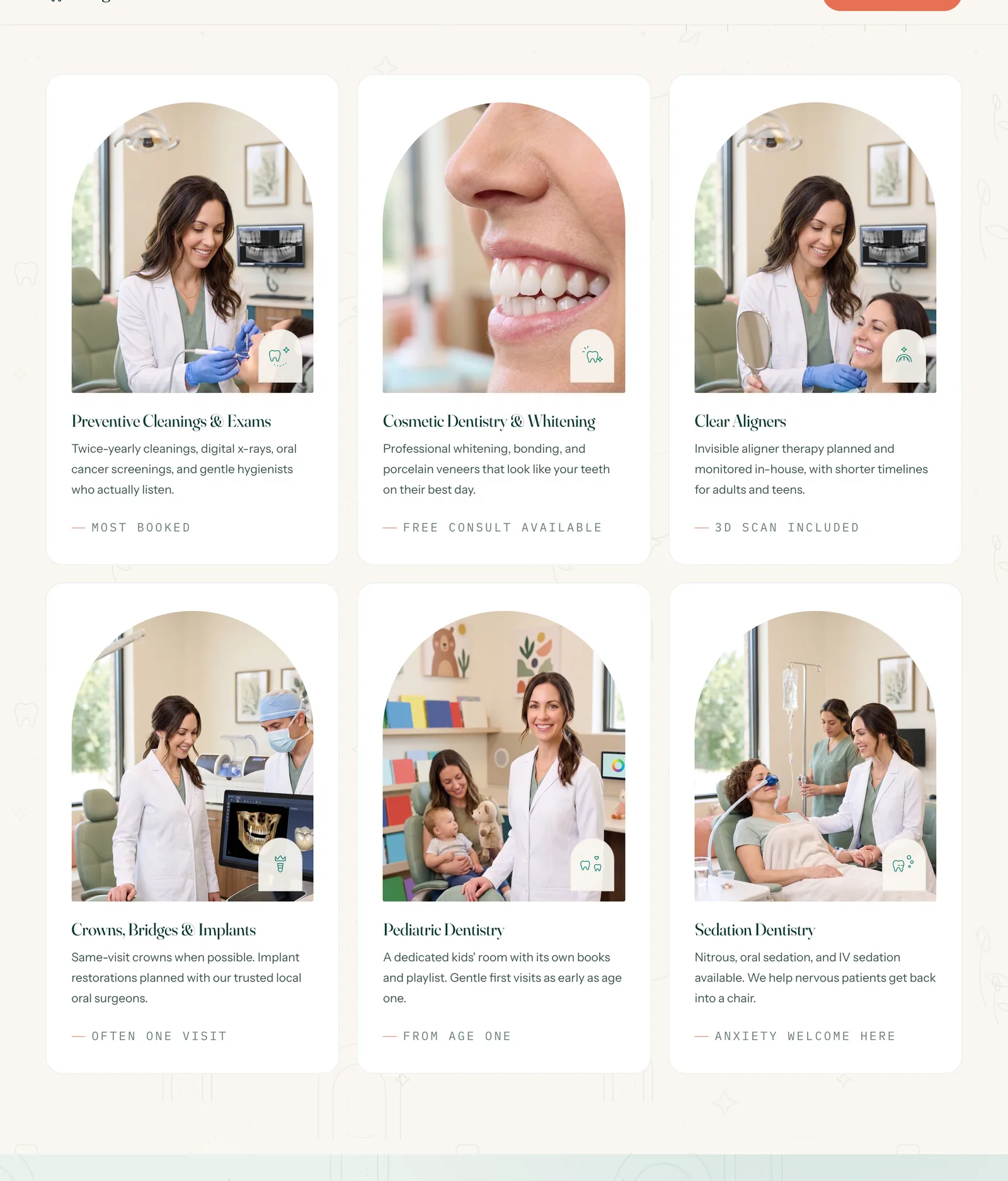
The services grid refuses procedure-code language. "Preventive Cleanings and Exams" pairs with "gentle hygienists who actually listen," because that is the outcome a patient is buying. "Cosmetic Dentistry and Whitening" closes with "your teeth on their best day." "Clear Aligners" leads with shorter timelines, because a working adult choosing aligners over braces is making a calendar decision. Each card carries a mono hint line, "Most booked," "Free consult available," "Anxiety welcome here," that does the quiet reassurance work.
What elevates the grid is that every card now carries a photograph of the practice actually doing the thing, masked in the site's arch, with the service's bespoke line-art mark riding the photo's corner as a badge. A cleaning in progress. A mirror reveal. An implant plan on the chairside screen. A mom and a toddler in the kids' room. A patient asleep under a blanket. The six images share one photographic language, warm porcelain rooms, evergreen cabinetry, the same doctor, so the grid reads as one practice rather than six stock photos.
On the Services page proper, the grid is followed by the priced rows: eight common procedures, each with its published fee range in mono, each linking into The Straight Answer with the procedure preselected. A service without a price is a phone call waiting to happen; every service here has a number.
Three Dated Offers Honored at the Front Desk
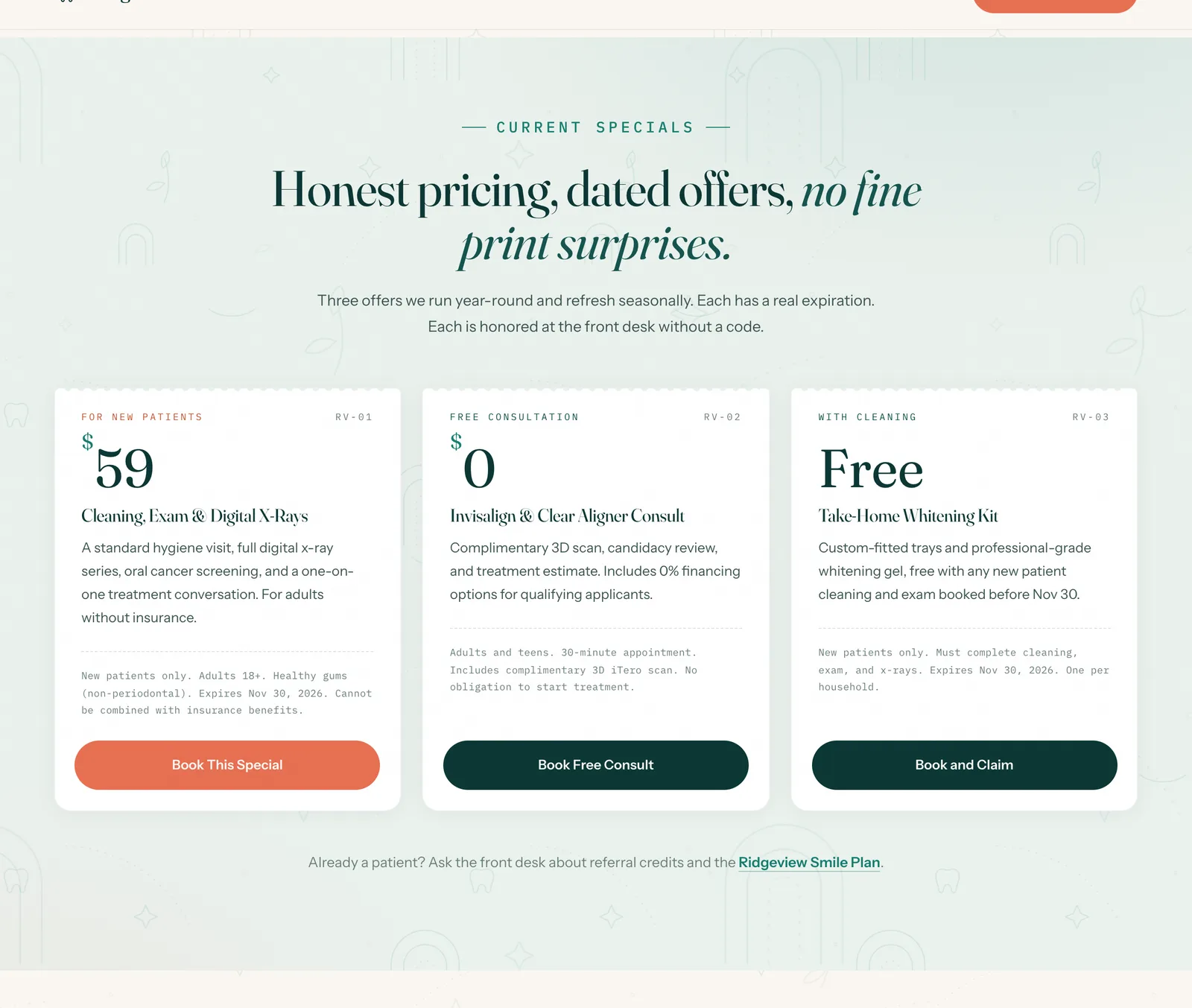
Most dental sites shape specials as an undated hero pill that says "New Patient Special," and the pill is almost never honored at the desk exactly as the site implies. Ridgeview treats specials as its own destination and renders each one as a literal receipt: perforated edges, a serif price, an audience tag, and the eligibility fine print set in the same mono register as everything else the site puts in writing. Hovering a receipt stamps it "Honored at the front desk," which is the whole trust argument in two words.
Three offers, dated, scoped, no codes. The $59 cleaning, exam, and x-ray bundle is the new-patient anchor. The $0 aligner consult is the cosmetic doorway. The free take-home whitening kit pairs the new-patient appointment with a future cosmetic conversation. Every card carries a real expiration date, because an offer that cannot commit to a date is not an offer, it is bait, and the patient who has been burned by one before can tell the difference in a single read.
An In-House Membership for the Uninsured
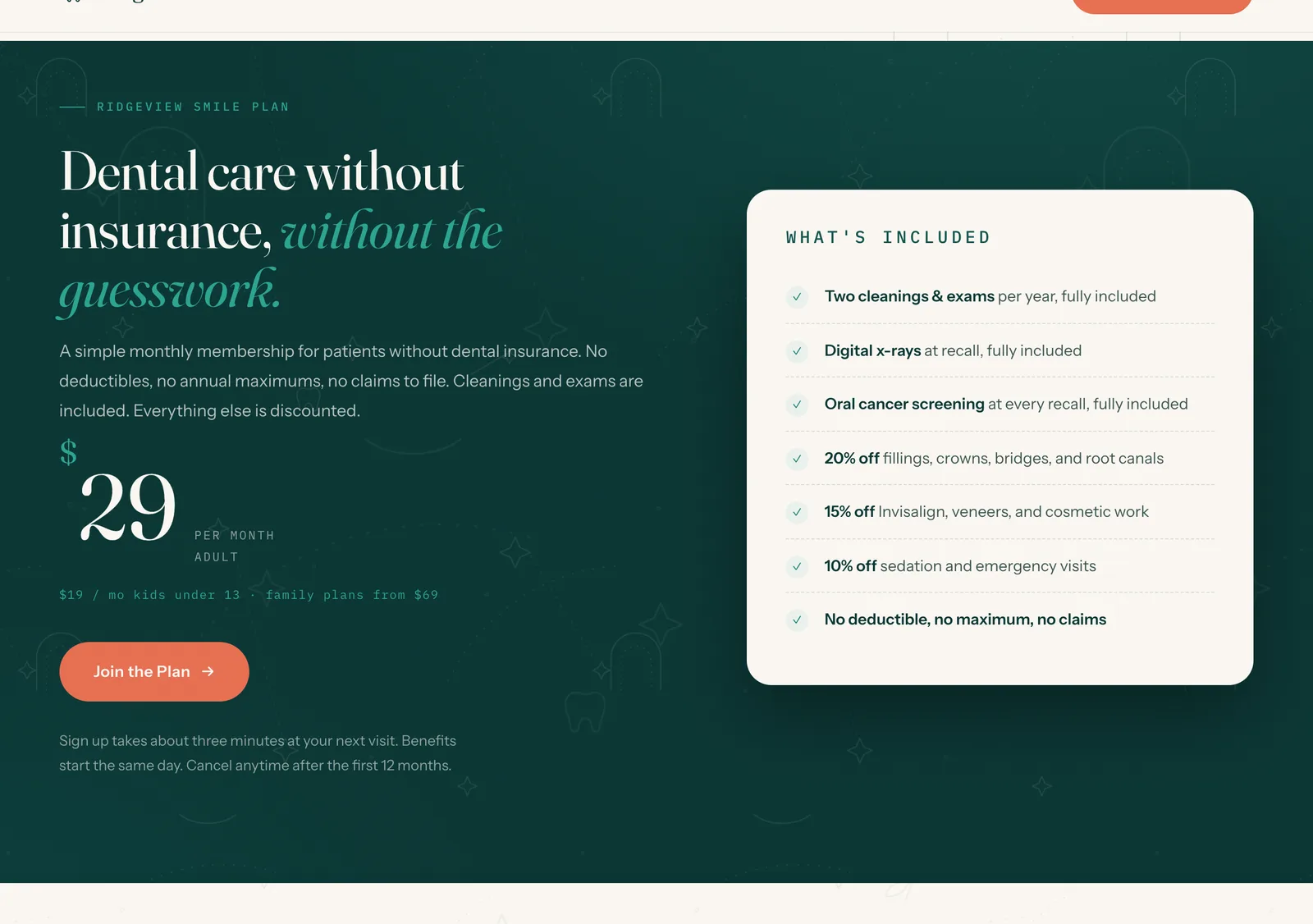
A dental membership is the highest-margin recurring line on a cash-pay patient, and it is also the surface most dental sites refuse to publish, because admitting the office runs an in-house plan means admitting it has thought about the uninsured patient enough to build one. Ridgeview publishes the plan in full: $29 a month for adults, $19 for kids under thirteen, family plans from $69. Two cleanings and exams included. X-rays and screenings included. The discounts named in percentages, not in vague savings.
The microcopy under the join button is the operational commitment that makes it real: sign-up takes about three minutes at the next visit, benefits start the same day, cancel anytime after the first twelve months. Three sentences, no salesperson, no claim forms. The closing checklist line, "no deductible, no maximum, no claims," names the three specific frustrations the uninsured patient has with traditional dental coverage, in order.
The Math, In Public
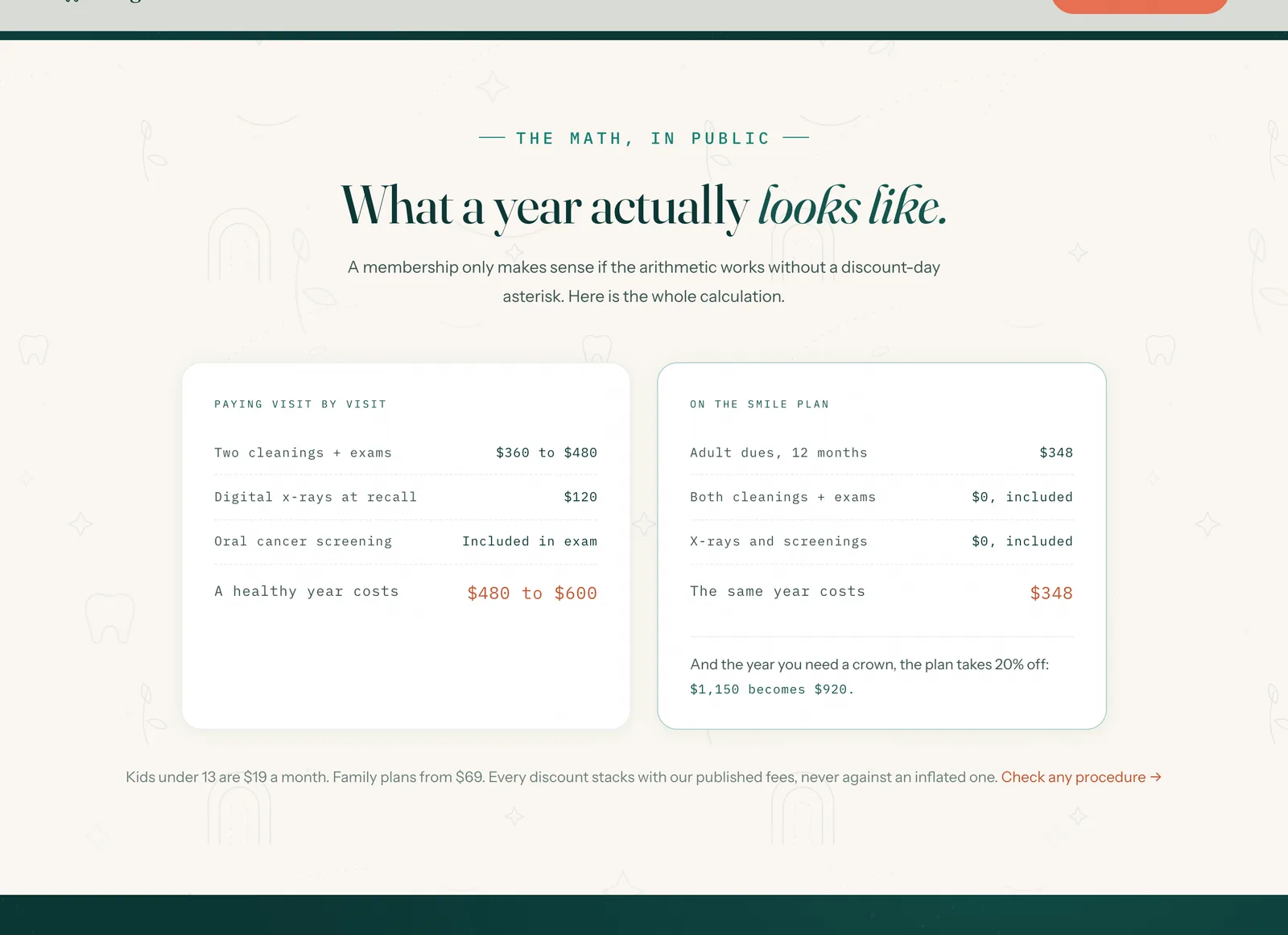
A membership only makes sense if the arithmetic works without a discount-day asterisk, so the Smile Plan page shows the whole calculation. One ledger prices a healthy year at the practice's own published fees: two cleanings and exams, x-rays at recall, $480 to $600. The other prices the same year on the plan: $348, cleanings and x-rays included. The kicker line runs the plan against the site's own published crown fee, $1,150 becomes $920, using the same number The Straight Answer quotes, because the site's figures are one fee schedule everywhere they appear.
This section exists because the alternative, "join and save," is exactly the kind of sentence the rest of the site was built to replace. A patient who can check the math is a patient who trusts the practice with the procedures that cannot be itemized in advance. The section closes by pointing back at the instrument: check any procedure, the discounts stack with published fees, never against inflated ones.
Walking Through the First Visit
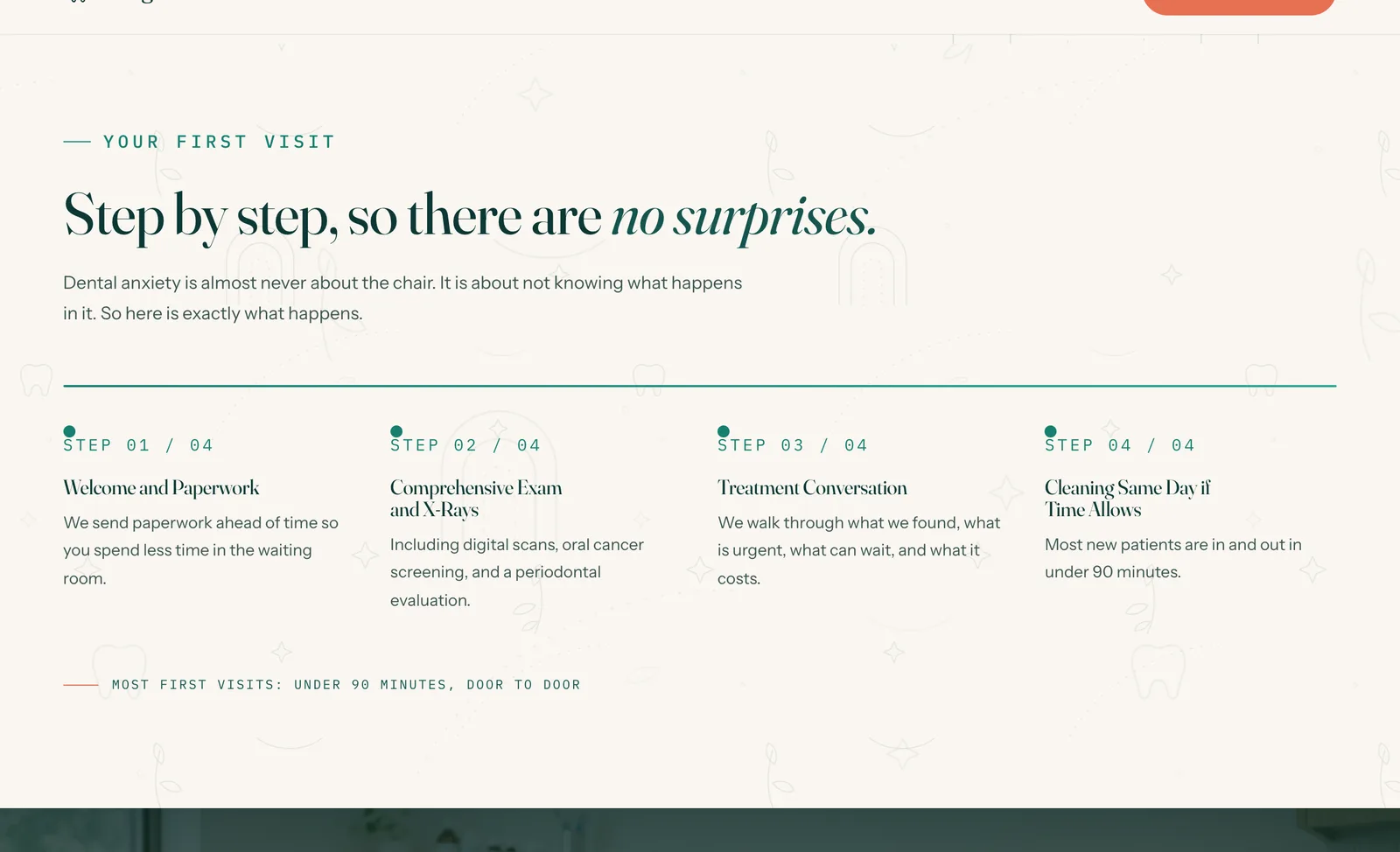
Dental anxiety is almost never about the chair. It is about not knowing what happens in it, and the highest-converting move on a dental site is not a prettier hero photo, it is a step-by-step walkthrough of the first visit. Four calm steps: paperwork sent ahead so the waiting room is short; the exam with its screening modalities named; the treatment conversation framed around "what is urgent, what can wait, and what it costs"; and a same-day cleaning if time allows, with the commitment that most first visits land under ninety minutes door to door.
The page pairs the timeline with the one testimonial that belongs here, the Velasquez family's son who used to cry before every visit and now asks when the next one is, and a what-to-bring list that ends on the sentence the returning patient needs most: "Six months or sixteen years since your last visit, say it plainly. Nobody here lectures. The gap changes the x-ray count, never the welcome."
The Dentist's Name in Print
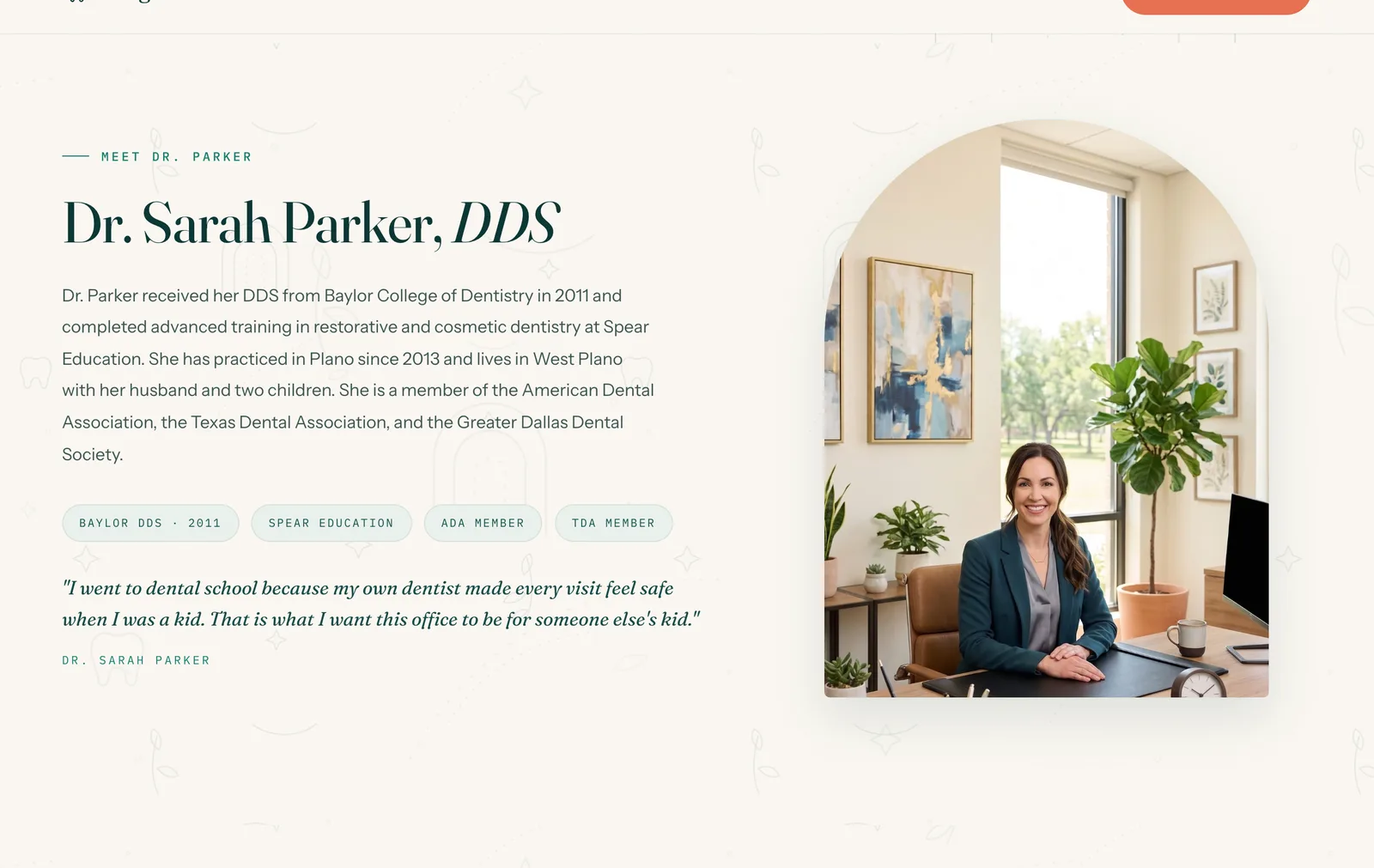
A patient choosing a dentist at this tier is choosing a doctor, not a brand, so the About page opens with "Meet Dr. Parker," not "Our Team." The bio is concrete and verifiable: dental school named, graduation year, advanced training program named, the year she started practicing in Plano, her family, three professional memberships. The portrait sits in the same operatory photography language as the rest of the site, because continuity is what separates a real practice from a stock-photo one.
The signed quote does the relational work no credential can: "I went to dental school because my own dentist made every visit feel safe when I was a kid. That is what I want this office to be for someone else's kid." It names a specific origin and a specific commitment, and it cannot be ghostwritten, which a parent on the other side of the screen can tell. The hygiene team gets the same treatment: Maya, Jordan, and Elena, photographed in the same rooms, each with a role and a reason a family would ask for them by name.
Real Patients, Real Outcomes
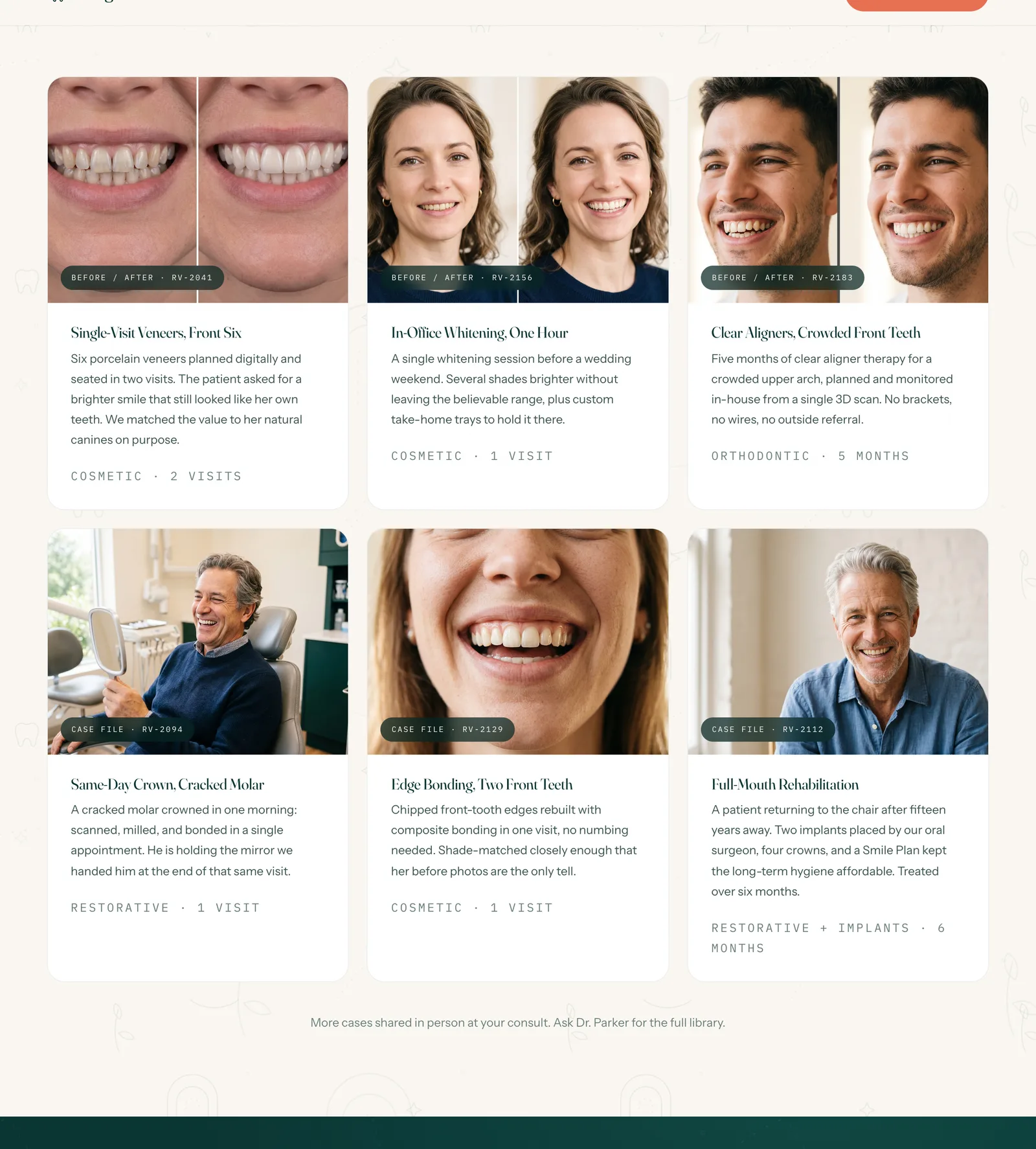
Most dental galleries are a wall of anonymous teeth, and patients scroll straight past them. Ridgeview's gallery leads with faces, and its top row is three true before-and-after diptychs: the same person, the same light, the same angle, whitening, veneers, and aligners, each labeled with a mono case number like everything else the practice puts on the record. The honesty rule runs the labeling: only a case whose image actually shows both states earns the "Before / After" chip; the crown, bonding, and rehabilitation cases are labeled "Case file," because their photographs show an outcome, not a comparison.
Each card's copy reads like a chart note translated for a human: what was done, how many visits, and one detail that proves a person made the decision, the veneers matched to her natural canines on purpose, the crown patient holding the mirror he was handed at the end of that same visit. The section's fine print states that photos are shared with each patient's written consent, and the closing line offers the full library in person, which is where a real practice's proof actually lives.
The Work and the Room, Paired
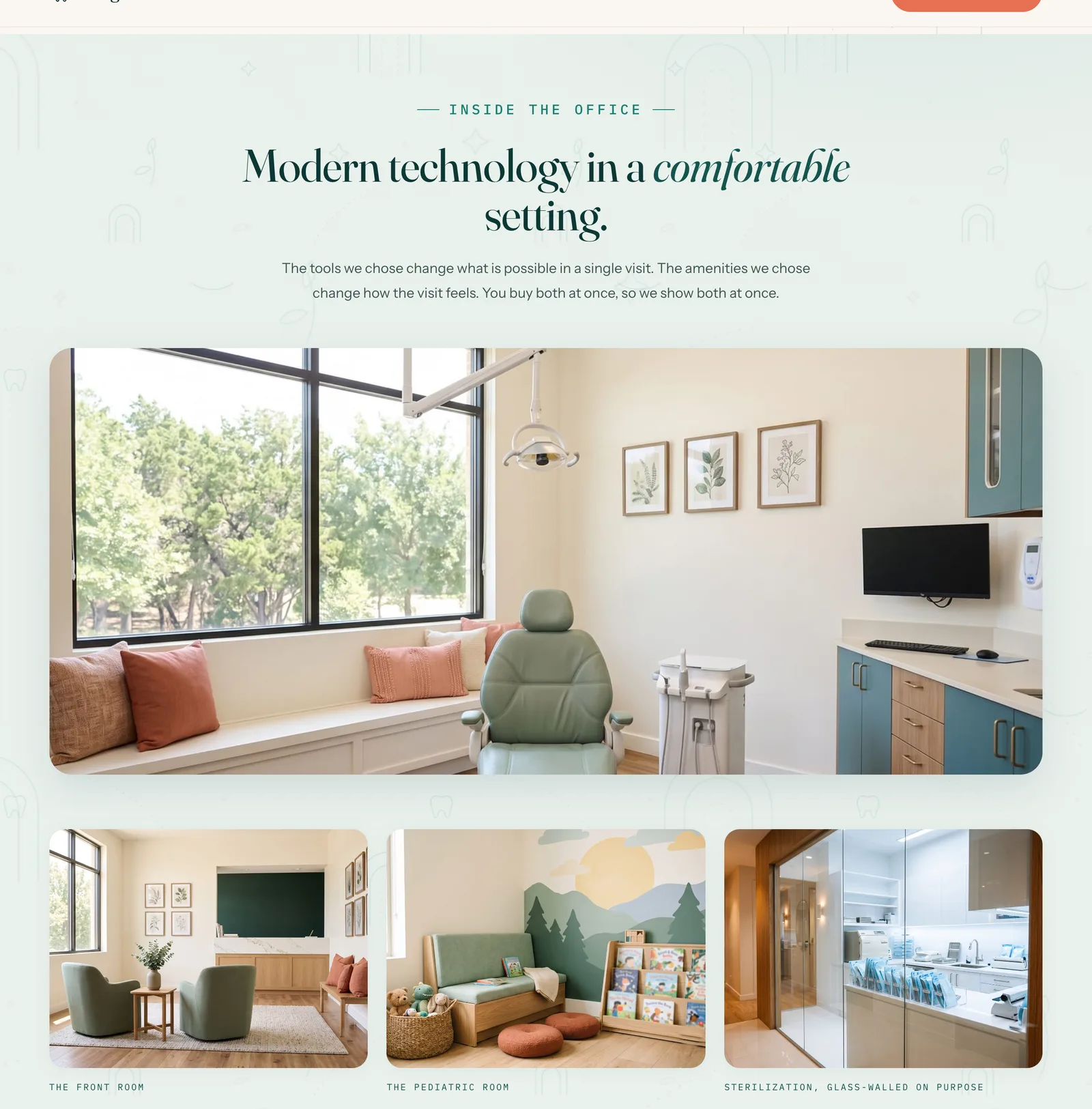
Most dental sites silo technology and comfort onto separate pages, technology for the procurement officer, comfort as a perk list. The patient buys both at once, so the office page sells both at once: a ledger with the work on the left and the room it happens in on the right. 3D iTero scans pair with overhead Netflix and Spotify. CEREC same-day crowns pair with heated massage chairs. Intraoral cameras pair with weighted blankets. The sedation suite pairs with sterilization the patient can see, glass-walled on purpose, with the CDC and OSHA standards stated and a walkthrough offered.
Above the ledger, the photography does the believing for the copy: the operatory in warm window light, the front room, the pediatric room, the sterilization room seen from the hallway. The rooms match the rooms in the service cards and the portraits, because it is one office, photographed once, used everywhere.
The Machine Behind the Promise
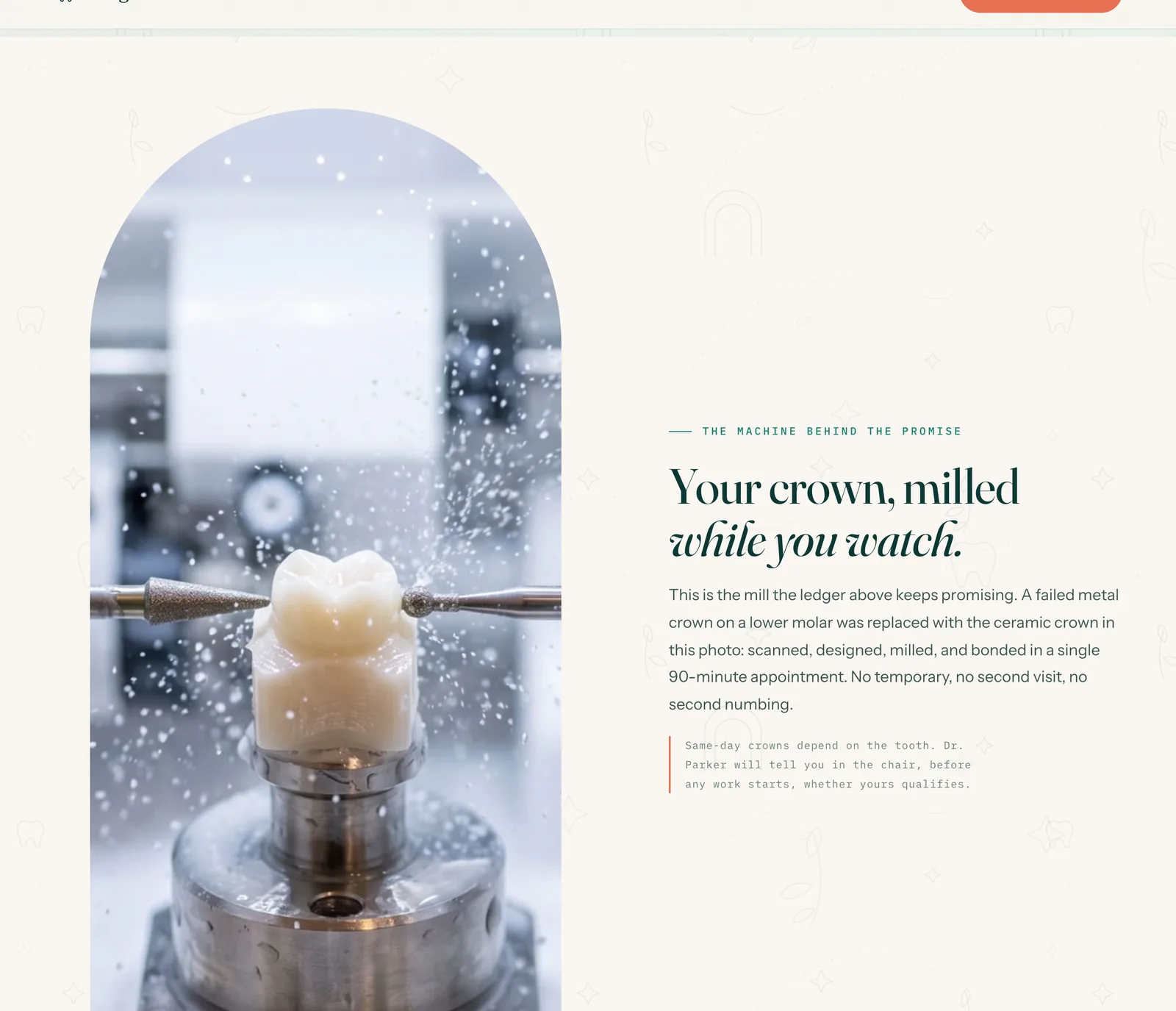
Every dental site claims same-day crowns. Ridgeview shows the machine. The office page ends at the mill itself, a ceramic crown mid-carve with the spray frozen in the air, and ties it to the specific case the gallery documents: a failed metal crown replaced in a single 90-minute appointment, no temporary, no second visit, no second numbing.
The mono footnote under the headline is the honesty move that keeps the promise credible: "Same-day crowns depend on the tooth. Dr. Parker will tell you in the chair, before any work starts, whether yours qualifies." A promise with its own limits stated is a promise a skeptical reader can believe, and the skeptical reader is exactly who this page is for.
Financing Without the Sales Pitch
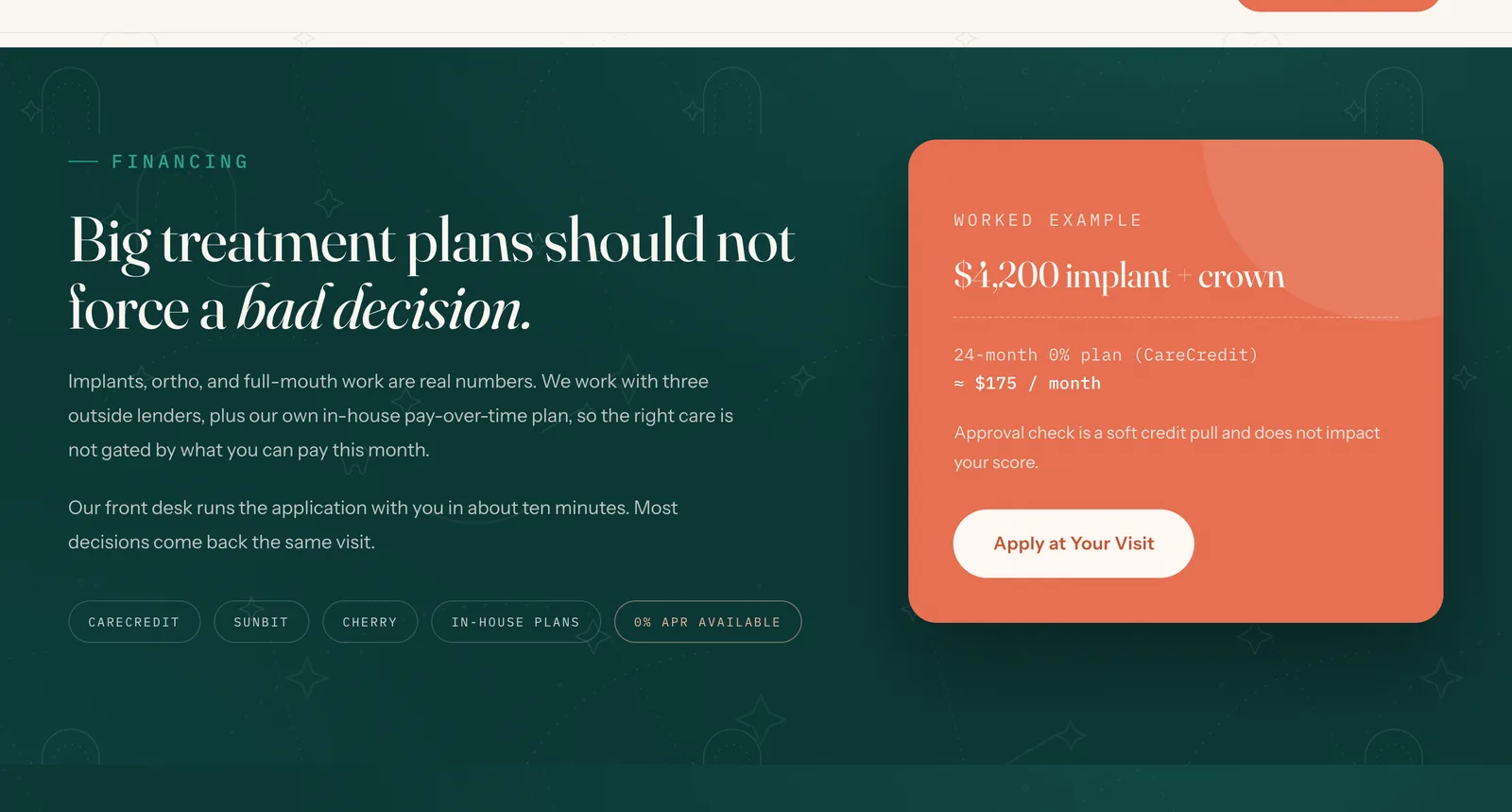
A four-thousand-dollar implant decision is the moment a patient walks away from a practice they otherwise liked, not because they cannot afford the work over time, but because the practice could not say how without a sales pitch. Ridgeview's financing surface is concrete and short: three outside lenders named, the in-house plan beside them as parity rather than backup, and the operational note that the front desk runs the application in about ten minutes with most decisions back the same visit.
The worked example does the conversion: a $4,200 implant and crown, a 24-month zero-percent plan, roughly $175 a month, and a soft credit pull that does not touch the score. The patient who arrived convinced they could not afford the work leaves with a sentence they can repeat to their spouse over dinner. That is the entire job of financing copy.
Each Insurance Plan Named on the Page
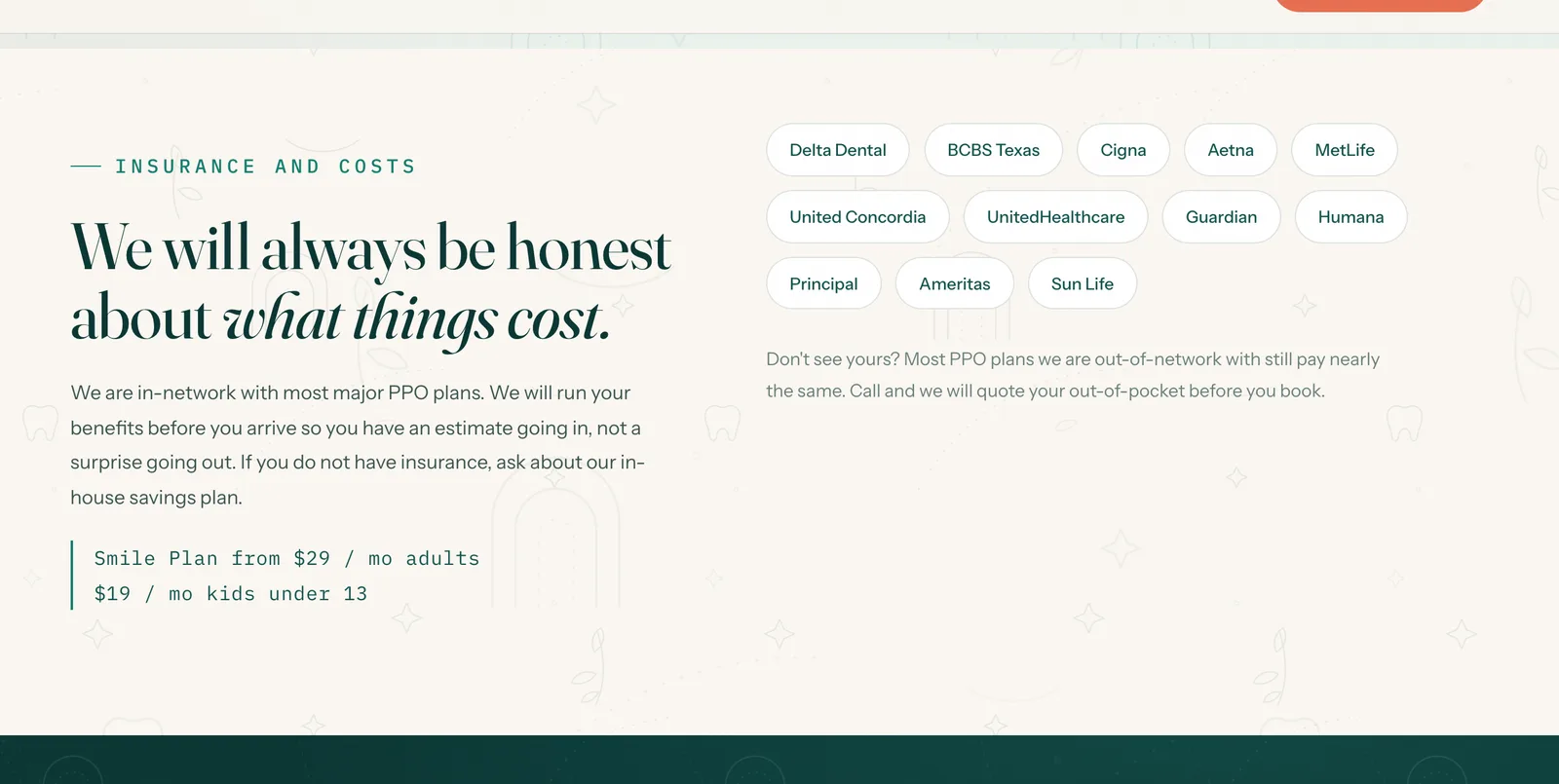
"We accept most insurance" loses about a third of the bookings it should win, because the patient is searching for their plan by name, and a plan not on the page reads as a plan not accepted. The fix is the most boring lift on the site: twelve carriers named as calm pills a patient can scan in five seconds. The disclosure beneath them closes the patient whose plan is missing: most out-of-network PPO plans still pay nearly the same, and the office will quote the out-of-pocket before booking.
The same honesty runs through the benefits promise: the practice runs your benefits before you arrive, so you have an estimate going in, not a surprise going out. On this site that sentence is not a slogan; it is a description of The Straight Answer, one page over, where the estimate is already waiting.
The Patient Portal: The Arithmetic From the Inside
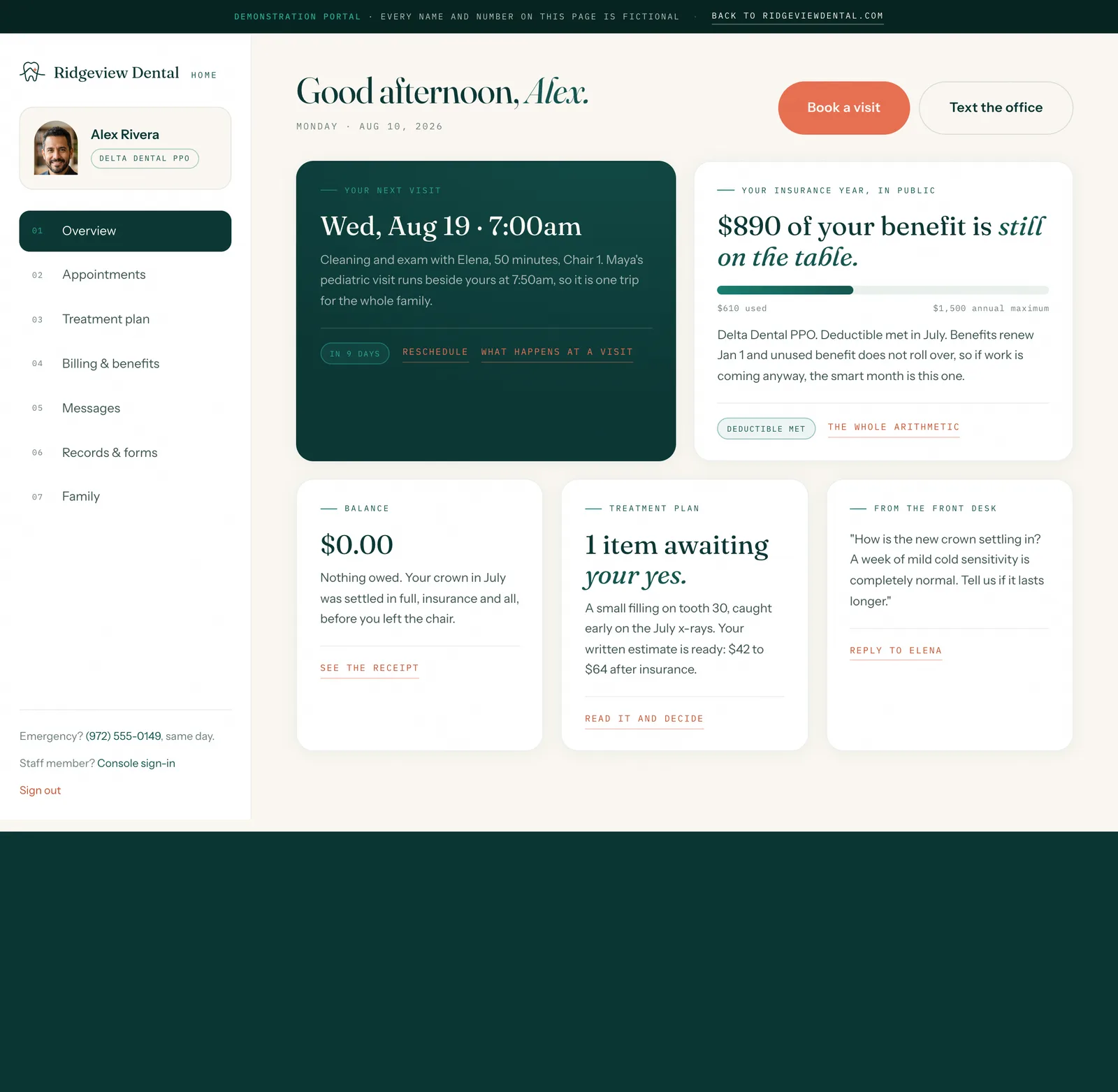
The marketing site promises that the practice publishes its arithmetic; the patient portal is what that looks like after you say yes. The demonstration account, the Rivera family, opens on a benefits meter that says the one thing no insurer's portal ever leads with: "$890 of your benefit is still on the table," with the annual maximum and the used amount on the same scale. The balance card shows $0 with the crown receipt that produced it, settled in writing before the patient left the chair.
The treatment plan renders as phases with written estimates, and each estimate links to the public What It Costs instrument, carrying the same promise: if the two ever disagree, the lower number wins. Records are framed as the patient's to take, the message thread answers within the hour during office hours and says so, and the whole surface is honestly ribboned as a fictional demonstration. Every figure in it, the crown at $1,150, the 50% major coverage, the $890 remaining, reconciles with the public fee schedule, because one practice has one arithmetic.
The Team Console That Feeds the Website
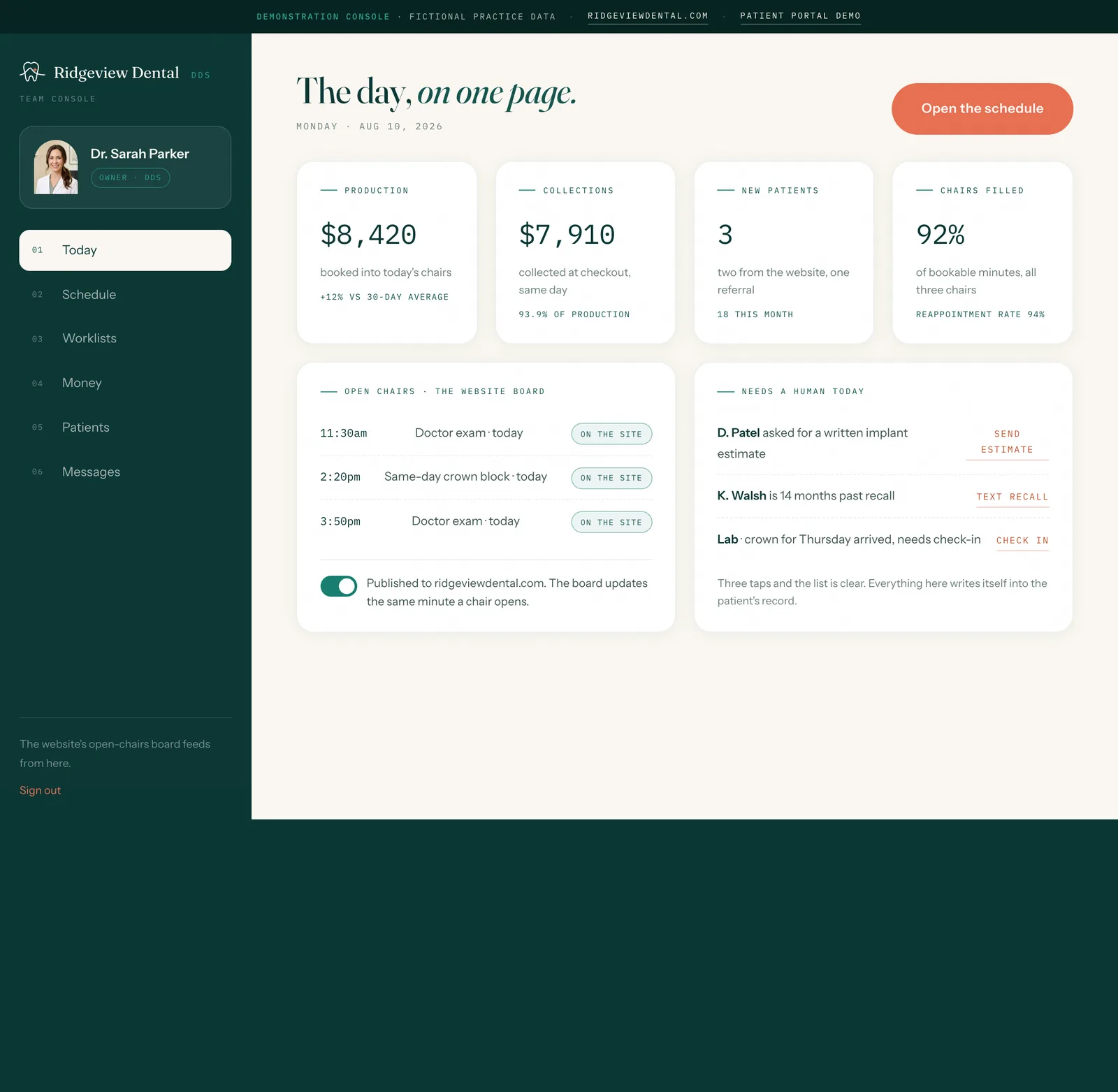
The second portal is the staff side, and its centerpiece closes the loop the home page opened: the open-chairs publisher, a seeded chair-timeline schedule that marks cancellations as claimable and a switch that posts them straight to the marketing site's board. The console carries the day sheet, recall and insurance-verification worklists with one-tap state flips, claims aging, Smile Plan recurring revenue, and the same message thread the patient sees, answered from the other side.
The console exists in the demonstrator for a strategic reason: a dental practice does not buy a website, it buys the operating loop the website is the front of. Showing the loop, cancellation to published chair to claimed appointment, is what separates "we built you a brochure" from "we built you the machine that keeps the chairs full."
Texas State Board Compliance
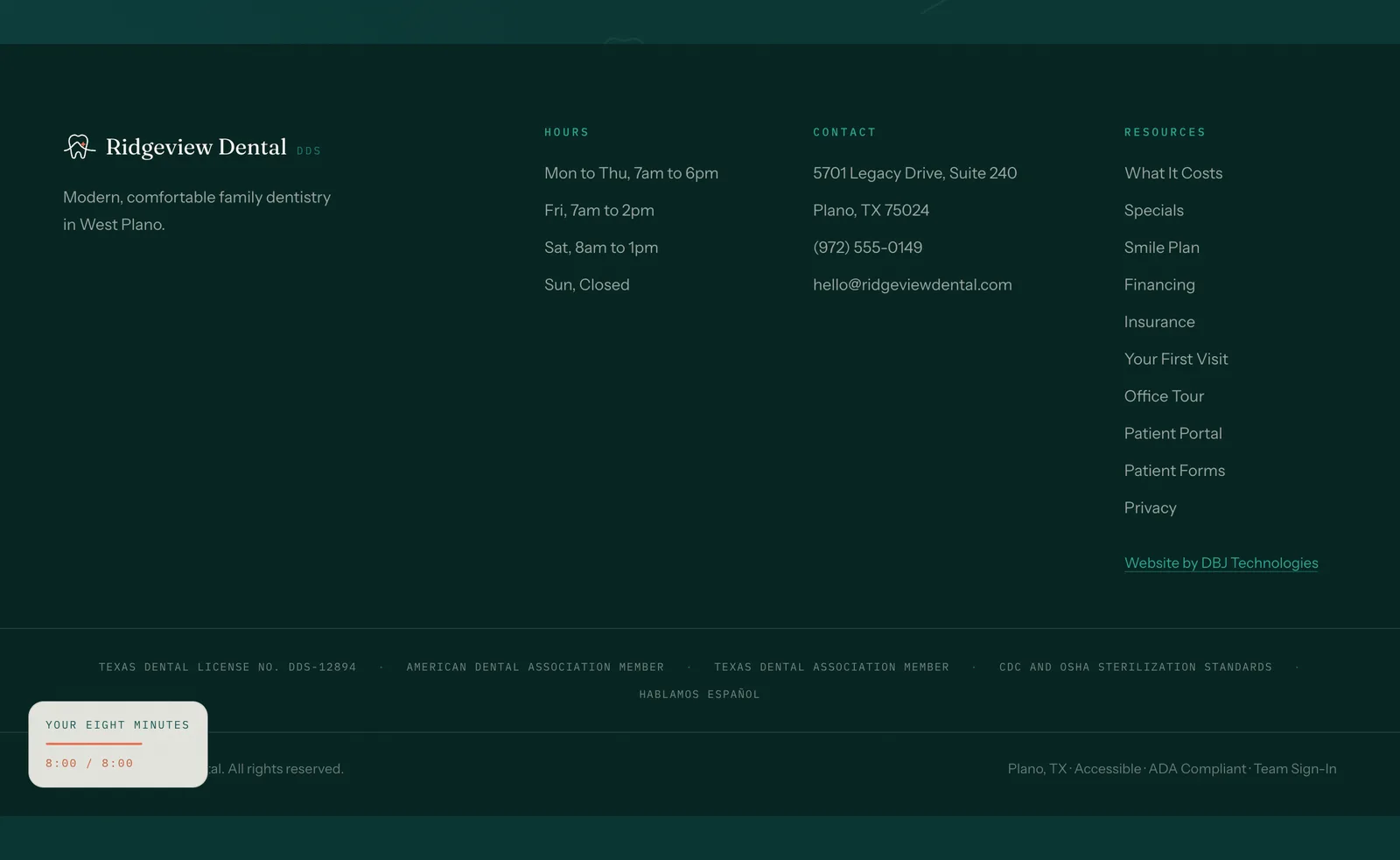
The footer is the regulator's surface and the patient's last reassurance. Hours are stated in full, Saturday mornings included, because a working West Plano family books cleanings on Saturday, and Sunday is stated as closed rather than omitted, because absence is the wrong signal for a healthcare practice. The compliance line runs everything a Texas dental practice is supposed to display, license number, ADA and TDA membership, CDC and OSHA sterilization standards, Hablamos Español, in a calm pale gray that reads as professionalism rather than fine print.
Nothing is hidden behind a Legal link. The Texas State Board of Dental Examiners, the ADA, and the careful patient who knows what to look for will find every required item exactly where it belongs, and the quiet "Website by DBJ Technologies" credit closes the page the way the studio signs all of its work: last, and small.
Build It For Real
Want this architecture, executed for your practice?
I build the version of this that ships. Designed end to end, launched on production grade infrastructure, with the surfaces above tuned to your actual book of business.