The Med Spa That Publishes Its Per-Area Pricing
Most med spas hide pricing behind a consult form. Reverie publishes the working menu the front desk quotes from. Specials and Society pricing layer on top. This brief proposes the eleven surfaces a Highland Park med spa needs to win the four-to-twelve-week decision.
Treatments Named by Outcome
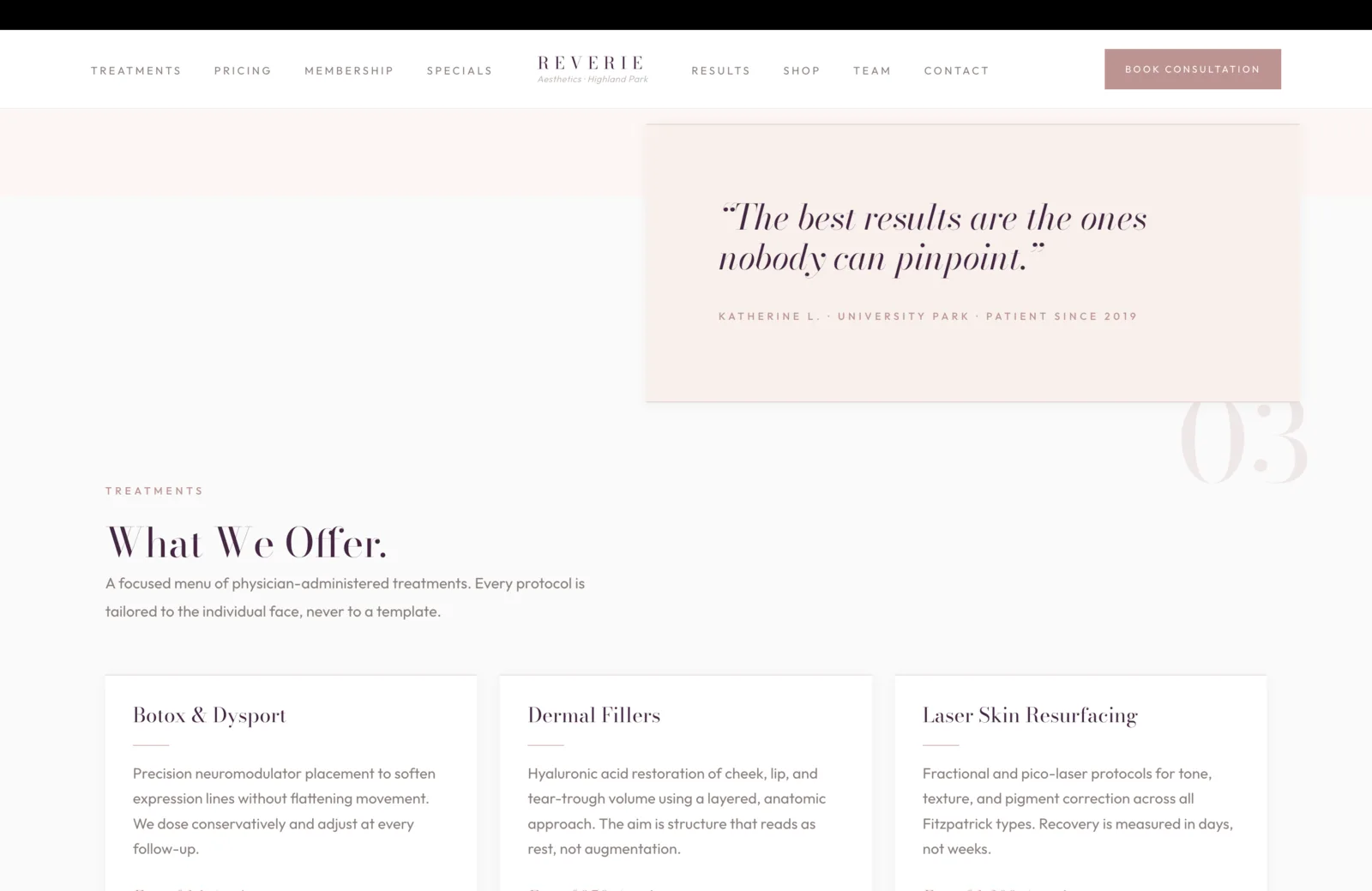
The treatments surface refuses to read like a procedure list. The standard med spa "Services" page is six lines of clinical jargon, each one terminating in a Schedule a Consult button. A patient in the four-to-twelve-week aesthetics decision window has already searched the procedure name on Google and read four other clinics' versions of the same paragraph. What earns this surface the click is the *aim*, not the procedure code.
So every card pairs a treatment name with a one-sentence description that names the outcome the patient is actually buying. Botox and Dysport "soften expression lines without flattening movement," because the patient's fear is freezing, not the wrinkle itself. Dermal Fillers aim for "structure that reads as rest, not augmentation," because the buyer at this tier has seen what aggressive filler looks like on her friends. Laser Skin Resurfacing names "recovery measured in days, not weeks," because the working professional reading this surface budgets her face by the calendar, not by the technology.
The pull-quote at the top of the section does the heaviest lift. "The best results are the ones nobody can pinpoint," attributed to a real patient with a name and a neighborhood and a year, is the brand promise rendered as social proof. It bridges from the doctor section above into the treatments grid below by answering the question every researching patient has when she lands on a med spa site for the first time: will this practice make me look done, or will it make me look rested. The quote answers that question in nine words.
The Per-Area Menu the Front Desk Quotes From
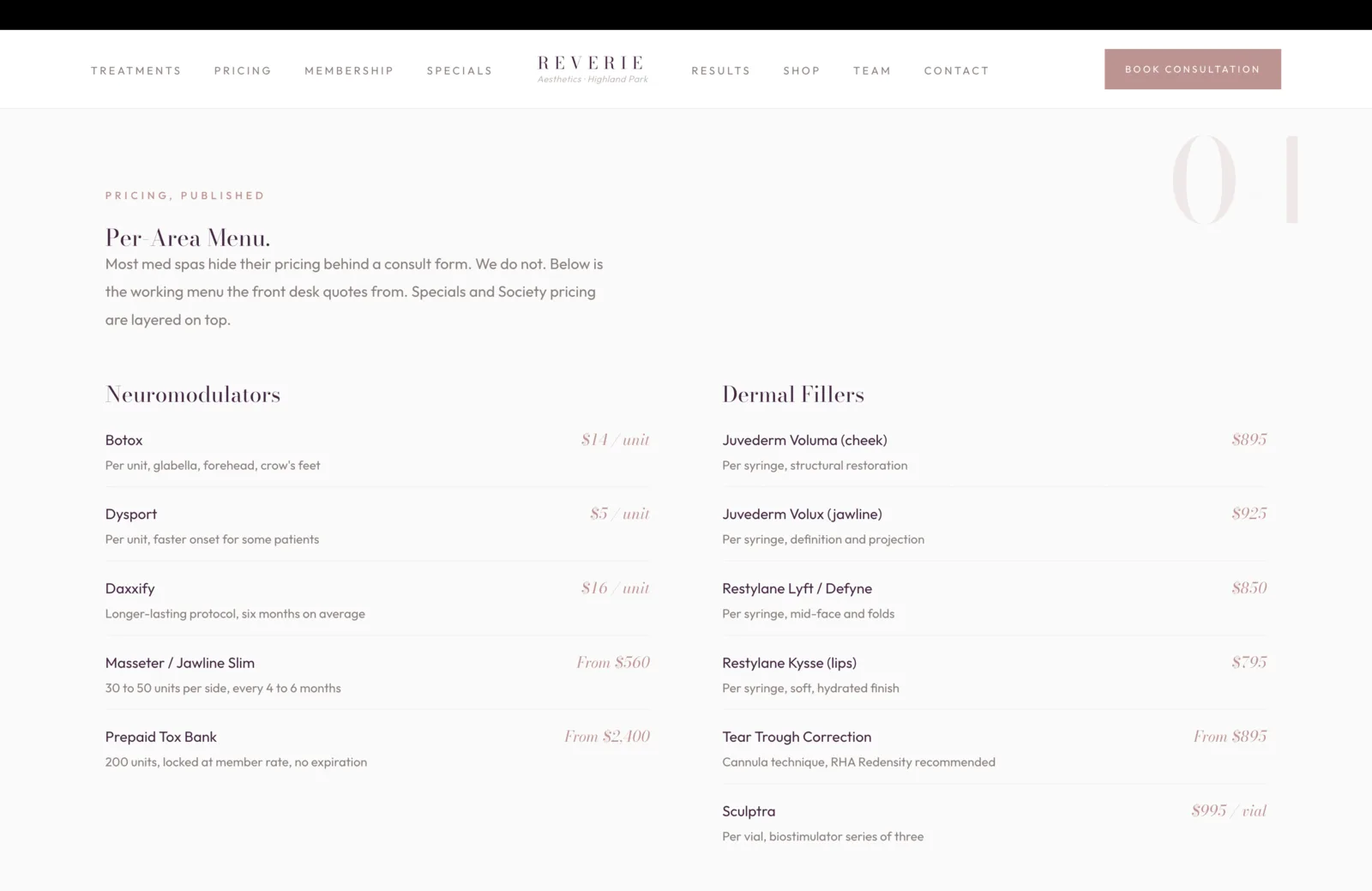
The single biggest lift in the med spa category is publishing the menu the front desk already quotes from. Most practices keep that menu locked in a Google Sheet and ask the patient to schedule a consult to learn the price. The friction is intentional. The negotiation is meant to happen in the room, after the patient has invested an hour and a parking fee and a slightly awkward conversation. A confident practice does not need that asymmetry.
So Reverie publishes the menu, on the same page as the rest of the site, in the same typography as the headline. Per-unit Tox, per-syringe filler, per-session laser, per-cycle CoolSculpting, per-vial Sculptra. The granularity is the credential. A patient who can compare the per-unit price across three Highland Park practices at 10pm on a Tuesday will book the practice that respected her enough to publish first. Every other practice on her short list pretends the asymmetry is the deal. Reverie pretends the symmetry is.
The microcopy under the headline is the structural admission that earns the section. "Most med spas hide their pricing behind a consult form. We do not. Below is the working menu the front desk quotes from. Specials and Society pricing are layered on top." That paragraph names the trade explicitly: published baseline, layered discounts, transparent ladder. A member sees her 15 percent immediately. A consult patient sees the per-unit baseline. A walk-in sees the seasonal special. None of the three feels surprised at the desk, because none of the three was kept in the dark before she arrived.
The Society Membership
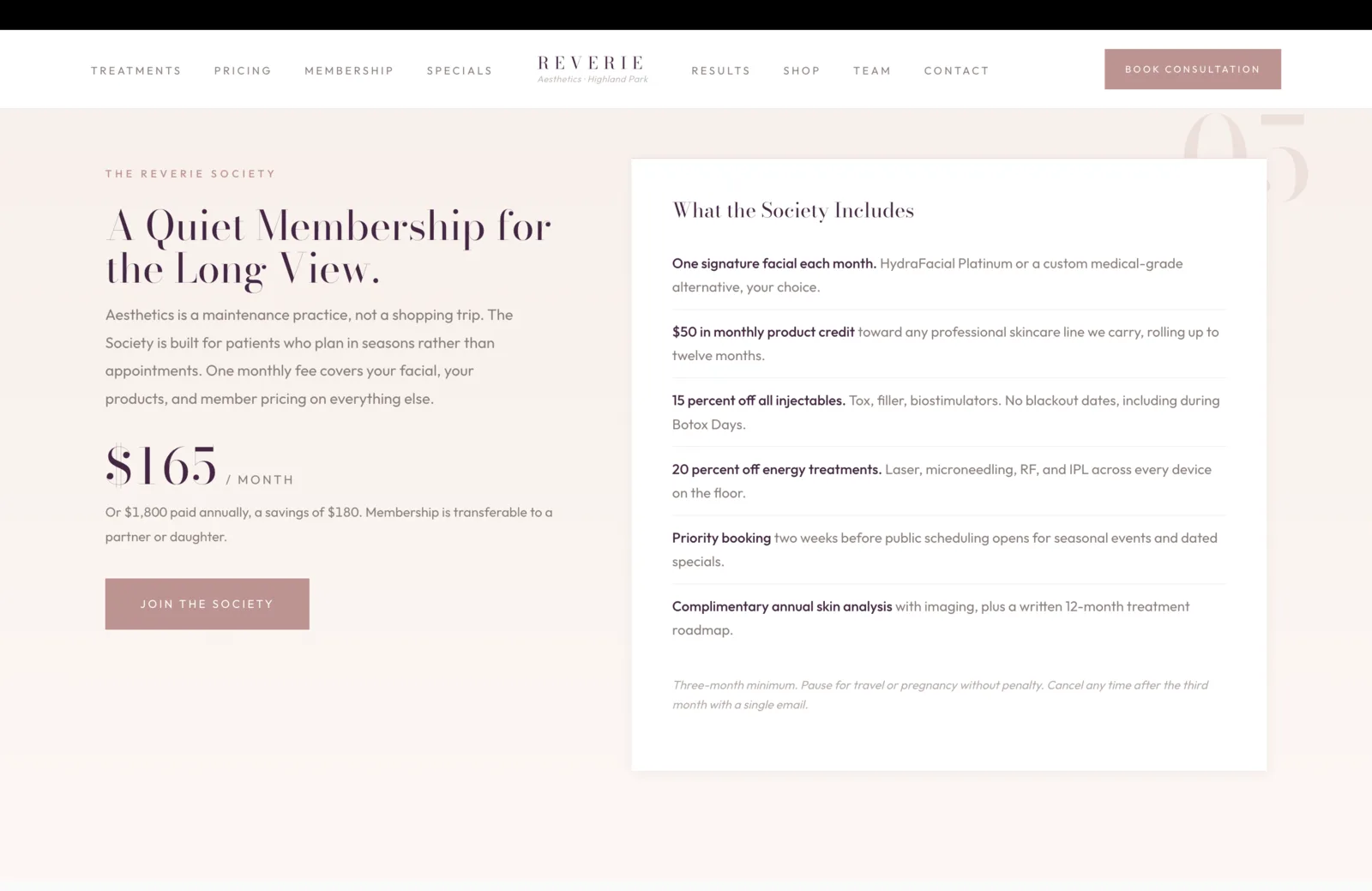
A med spa membership is the single highest-margin recurring revenue line in the category, and most practices either omit it or hide it behind "ask us at your consult." Reverie publishes it as a destination surface. The price is anchored at $165 a month, which is the right number for the Highland Park demographic: too high to read as a Groupon, too low to read as a yacht.
The benefits panel does the structural work. One signature facial included means the membership pays back the patient who would otherwise book a HydraFacial four times a year at the per-treatment rate. The $50 monthly product credit, rolling up to twelve months, is the line that converts the patient who already buys ZO or SkinMedica somewhere else. The "no blackout dates including during Botox Days" microcopy is the operational commitment that members notice and remember. Most membership programs blackout exactly the events the members want to attend. This one does not, and the page admits that.
The fineprint at the bottom is the dignity move. "Three-month minimum, pause for travel or pregnancy without penalty, cancel any time after the third month with a single email." Three sentences. No phone tree. No retention specialist. No cancellation form that opens a CRM ticket. A patient who has been trapped in a gym membership or a meal kit subscription this year reads those three sentences and understands that this practice is not trying to imprison her into a recurring charge. The transferable-to-partner-or-daughter clause is the family-aware detail that closes the same patient when the brand reaches her in fifteen years.
Three Capped Specials Each Quarter
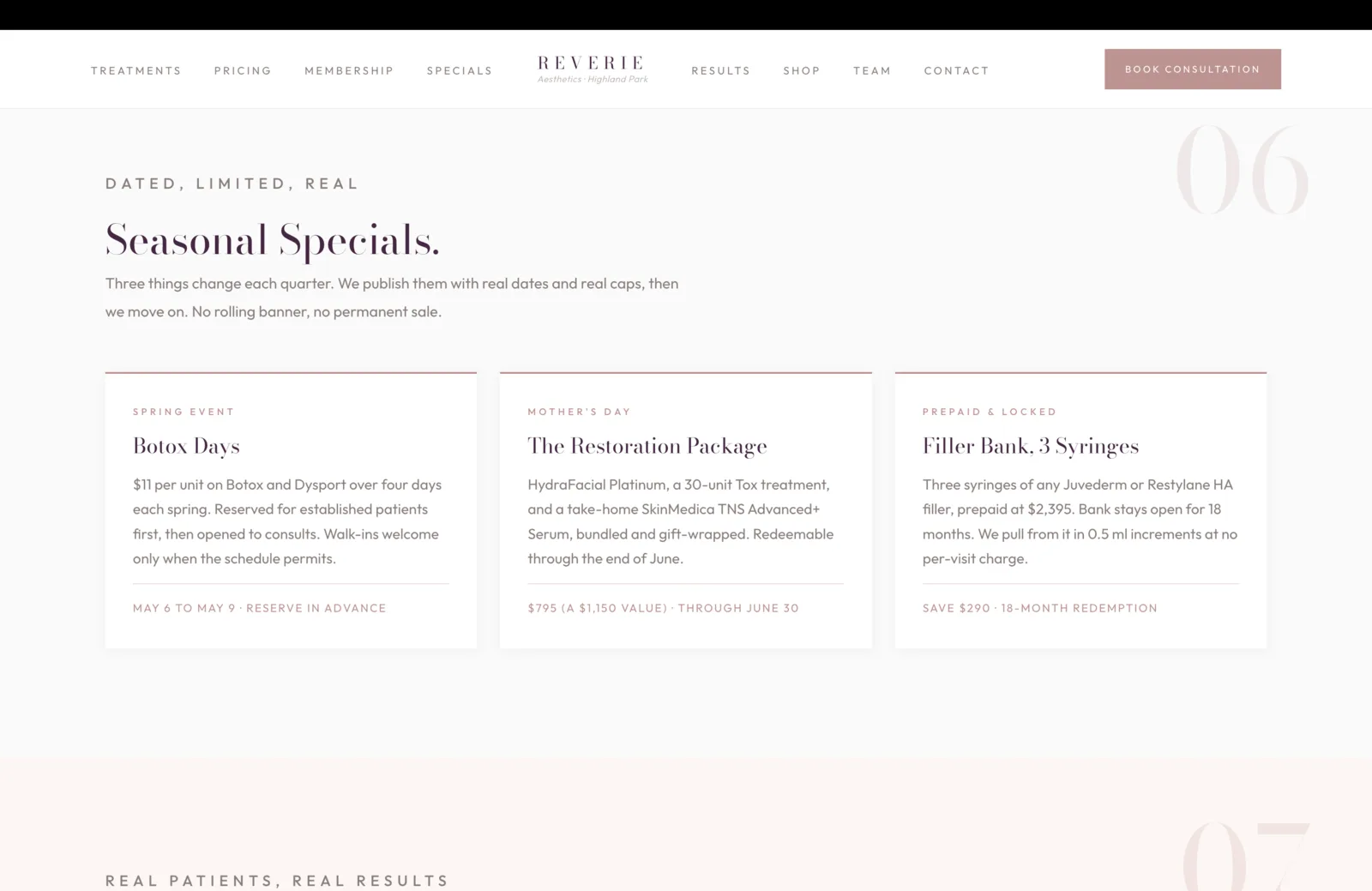
The "Save 20% on Botox" rolling banner is the laziest surface in the category and the one patients have learned to mute fastest. Reverie replaces it with three quarterly offers, each with a real date, a real cap, and a real redemption window. A patient reads "May 6 to May 9, reserve in advance" and understands two things at once: this offer is going to end, and this offer was real to begin with.
The three offer types are deliberately structured. Botox Days is the *event*: a four-day window at a discounted per-unit price, reserved for established patients first to reward loyalty, opened to consults next, and walk-ins last when the schedule permits. The Restoration Package is the *bundle*: a gift-wrappable Mother's Day combo of facial, Tox, and serum at $795 for $1,150 of stated value, redeemable through June 30. The Filler Bank is the *prepaid commitment*: three syringes locked at $2,395 with an 18-month redemption window and a 0.5 ml per-visit pull rate. Each offer serves a different patient psychology. Together they cover event-driven, bundle-curious, and prepaid-confident behavior in three cards.
The headline above is the architecture in one phrase. "Dated, Limited, Real." The supporting line earns it: "Three things change each quarter. We publish them with real dates and real caps, then we move on. No rolling banner, no permanent sale." That sentence is a structural commitment most marketers cannot bring themselves to make, because a permanent sale is the easiest banner to leave up. A practice that takes the banner down at the cap is signaling that the discount was real, the inventory was real, and the trust on the other side of the discount is therefore real too.
Patients Speak for Themselves
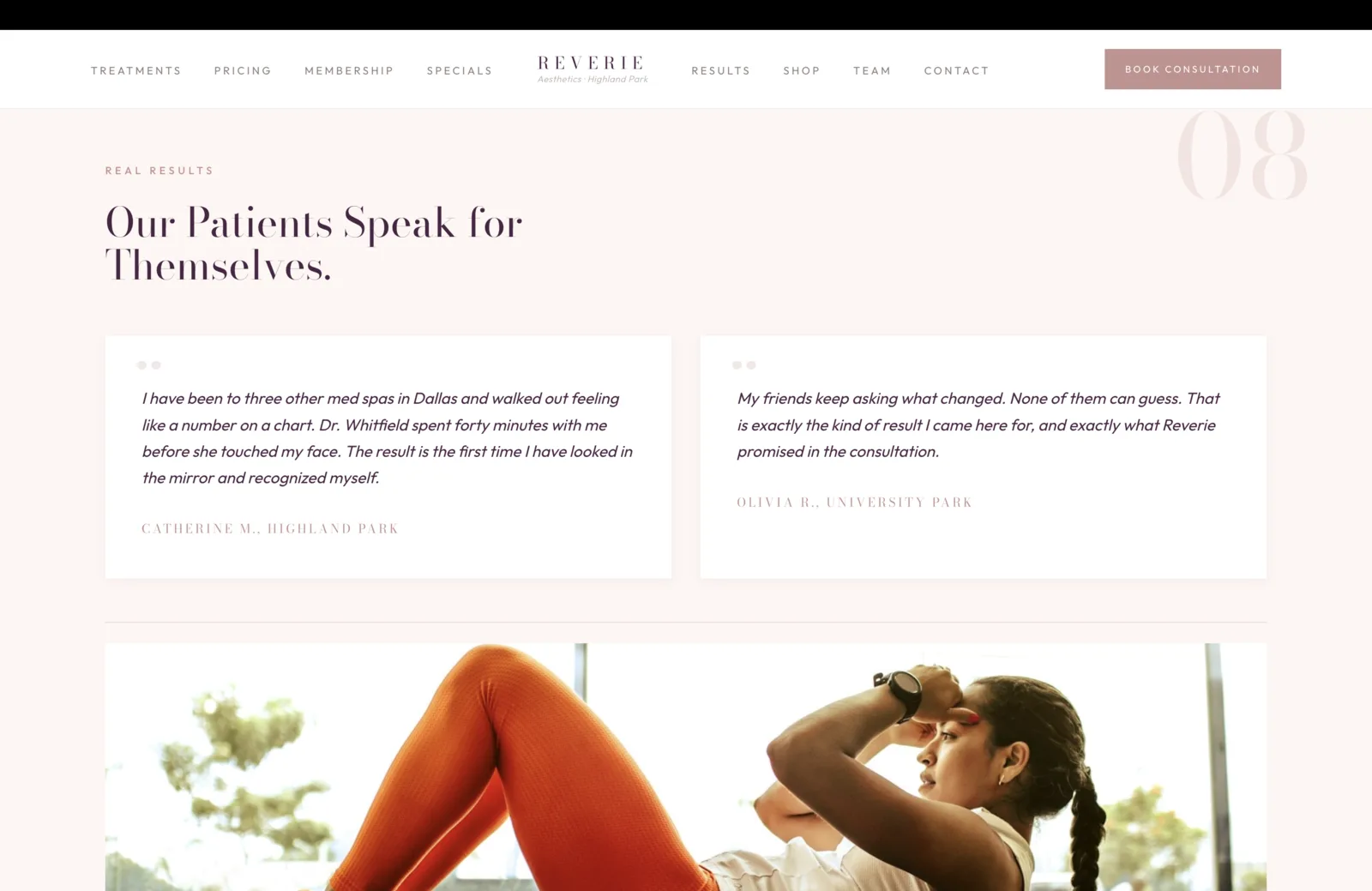
Two quotes, two columns, no aggregate rating. That is the entire surface, and it converts harder than a four-star pill with a count attached. A patient at this price point has already seen the platform ratings on Google and RealSelf. The number is not what closes her. The story is.
The two quotes here are deliberately different in shape. Catherine M. opens with a comparative claim: she has been to three other med spas in Dallas, and the differentiation is named explicitly, "forty minutes with me before she touched my face." That sentence delivers the entire architectural commitment of the practice in nine words: the consultation is real, the listening is real, and the procedure follows from the conversation. Olivia R.'s quote is the *outcome* claim: "My friends keep asking what changed. None of them can guess." That is the brand's hero promise, "the best results are the ones nobody can pinpoint," rendered as a real patient's lived experience.
The structural choice on this surface is the absence rather than the presence. No five-star icon row. No "rated 4.9 across two hundred reviews" pill. No video carousel. The two italic quotes sit on a soft pink field with enough whitespace that the eye reads each one in full. A practice that publishes only two testimonials, each substantial, is a practice that has read every testimonial on its own page. A practice with a sixteen-quote slider is one that has not.
Each Provider Named With Credentials
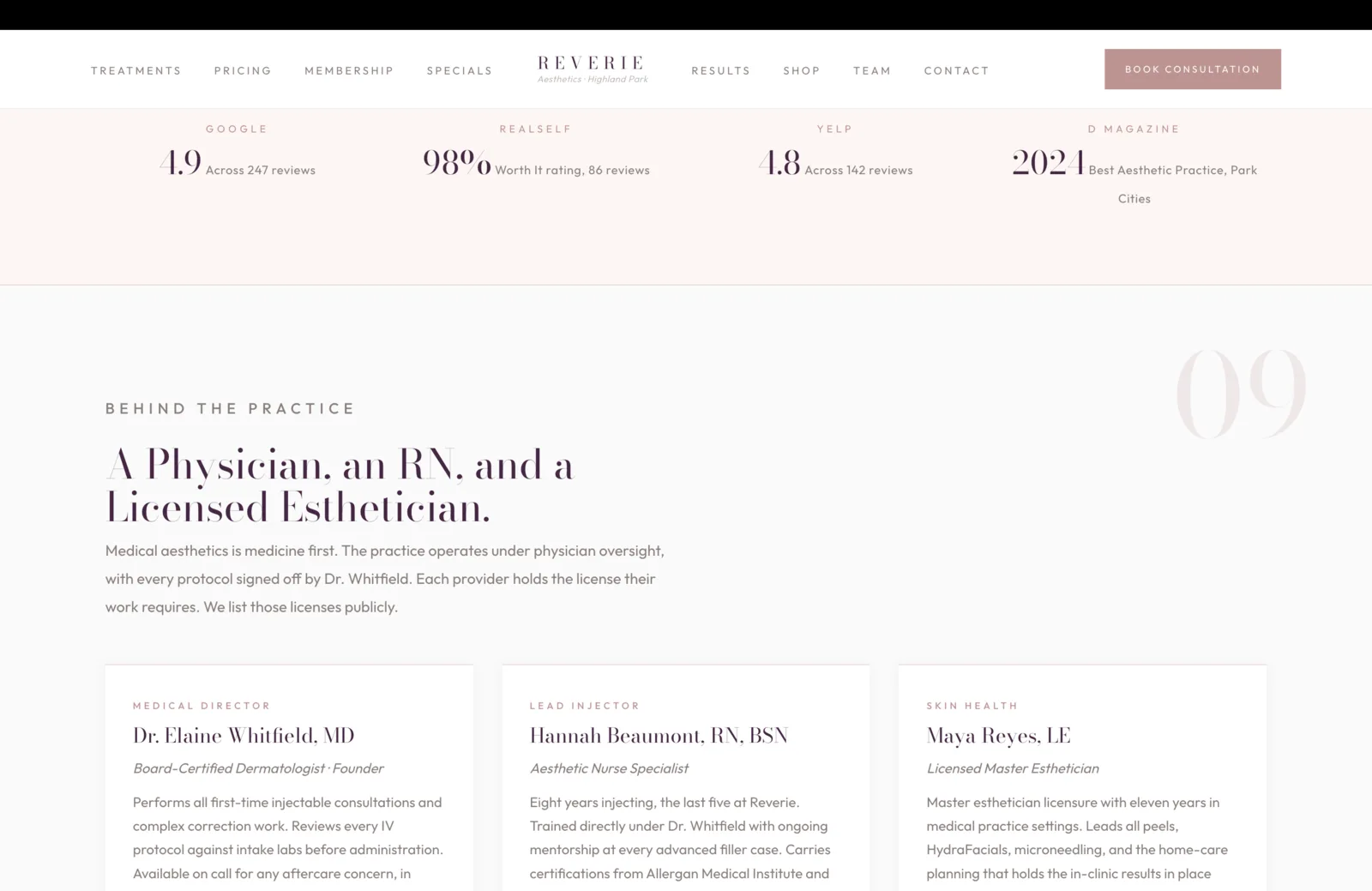
The reviews band at the top of the section names four platforms by name, each with a count and a rating. Google, RealSelf, Yelp, D Magazine. That is the right way to render social proof at this tier: platform-named, count-attached, regional-credential included. A patient who has spent her last two weeks reading RealSelf "Worth It" reviews sees the 98 percent rating across 86 reviews and registers it as a specific signal, not an aggregate. The D Magazine 2024 Best Aesthetic Practice in Park Cities is the regional credential a Highland Park buyer recognizes by name.
The team grid below makes the medical hierarchy visible. Physician Medical Director at the top, RN Lead Injector trained directly under the physician, Licensed Master Esthetician handling skin health and home-care planning. Each role-card carries the credential, the scope, and the training lineage. Dr. Whitfield "performs all first-time injectable consultations and complex correction work" makes the founder's role concrete. Hannah Beaumont's "trained directly under Dr. Whitfield with ongoing mentorship at every advanced filler case" makes the lineage visible. Maya Reyes's "eleven years in medical practice settings" disambiguates her from the spa-trained estheticians at retail-grade competitors.
The headline is the structural commitment. "A Physician, an RN, and a Licensed Esthetician, Each With a License." The supporting line earns it: "Medical aesthetics is medicine first. We list those licenses publicly." A patient who has been treated at a med spa where the injector's license was vague, or where the physician was named on the website but never on the floor, reads that paragraph and understands that the line between this practice and the rest of the category is exactly the line between a medical practice and a retail spa.
Skincare Plans Built From the Patient Chart
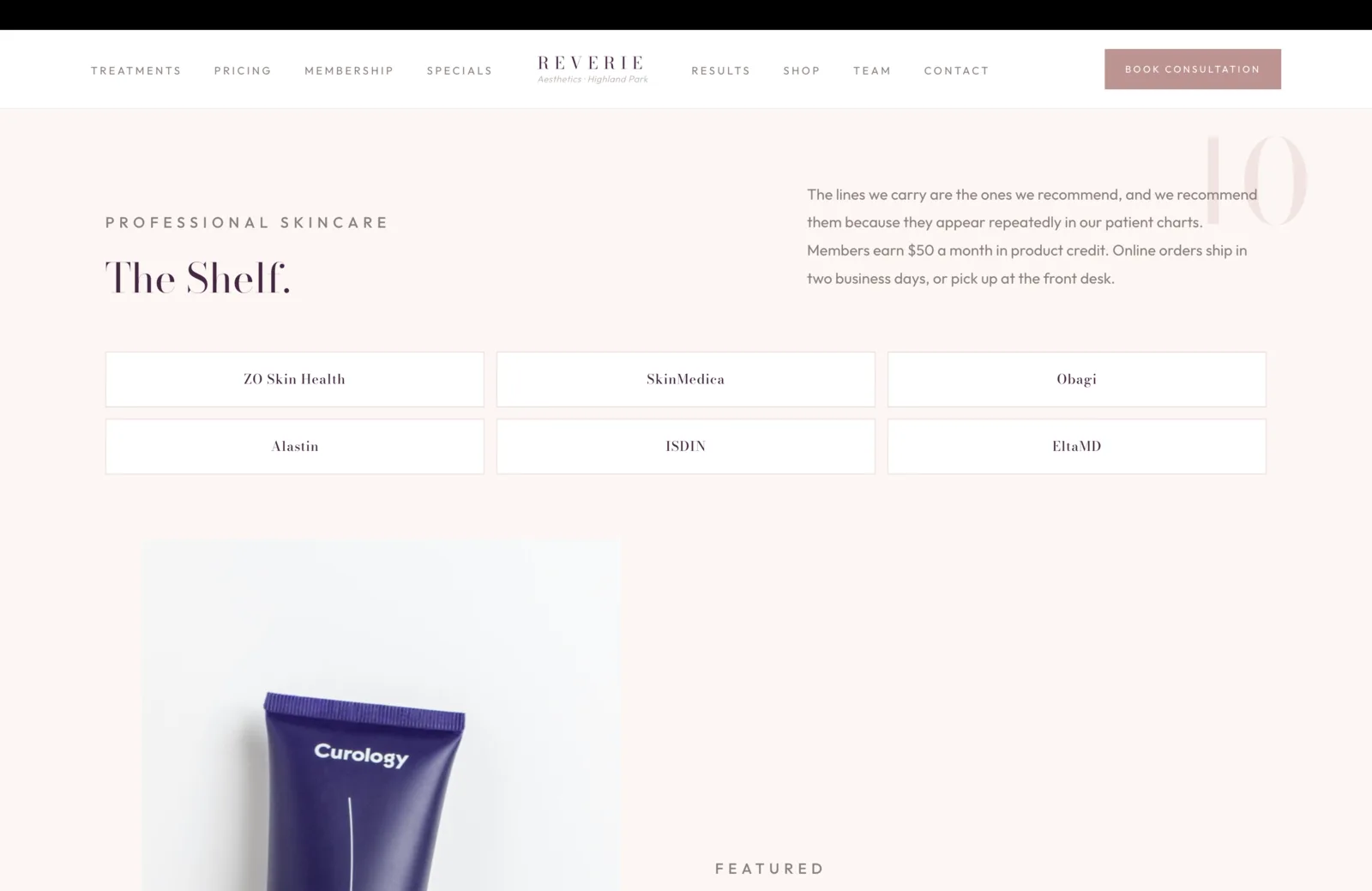
The skincare retail surface is the category's most-skipped revenue line. Most med spas treat retail as a separate concern, sometimes a separate brand entirely, and lose the patient who wanted to buy her ZO Skin Health regimen from the practice that recommended it. Reverie pulls retail back onto the same page with a single, calm grid of six professional brands.
The phrasing on the supporting paragraph is the operational commitment: "the lines we carry are the ones we recommend, and we recommend them because they appear repeatedly in our patient charts." That sentence is what separates a physician-curated shelf from a retail-driven one. The shelf is not a list of every brand the rep walked in last quarter. It is a list of six brands that show up on the chart of patients whose results led to other patients' bookings.
The brand selection itself is the credential. ZO Skin Health and SkinMedica are physician-only Texas standards, the regimens patients in Park Cities already recognize. Obagi adds the prescription-strength dermatology depth. Alastin and ISDIN cover post-procedure recovery and sun protection, the two categories where the wrong product wastes the in-clinic investment. EltaMD is the daily-sunscreen anchor that every dermatology practice in Texas carries because it is what the chart actually recommends. Six lines, no Curology-grade consumer brand, no Amazon-friendly fillers. Members get $50 a month in product credit toward any of them, online orders ship in two business days, in-clinic pickup is offered, and the same chart that drove the recommendation drives the regimen.
Safety Is the Quiet Part of the Work
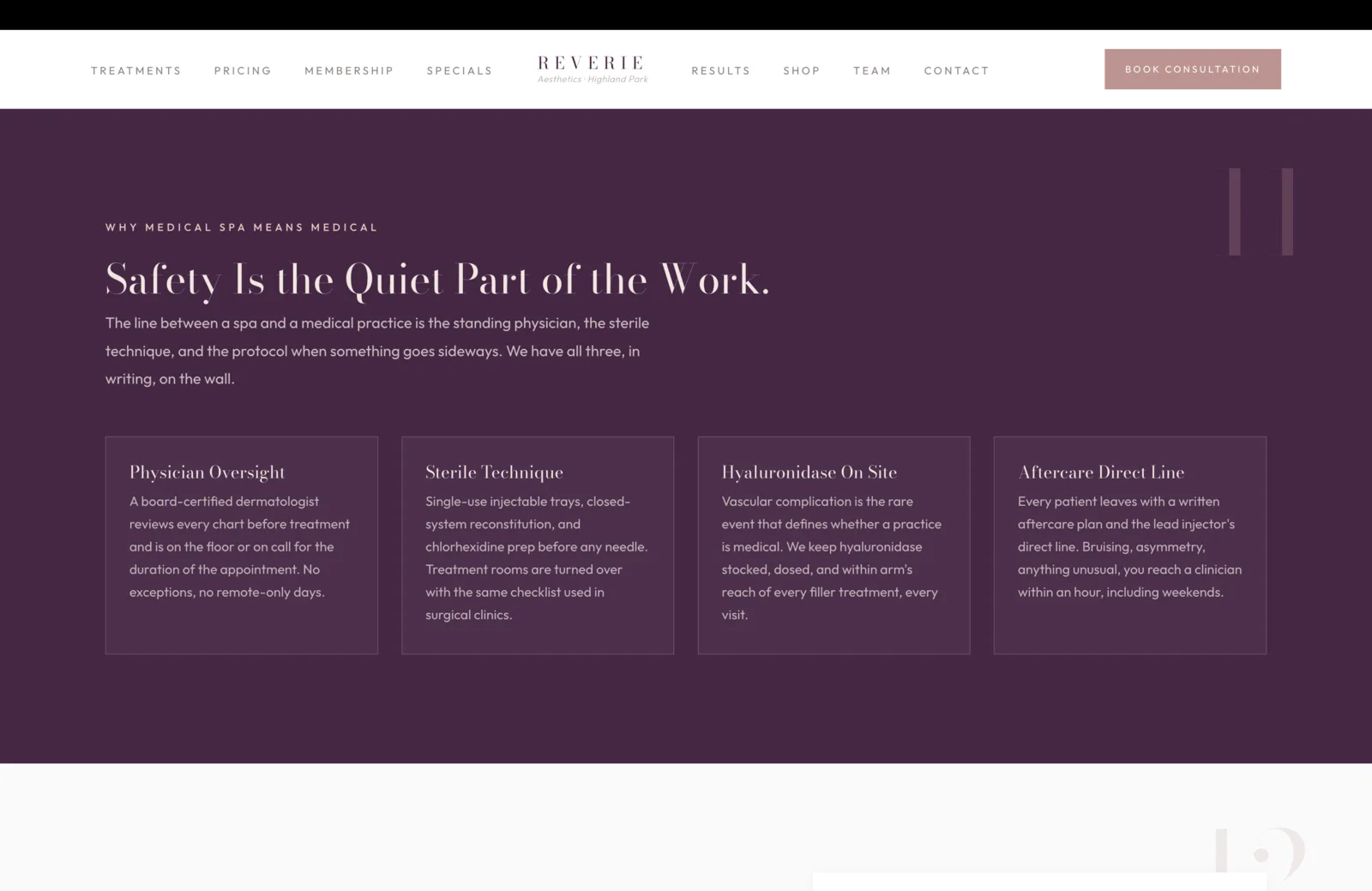
This section is what makes the rest of the page believable. A med spa that does not name physician oversight, sterile technique, hyaluronidase availability, and aftercare lines is selling injectables on the same architectural footing as a manicure. Reverie names all four, on a deep plum field that signals gravity in the page hierarchy, with copy specific enough that another medical-grade injector recognizes the language.
The four cards do four distinct jobs. Physician Oversight names the structural commitment ("on the floor or on call for the duration of the appointment, no exceptions, no remote-only days"), which is the line that distinguishes a real medical practice from a "physician-supervised" sticker. Sterile Technique names the surgical-clinic-grade protocol ("single-use injectable trays, closed-system reconstitution, chlorhexidine prep, the same checklist used in surgical clinics"), which is the language a former surgical nurse recognizes immediately. Hyaluronidase On Site names the rare-event preparedness that defines whether a filler complication ends in a clinic visit or an emergency room. Aftercare Direct Line names the post-procedure architecture: written aftercare plan, lead injector's direct line, one-hour clinician response including weekends.
The headline is the architectural argument. "Safety Is the Quiet Part of the Work." It is quiet because most patients will never need any of the four protocols. It is the work because the day a patient does need one of them, the practice's preparedness is the only thing that matters. A page that names the four out loud is signaling to the medical-savvy patient, the one who has read every Reddit thread about vascular occlusion, that this practice already had the conversation she was about to ask for.
Financing Disclosed Upfront
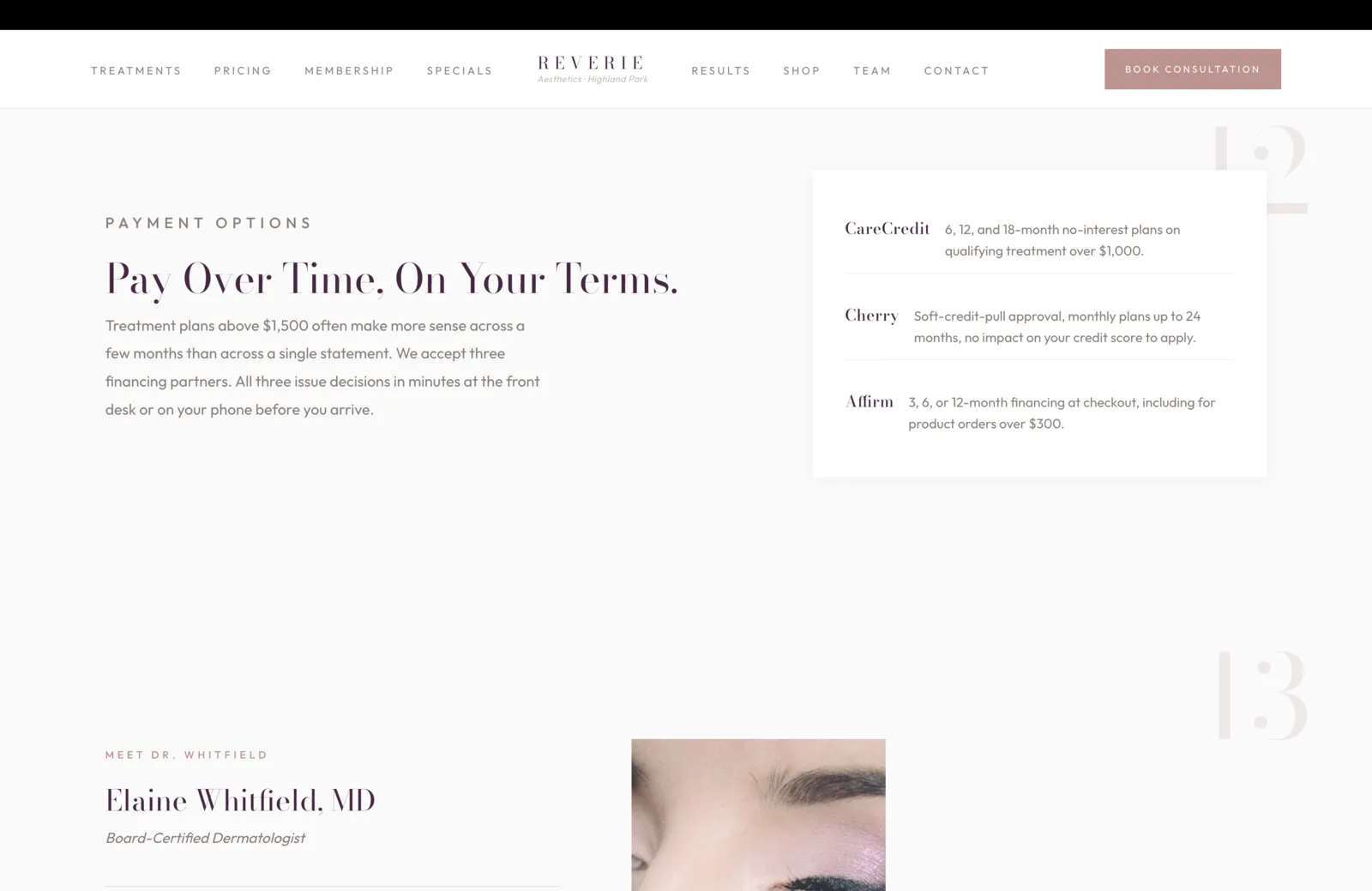
A $2,400 fractional CO2 series and a $3,200 Emsculpt Neo course are the moments a patient walks away from a practice she otherwise liked. Not because she cannot afford the work over time, but because the practice could not name how the work could be paid for over time without a sales pitch in the room. So the financing surface sits as its own destination, with three lenders named, each tied to a specific patient situation.
CareCredit is the larger-treatment-plan anchor: 6, 12, and 18-month no-interest plans on qualifying treatment over $1,000. Cherry is the soft-pull alternative for the patient who would rather not run a hard credit pull this quarter: monthly plans up to 24 months, no credit-score impact to apply. Affirm extends financing to retail orders over $300, which means the patient who is also buying a $400 ZO regimen from the Shelf can finance the regimen alongside the in-clinic treatment in one decision.
The supporting paragraph is the operational commitment that earns the section: "All three issue decisions in minutes at the front desk or on your phone before you arrive." That sentence converts because it removes the awkwardness from the conversation. A patient who knows her financing answer before she walks through the door is a patient who arrives ready to schedule, not ready to negotiate. The practice loses no leverage by publishing the names. It gains every patient who would otherwise have left the consultation room with an unspoken "I need to think about it" that meant "I cannot find a way to pay for this."
A 30-Minute Complimentary Consult
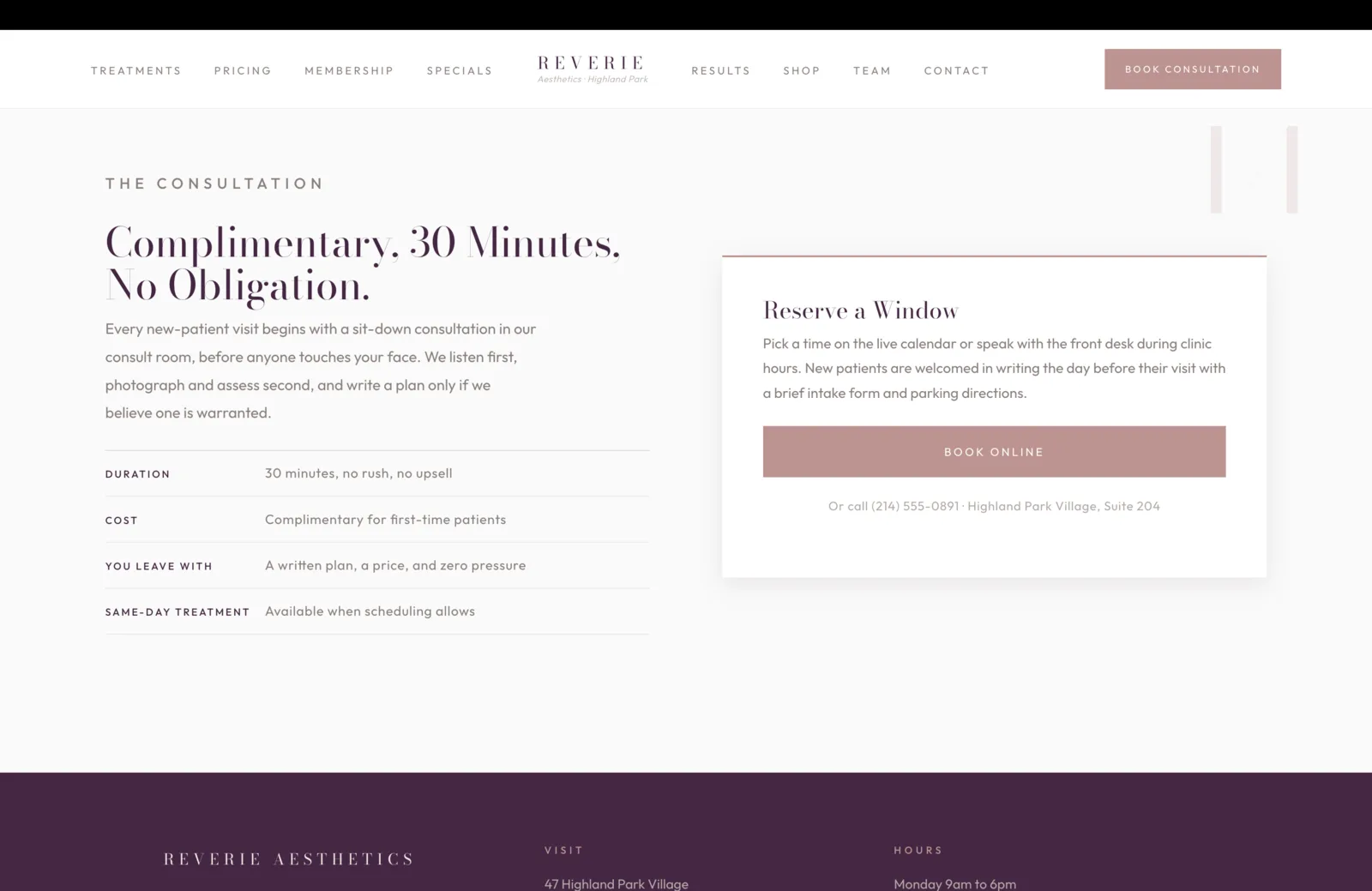
The consultation is the highest-converting surface on the entire site, and most med spas waste it on a contact form with seven required fields. Reverie treats the consultation as a destination with structural commitments rendered as a four-row table.
DURATION says "30 minutes, no rush, no upsell." That last microcopy commitment is the one that closes the patient who has been treated like a transaction at three other Dallas practices. COST says "complimentary for first-time patients," which is the right tier-defining choice (most practices either charge for consults at this price point and lose the researching patient, or undercharge for everything else and erode margin). YOU LEAVE WITH says "a written plan, a price, and zero pressure," which is the operational commitment the patient needs in writing before she walks in. SAME-DAY TREATMENT says "available when scheduling allows," which acknowledges that some patients want the treatment the same day and the practice can accommodate that without forcing it.
The Reserve a Window card on the right is the booking surface itself, with a live-calendar path, a front-desk path, and a written welcome the day before the visit. The patient is offered three operational doorways: book online, call the front desk, or wait for the day-before email with the intake form and parking directions. None of them is a CRM trap. The whole surface is the architectural rebuttal to the "schedule a consult to learn more" curtain that most med spas hide their entire practice behind.
License Numbers and the Medical Director
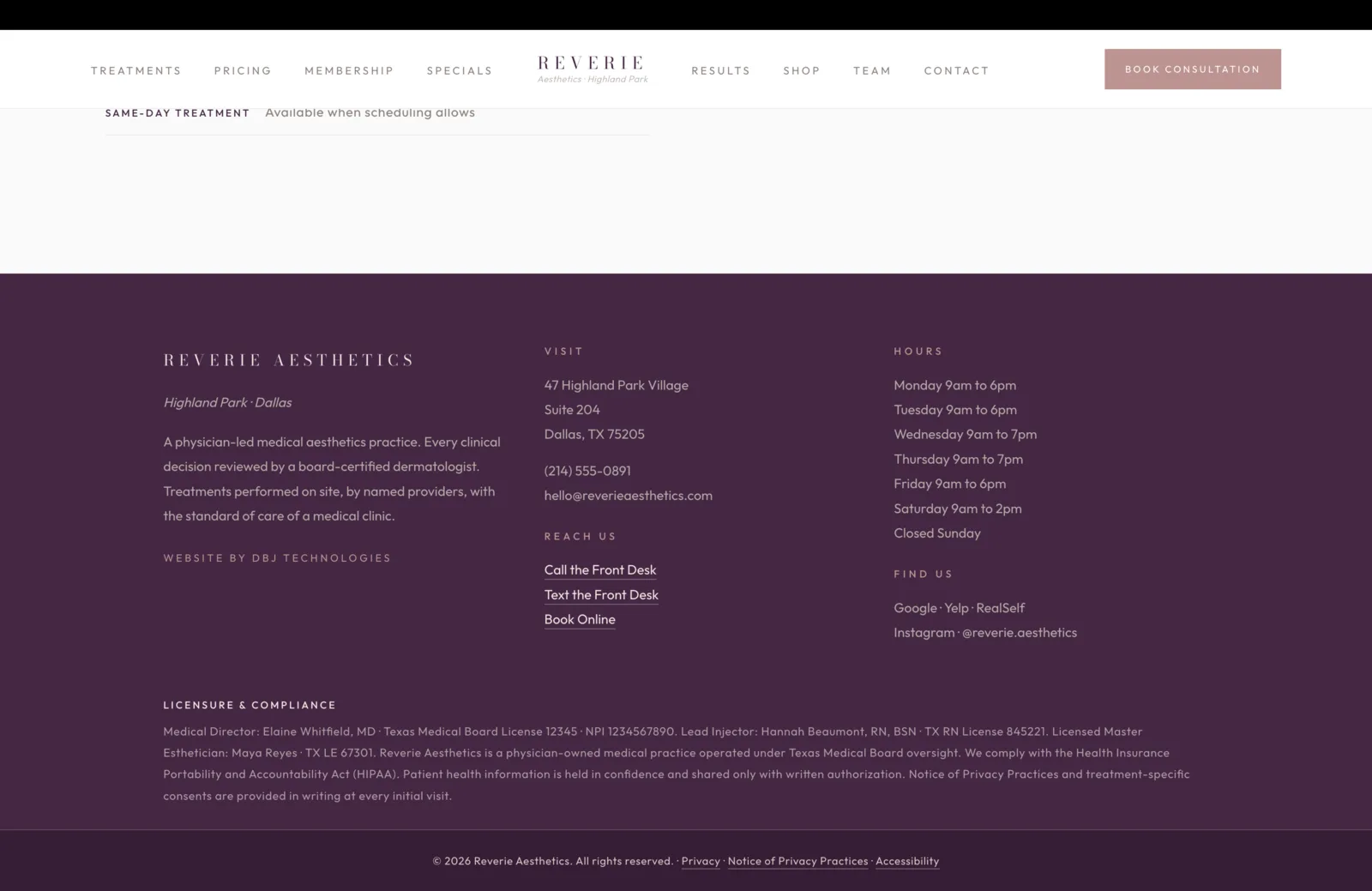
The footer is the regulator's surface and the patient's last reassurance. A med spa footer that does not list a Texas Medical Board license number, an NPI, an RN license number, an LE license number, and a HIPAA compliance line is a footer that has not earned the medical word in its name. Reverie publishes all five.
The Licensure and Compliance block is the surface most med spa sites refuse to spend the pixels on. Medical Director with name, MD credential, Texas Medical Board License number, and NPI. Lead Injector with name, RN credentials, and TX RN license number. Licensed Master Esthetician with name and TX LE license number. The line that runs after the credentials, "Reverie Aesthetics is a physician-owned medical practice operated under Texas Medical Board oversight, complies with HIPAA, patient health information held in confidence and shared only with written authorization, Notice of Privacy Practices and treatment-specific consents provided in writing at every initial visit," does the regulatory work that 90 percent of med spa footers omit entirely.
The three navigation columns above carry the operational footing. Visit names the address and the suite. Hours states the calendar including Sunday closed. Find Us names the four reputation surfaces (Google, Yelp, RealSelf, Instagram), which closes the loop on the platform reviews band higher up the page. The "Website by DBJ Technologies" credit sits quietly in the brand color, framed as a closing seal rather than a brag. This is what a Highland Park med spa running quietly at the top of the market looks like in its footer: comprehensive, calm, and unmistakably built by someone who has read the Texas Medical Board advertising rule, the HIPAA Privacy Notice requirements, and the WCAG accessibility statement in full.
Build It For Real
Want this architecture, executed for your practice?
I build the version of this that ships. Designed end to end, launched on production grade infrastructure, with the surfaces above tuned to your actual book of business.