Bishop Arts on a Tuesday Night
A Dallas diner on a Tuesday-night impulse will compare three Bishop Arts dining rooms and book one of them in eight minutes. The dining room she chooses is not the one with the cleanest photographs. It is the one that signals, in writing, that the chef is at the pass tonight. This brief proposes the ten surfaces that earn the reservation.
We Cook What the Season Gives Us
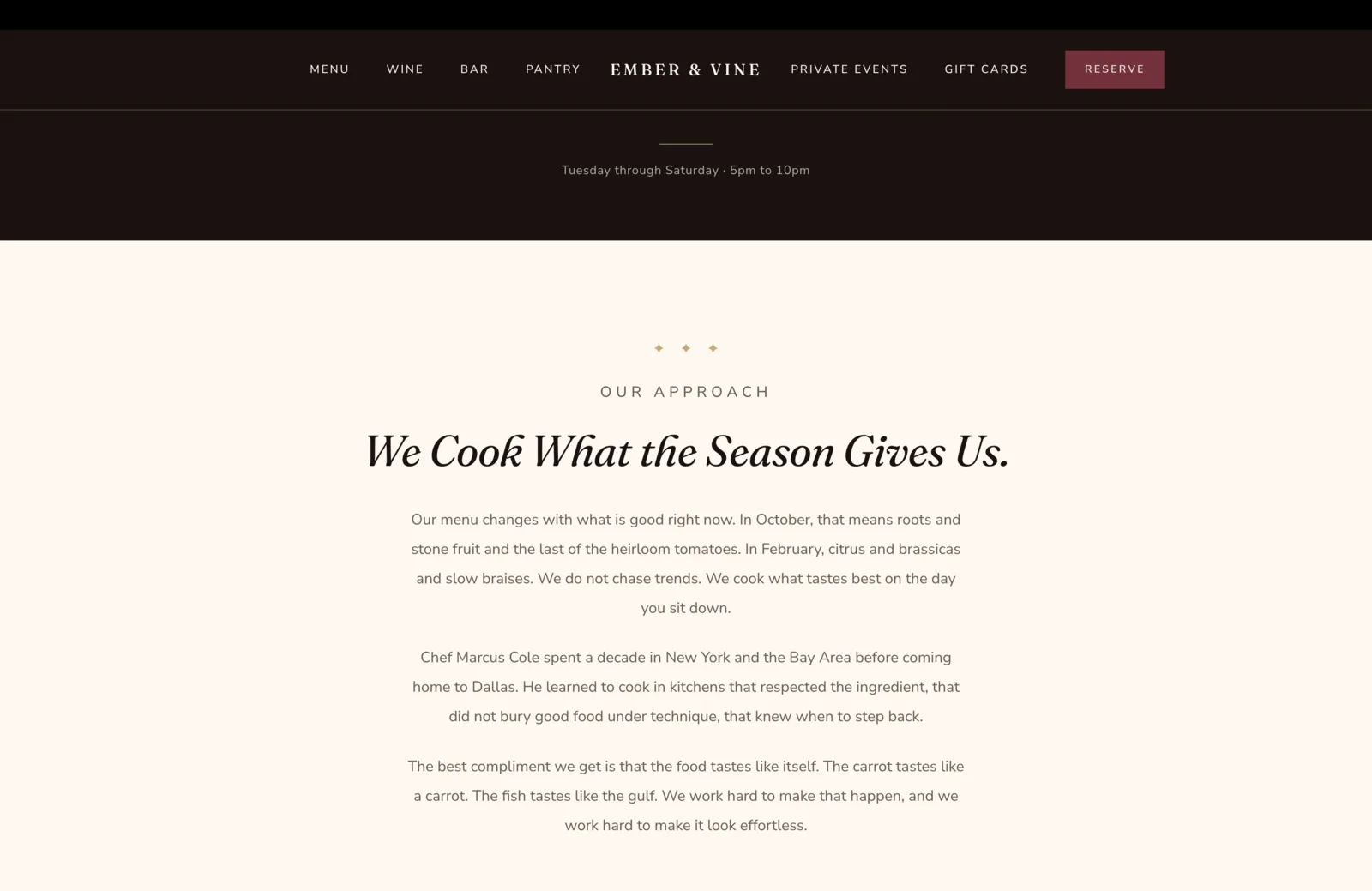
The first surface inside the page is not the menu. It is a quiet philosophical paragraph block on a calm cream field, set in a centered editorial column with the three-diamond ornament floating above it like a chapter break. That choice is unusual in the category, where most restaurant sites lead with a photo gallery or a reservation widget bolted to the next surface down. The serious diner on a Tuesday evening rewards the restaurant that signals confidence by leading with prose instead of bait.
The three paragraphs do three distinct jobs. The first names the menu's seasonality with two specific months and three specific ingredients ("October means roots and stone fruit and the last of the heirloom tomatoes; February citrus and brassicas and slow braises"), which converts because the diner has been burned by ten "seasonal menus" that meant a wedge salad with roasted beets year-round. The second paragraph names the chef's lineage with two specific cities (New York and the Bay Area) and a decade of training, which is the credential a Bishop Arts diner recognizes. The third paragraph commits to the brand's actual aesthetic standard: "the food tastes like itself," which is exactly what the kitchen is selling and exactly what the Mediterranean-American category usually fails at.
The closing line of the section is the architectural commitment that earns the rest of the page: "We work hard to make that happen, and we work hard to make it look effortless." That sentence is the brand voice in fifteen words. The restaurant is taking the work seriously without taking itself seriously. A diner who reads that line will book the table because she has been to too many restaurants that reverse the proportion.
A Named Chef Who Still Works the Pass
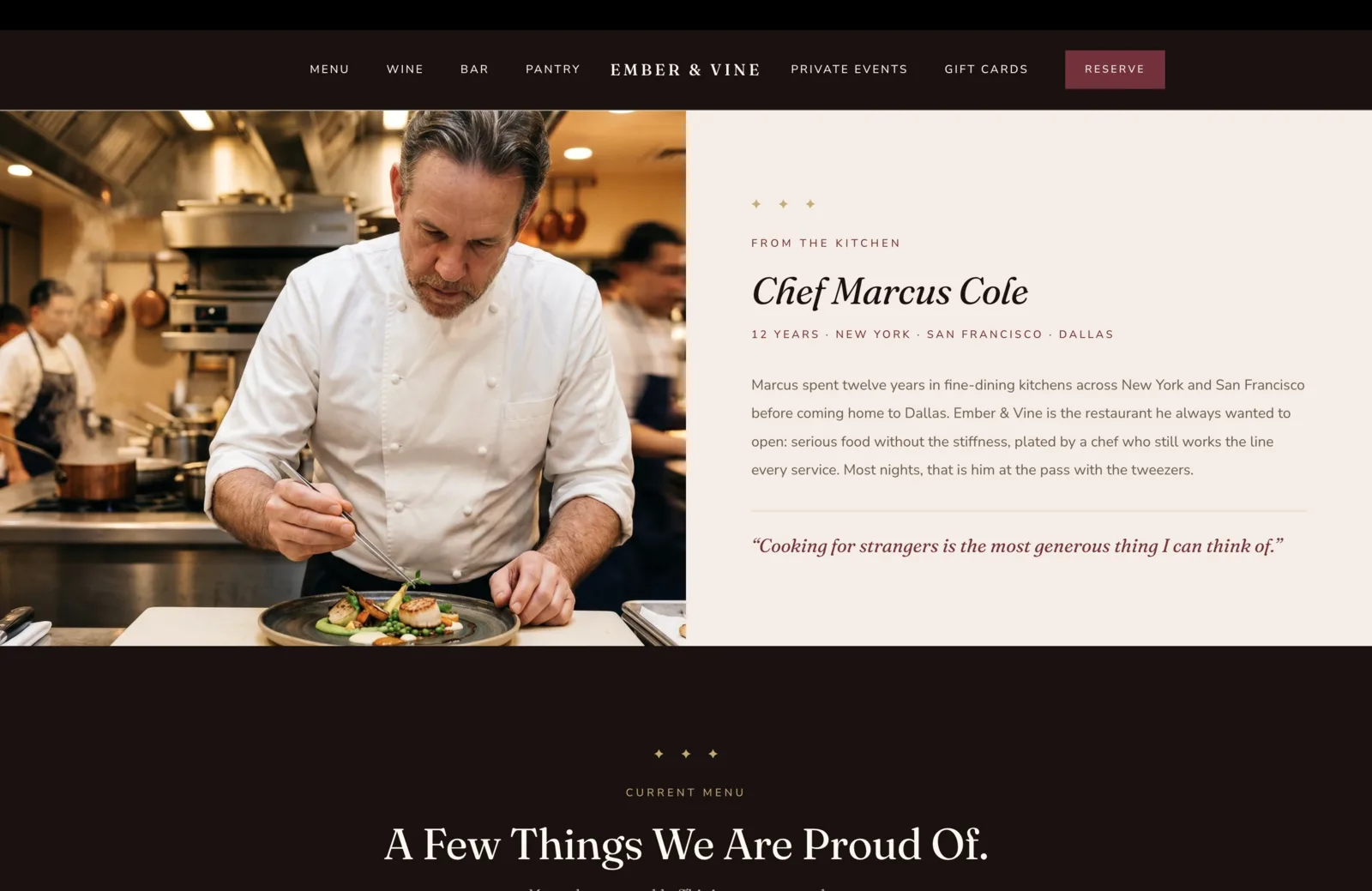
A diner at this price point is not booking a restaurant. She is booking a chef. So the chef section opens on a documentary photograph that earns the rest of the page: Marcus at the pass, plating with tweezers, in a real kitchen during a real service. Copper pans, steam, dark-aproned cooks in soft focus behind him. That photograph is the credential the next ten surfaces lean against, because every claim about seasonality and restraint becomes verifiable when the diner can see the person making it.
The bio paragraph is short, which is the right length. Twelve years. New York and San Francisco. Came home to Dallas. The restaurant he always wanted to open. The line that closes the paragraph, "Most nights, that is him at the pass with the tweezers," is the operational commitment that converts the diner. Most chef-driven restaurants in DFW are chef-named in the marketing and chef-absent on the floor. The diner who has had that experience reads the tweezers line and registers the difference.
The pull-quote underneath is the relational move. "Cooking for strangers is the most generous thing I can think of." That sentence is the brand voice rendered as a personal philosophy. It does not say good food, technique, market-fresh, farm-to-table, or any of the other phrases the category has worn smooth. It says cooking is a generous act, and the diner reads that and understands that the chef has thought about the table from the diner's side, not just the kitchen's side. That is the line that fills the second seating on a Wednesday night.
The Menu Published on the Page
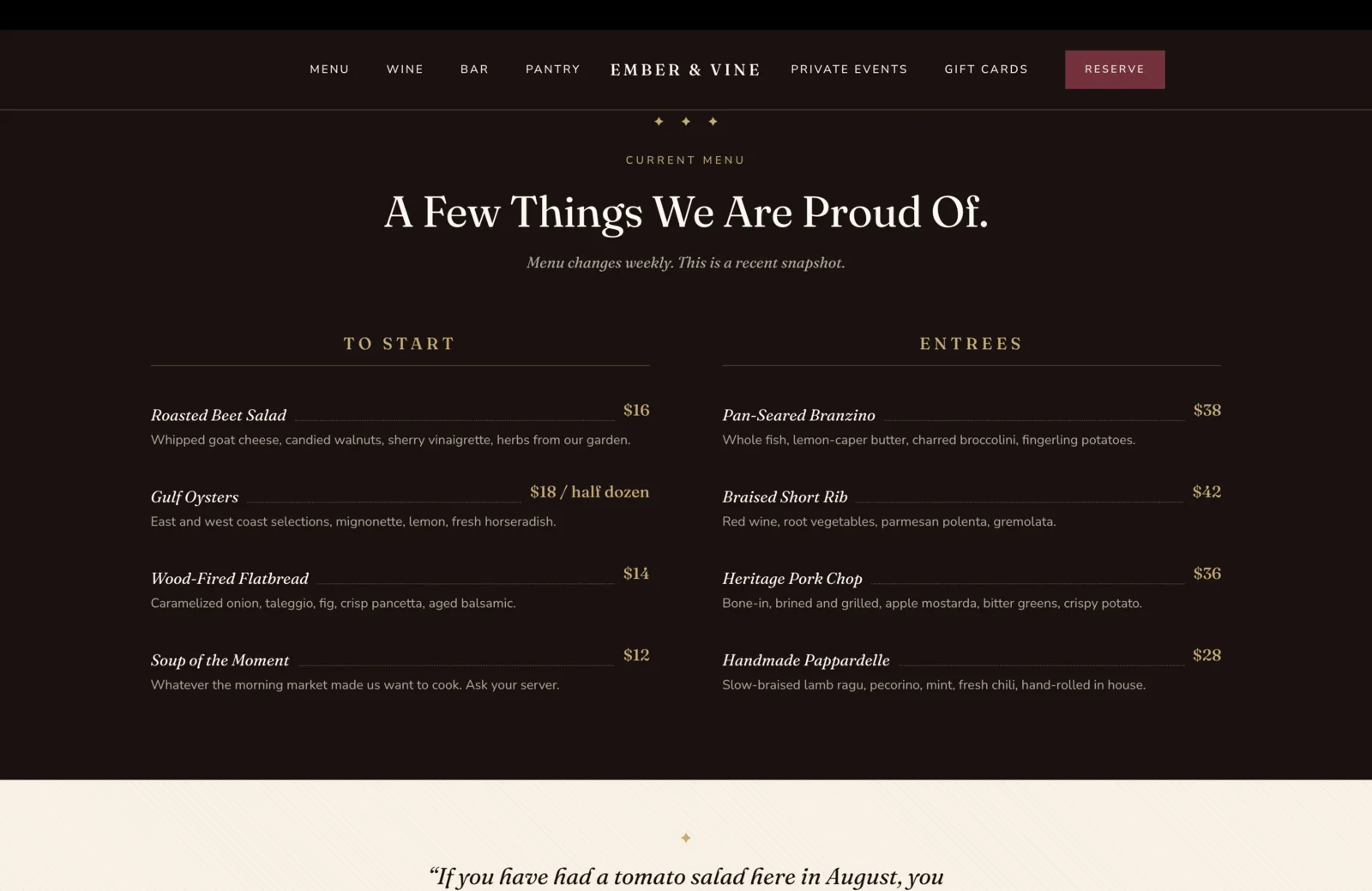
The menu lives on the page, not in a PDF. That single architectural choice separates the restaurant that books out from the restaurant that does not. A diner researching at 11pm on a Sunday cannot open a 2.4 megabyte PDF on her phone, and she will not call the restaurant to ask. She will close the tab and book the place that put the menu on the page.
The format is editorial, not transactional. Italic dish names, dotted leader lines to gold prices, calm pale descriptions in body copy. The pricing range is the section's unspoken positioning signal: starters $12 to $18, entrees $28 to $42. That range tells the diner exactly what room she is booking before she scrolls another pixel. The "Soup of the Moment, $12, whatever the morning market made us want to cook, ask your server" is the line that rewards the careful reader, because it admits the menu is alive and the kitchen is honest.
The section's most load-bearing piece of microcopy is the italic line beneath the headline: "Menu changes weekly. This is a recent snapshot." That sentence does the trust work. It commits to the idea that the menu shifts with the season without committing to the specific dishes shown, which means a diner who books this Saturday and finds the Heritage Pork Chop replaced by a different protein will read the swap as integrity rather than bait. The headline above, "A Few Things We Are Proud Of," is the right register: a chef who has cooked for twelve years across New York and San Francisco does not list a menu, he names what he is proud of right now.
A Bar Program Run Separately
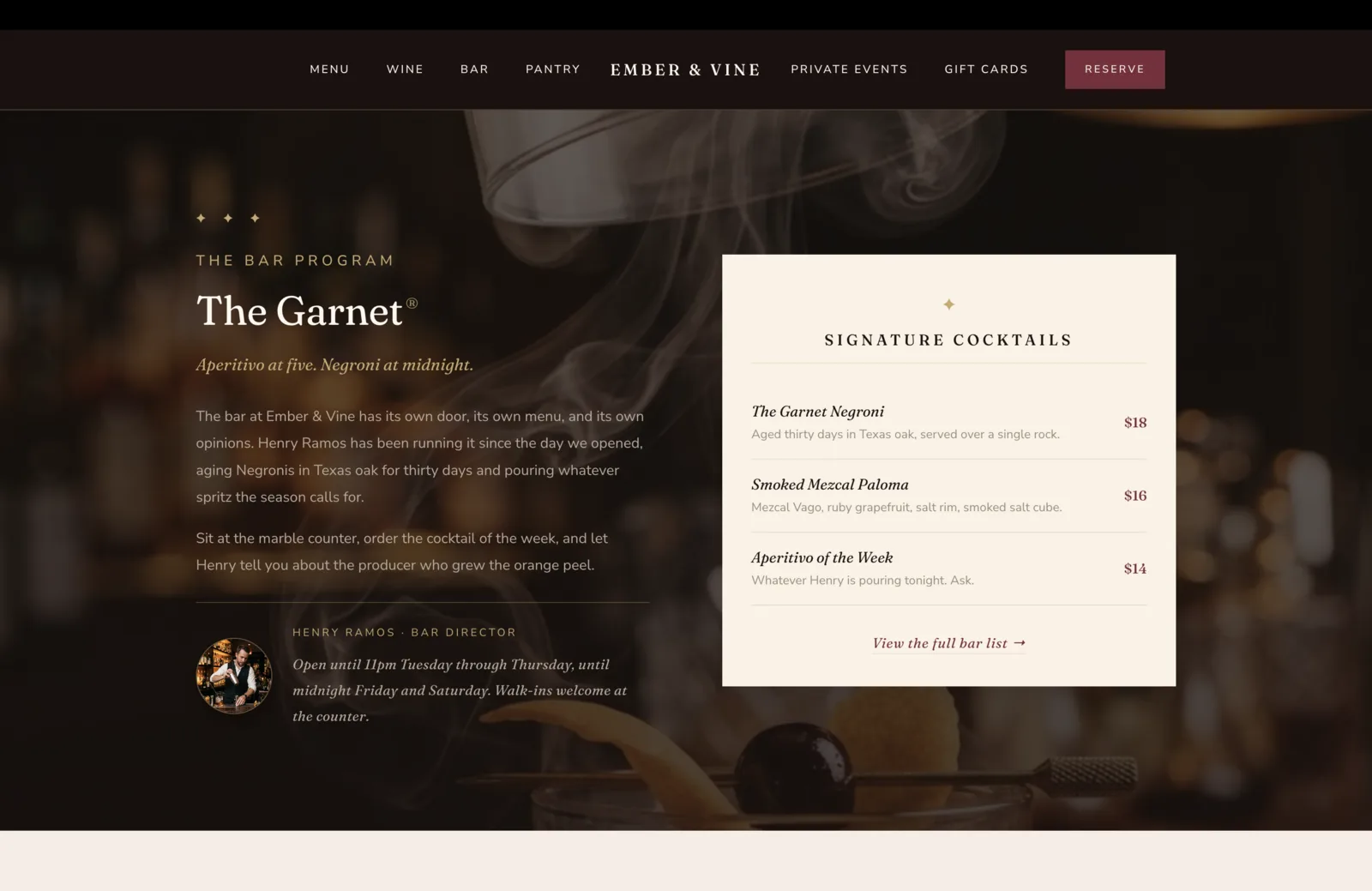
A bar program at an upscale restaurant in 2026 is not a side hustle. It is forty percent of the revenue most nights and the highest-margin line in the building. Most restaurant sites give the bar a single sentence and no menu. Ember & Vine gives The Garnet its own destination surface with a name, a director, a tagline, three signature cocktails with prices, and a hours commitment for late-service walk-ins.
The branding move is structural. The bar has its own name (The Garnet), its own door, its own menu, and a director who has been running it since opening. Henry Ramos is named, photographed, and quoted indirectly through the operational claim "aging Negronis in Texas oak for thirty days." That detail is what wins the cocktail-savvy diner who is comparing The Garnet against three other Bishop Arts bars on a Friday night. Aging a Negroni in Texas oak for thirty days is not a marketing line, it is a behind-the-bar commitment that takes thirty days to fulfill and cannot be faked.
The signature-cocktails card on the right is the operational tail. Three cocktails, three prices, three single-sentence descriptions that name the technique or the producer. The Garnet Negroni at $18 over a single rock is the brand drink. The Smoked Mezcal Paloma at $16 names the producer (Mezcal Vago) and the technique (smoked salt cube), which is the kind of detail the regulars share with friends. The Aperitivo of the Week at $14, "whatever Henry is pouring tonight, ask," is the conversational hook that turns the bar into a relationship rather than a menu.
Sixty Bottles, Half by the Glass
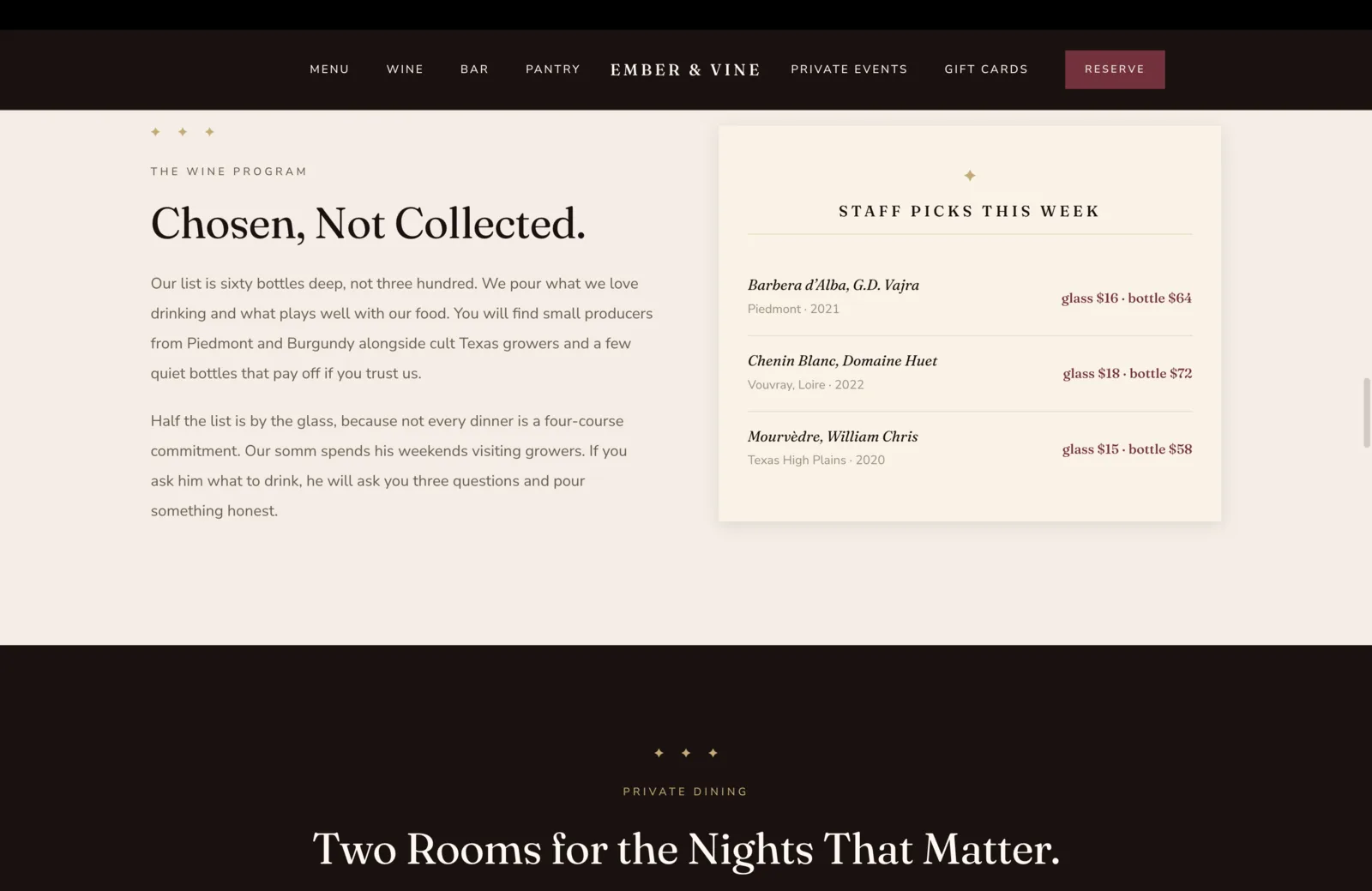
A 300-bottle wine list at a 60-seat restaurant is a marketing decision. A 60-bottle list is an editorial one. Ember & Vine names the depth of its list out loud, frames the curation as restraint, and earns the headline ("Chosen, Not Collected") with a paragraph that explains how the curation actually happens. "Our somm spends his weekends visiting growers" is the line that wins the wine-savvy diner who has read the same ten Robb Report wine-list reviews and is looking for the practice underneath.
The half-by-the-glass commitment is the operational truth that separates a serious restaurant wine program from a sommelier's vanity project. Most upscale restaurants pour eight wines by the glass and 290 by the bottle, which means a Tuesday-night two-top has to commit to a $90 bottle they will not finish. Ember & Vine pours thirty by the glass, which means a diner can drink alongside the food the chef just served without the bottle math.
The Staff Picks card on the right is the architectural credential. Three rows, three regions, three producers a wine drinker recognizes and a fourth she is about to learn. Barbera d'Alba from Vajra is the Piedmont anchor every serious list carries. Domaine Huet's Chenin Blanc from Vouvray is the Loire by-the-glass that pairs with everything the kitchen sends out. The Mourvèdre from William Chris on the Texas High Plains is the cult Texas pour the section's headline promised, and listing it next to a Burgundy is the architectural statement that seals the curation. A diner reads three rows and understands that the somm is honest, regional, and unpretentious.
Two Rooms for the Nights That Matter
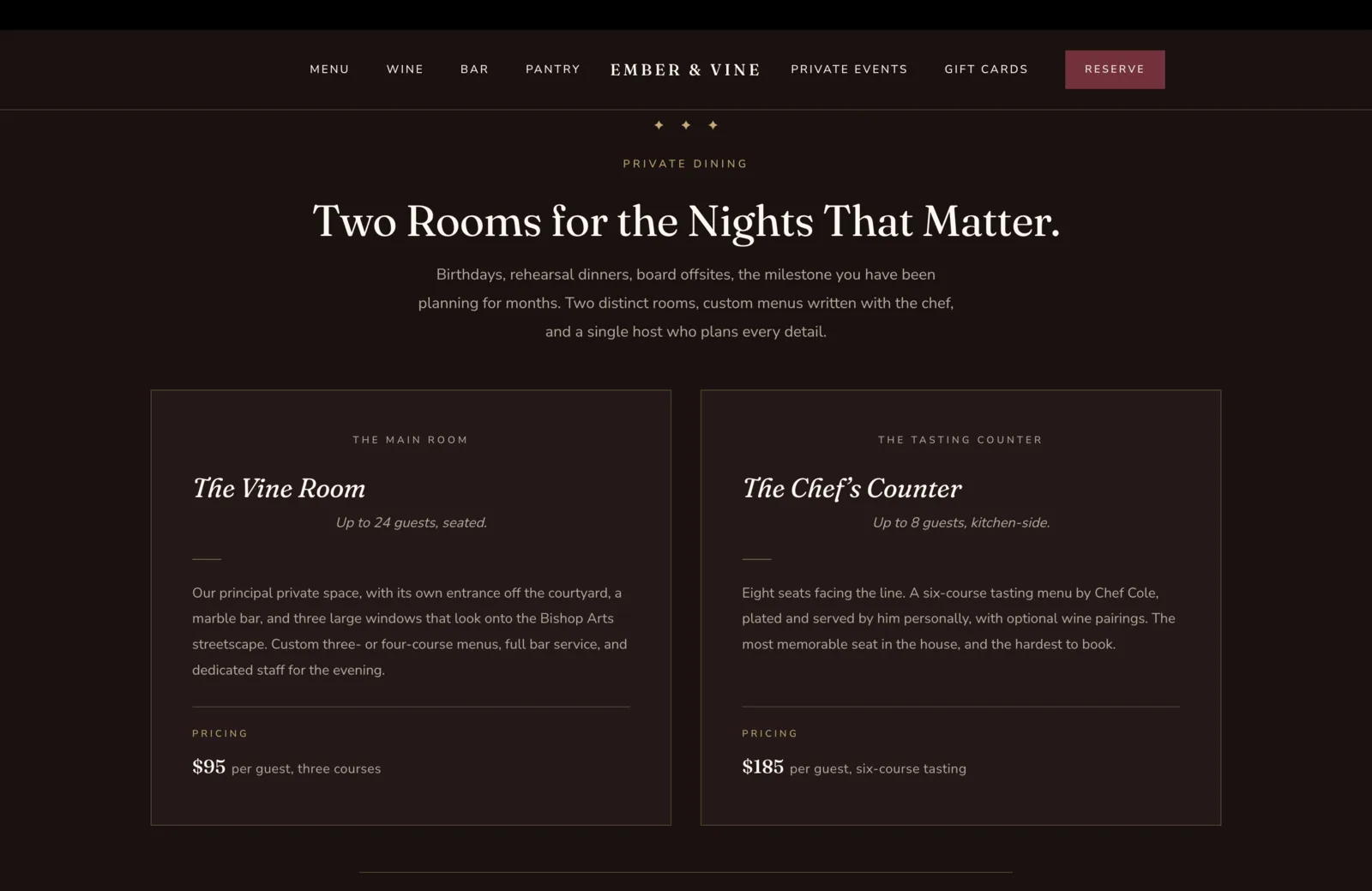
Private dining is the highest-margin line in an upscale restaurant building, and most restaurant sites hide it behind a contact form with no room dimensions, no per-guest pricing, and no named host. Ember & Vine publishes both rooms on the same page as the menu, with capacity, scope, and price visible without a click.
The two-tier structure is the architectural choice that earns the section. The Vine Room at $95 per guest for three courses is the *milestone* room: birthdays, rehearsal dinners, board offsites, the kind of event the planner has been working on for months. Twenty-four seats, courtyard entrance, marble bar, three windows onto the Bishop Arts streetscape. The Chef's Counter at $185 per guest for six courses is the *intimate* room: eight seats facing the line, a tasting menu by Cole personally, plated and served by him. Two rooms, two price points, two operational shapes. A planner reading this section can pick the right room in twelve seconds and forward the link to her boss.
The closing line on the Chef's Counter, "the most memorable seat in the house, and the hardest to book," is the editorial line that earns the $185 tier. It admits to scarcity without bragging about it, and it converts the planner who is choosing between this and four other tasting menus on the Bishop Arts circuit. The pricing is named, not "starting at," because at this tier the planner needs the number on the page to fit the budget conversation she is already having with her CFO.
A GM With a Direct Line
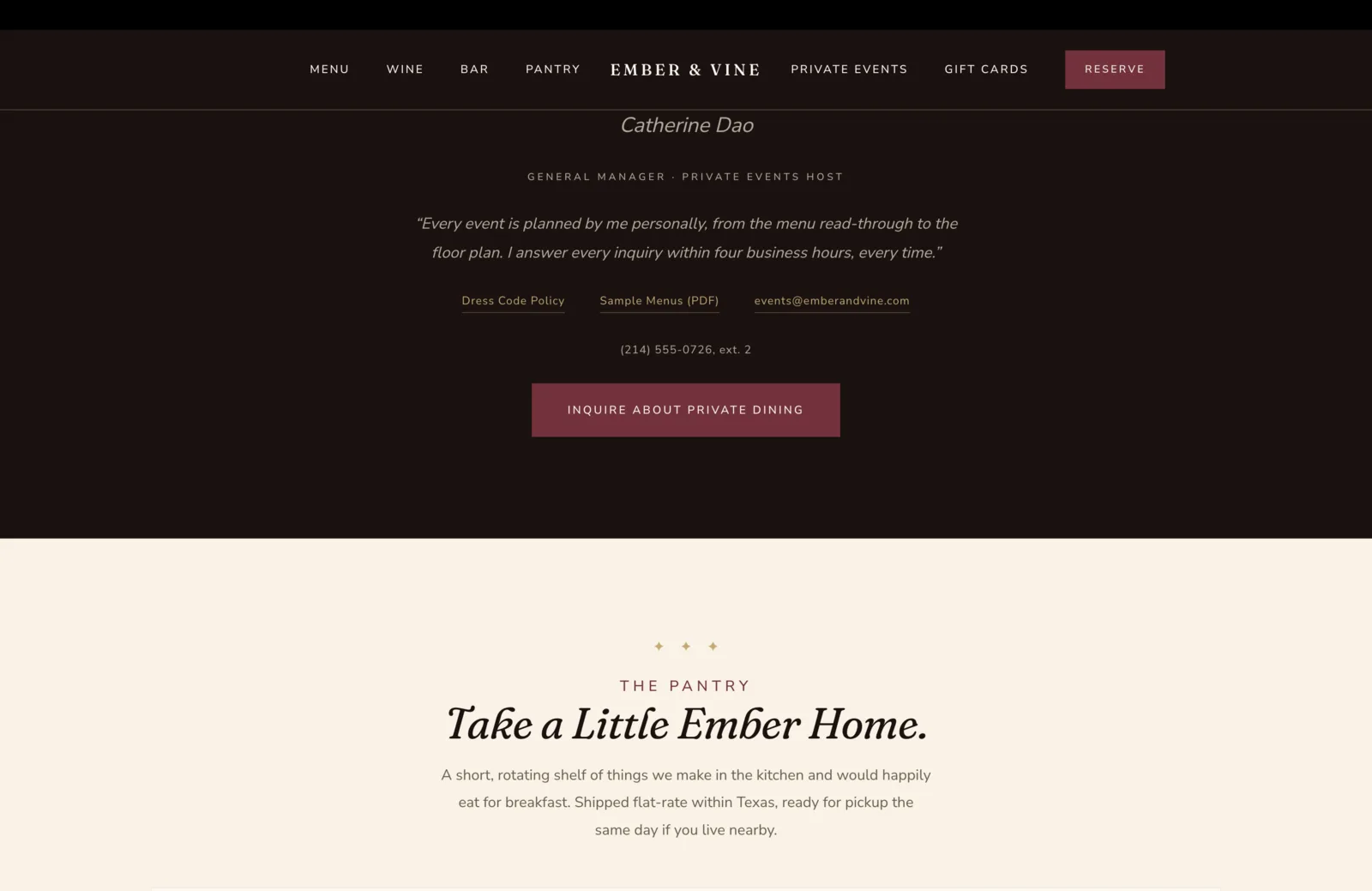
The private events conversion happens at the host, not at the form. So the section names her, photographs her elsewhere, and quotes her directly: Catherine Dao, General Manager, Private Events Host. The pull-quote does the operational commitment in two sentences: "Every event is planned by me personally, from the menu read-through to the floor plan. I answer every inquiry within four business hours, every time." That second sentence is the line a planner remembers, because every other restaurant she has inquired with has ghosted her for a week.
The three quick-links row is the architectural detail that closes the planner. Dress Code Policy, Sample Menus PDF, and the dedicated events email at the firm's domain. The dress code link is the question every planner has and never gets answered. The sample menus PDF is the artifact she needs to forward to her boss. The dedicated events email is the routing that promises her inquiry will not land in a generic info inbox. Three links, three closed loops. The phone extension below ("(214) 555-0726, ext. 2") is the operational seal: a real ext-2 means a real desk in the building.
The bottom edge of the section opens The Pantry surface, which is the kitchen's direct-to-consumer revenue line. "A short, rotating shelf of things we make in the kitchen and would happily eat for breakfast. Shipped flat-rate within Texas, ready for pickup the same day if you live nearby." That sentence does two things at once. It commits to a small, edited shelf rather than a sprawling product line, which protects the brand from looking like a gift shop. And it closes the local-pickup loop that turns the regulars into shippers and the shippers into regulars. The Pantry section that follows below carries the actual products, gift cards card, and a closing line about the cookbook being back in stock.
Press Coverage With Dates
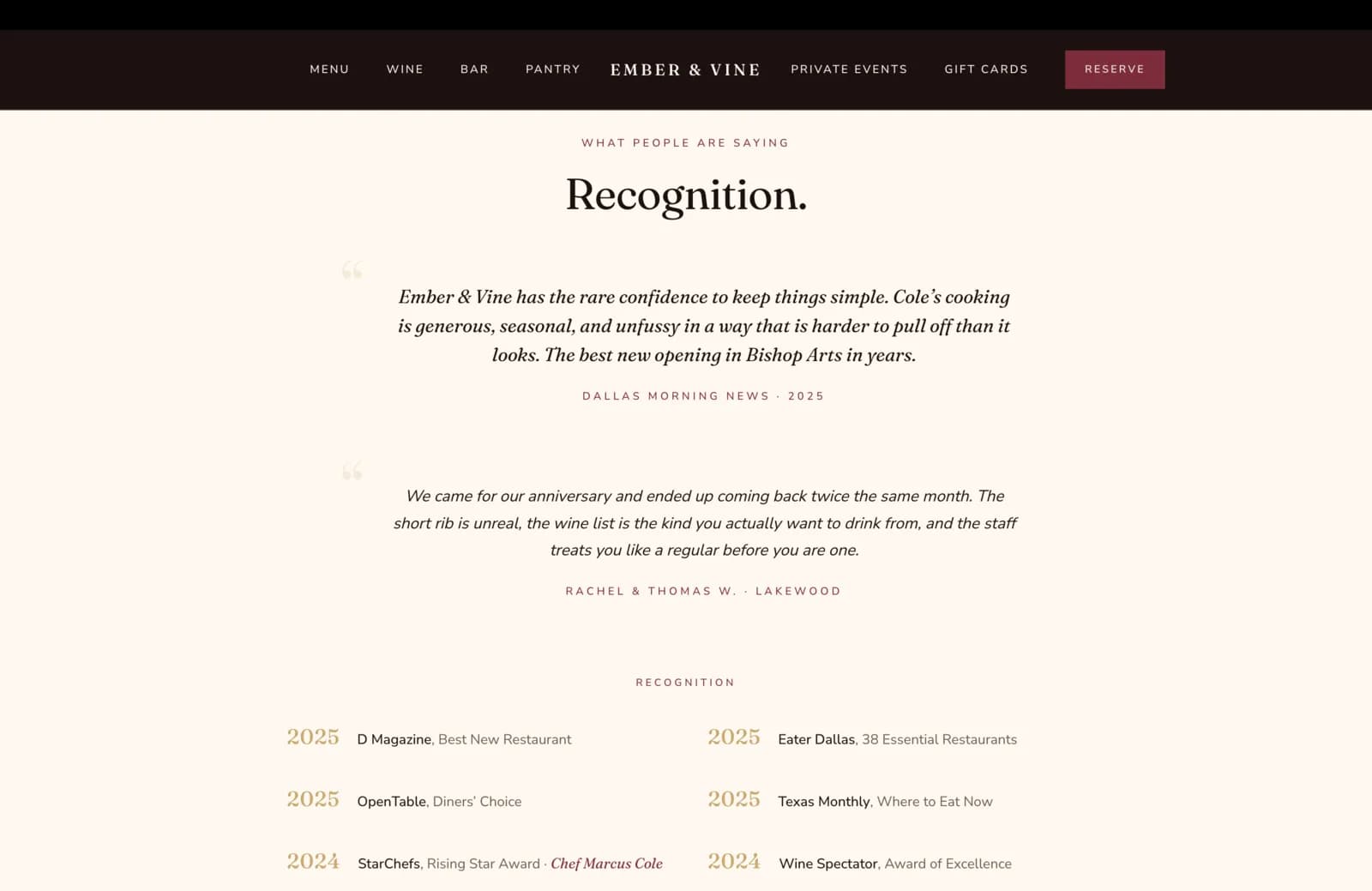
Press placements without a year are noise. A 2017 mention in Eater reads exactly the same as a 2025 one if the dates are not visible, and the diner who has been pitched on every Bishop Arts opening for a decade has learned to discount undated claims entirely. So every press mark on this surface is dated, and every honor is dated.
The two-quote pairing above the awards block is the section's editorial move. The first quote is from the publication of record (Dallas Morning News, 2025) and names the brand's structural commitment ("rare confidence to keep things simple"). The second quote is from a real guest household (Rachel and Thomas W., Lakewood) and names a specific dish (the short rib) and a specific behavior ("the staff treats you like a regular before you are one"). Critic plus customer in two stacked quotes converts harder than ten of either alone, because the diner reads both registers and can see the brand promise verified from two directions.
The awards grid below earns its weight by being current and dense. Six awards across 2024 and 2025, with the publication and the recognition named. D Magazine Best New Restaurant. Eater Dallas 38 Essential. OpenTable Diners' Choice. Texas Monthly Where to Eat Now. StarChefs Rising Star to Chef Cole personally. Wine Spectator Award of Excellence. The last two are the ones that distinguish the kitchen from the dining room: StarChefs names the chef as the person earning the award, and Wine Spectator validates the wine program section higher up the page. The structure is the architecture of the entire site rendered in six lines.
Reservations Recommended, Walk-Ins at the Bar
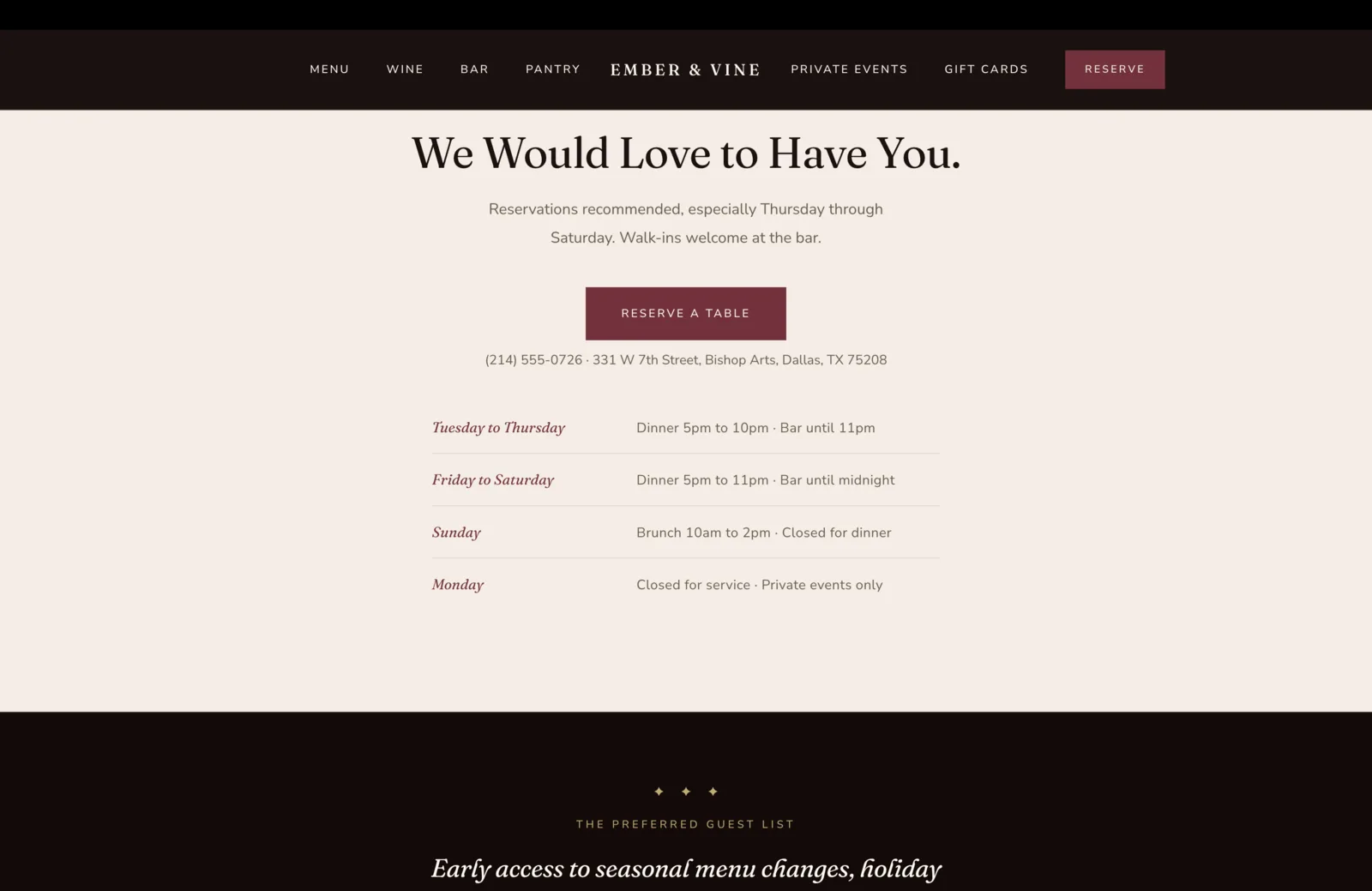
The reservation surface is calm because the rest of the page has done the work. By the time a diner reaches this section she has already read the philosophy, met the chef, scanned the menu, considered the bar, evaluated the wine list, weighed the private dining options, met the GM, and verified the recognition. The Reserve a Table button at the center of this section is the close, and the close does not need a sales pitch.
The hours table beneath the button is the operational commitment that distinguishes this restaurant from the next one. Four rows, each annotated with the dinner window AND the bar window, because the diner choosing between this restaurant and a competitor often makes the choice on whether the bar is open after dinner service. Tuesday to Thursday, dinner 5pm to 10pm, bar until 11pm. Friday to Saturday, dinner 5pm to 11pm, bar until midnight. Sunday, brunch 10am to 2pm, closed for dinner. Monday, closed for service, private events only. The format annotations turn a generic hours table into an operational truth: a diner planning a 10:30pm drink after a play knows from the table whether to come.
The "Walk-ins welcome at the bar" admission in the subhead is the structural permission slip that makes the section work. Most upscale restaurant sites refuse to admit they take walk-ins because they think it cheapens the reservation. The opposite is true. A diner who reads "walk-ins welcome at the bar" registers the restaurant as a real place she can show up at, which makes the reservation she ends up making feel like a privilege rather than a gate. The brand earns the reservation by admitting it can be skipped.
The Preferred Guest List
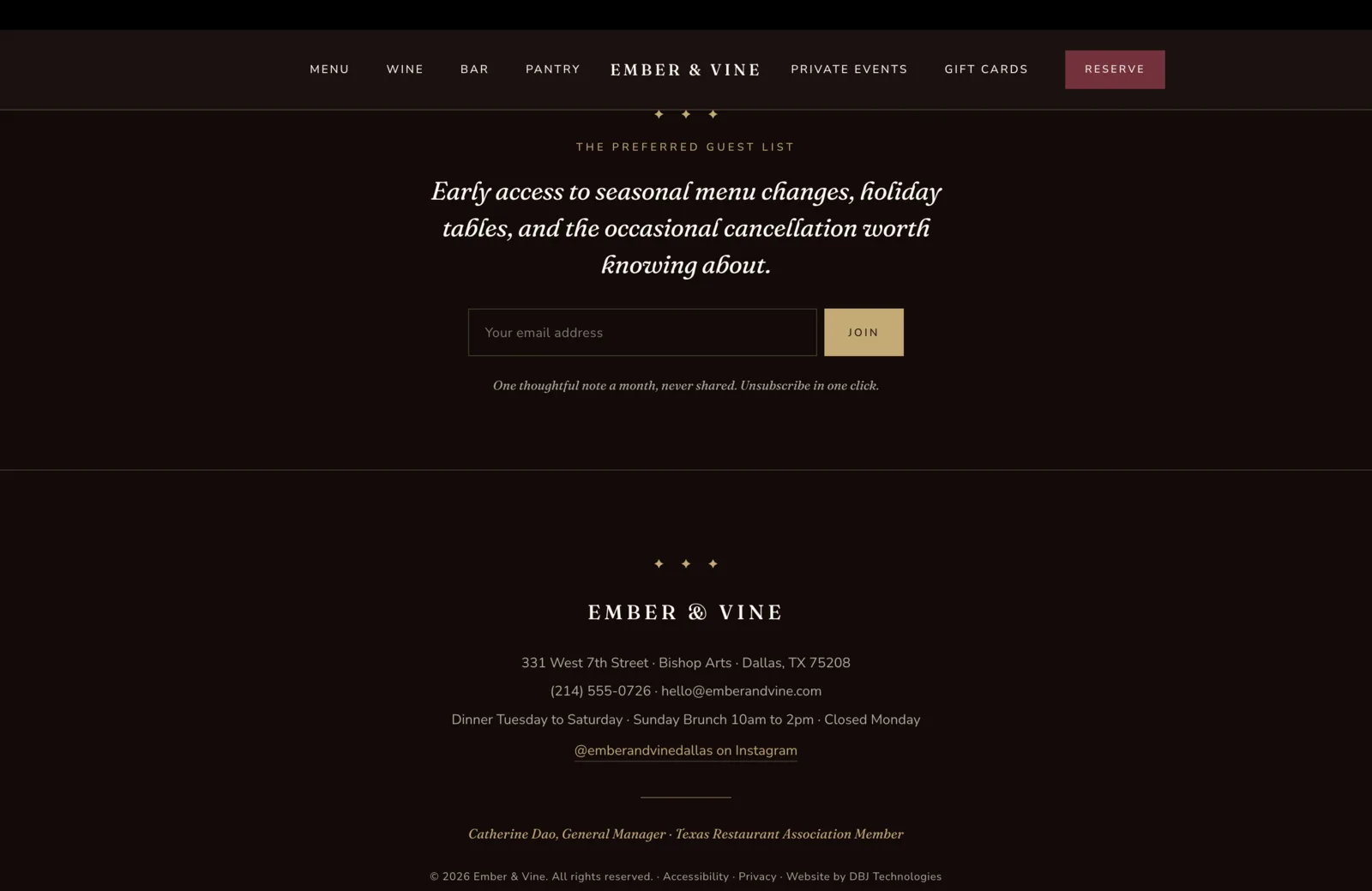
A restaurant email list is the most-abused list category in hospitality. The default flow is "Sign Up for 10% Off," weekly emails about specials, and an unsubscribe form that hides behind a customer service ticket. Ember & Vine treats the email surface as a privilege list, not a marketing list, and the copy earns it.
The headline does the conversion in one sentence: "Early access to seasonal menu changes, holiday tables, and the occasional cancellation worth knowing about." Three specific value claims, each one calibrated for the regular who is about to give her email. Seasonal menu changes is the editorial reward; holiday tables is the operational reward; the "occasional cancellation worth knowing about" is the insider reward that makes the list feel like an actual list. The microcopy beneath, "One thoughtful note a month, never shared. Unsubscribe in one click," is the structural commitment that closes the regular who has been spammed by every restaurant CRM in DFW.
The footer that follows is short on purpose. Wordmark, address, phone and email, hours summary, Instagram handle, GM credit, and the trade association membership. The italic line "Catherine Dao, General Manager, Texas Restaurant Association Member" is the closing seal: the GM is named once at the top of the events section and again here at the bottom, which means the regular ends the page with the same name she started the inquiry with. The "Website by DBJ Technologies" credit sits quietly in the bottom strip, framed as a closing seal rather than a brag. This is what a Bishop Arts chef-driven restaurant running quietly at the top of the Dallas market looks like in its footer: comprehensive, calm, and unmistakably hospitable down to the typography.
Build It For Real
Want this architecture, executed for your practice?
I build the version of this that ships. Designed end to end, launched on production grade infrastructure, with the surfaces above tuned to your actual book of business.