Twenty Years of Studying Park Cities Setbacks
A Highland Park or Preston Hollow buyer reviews a custom home builder across a six-to-eighteen-month commission cycle. The credential that wins them is not the count of houses built. It is the years spent reading the same lots, the same alley access, the same setback patterns, the same architects. This brief proposes the seven surfaces a Park Cities builder needs to earn the contract.
The Face Before the Brand Mark
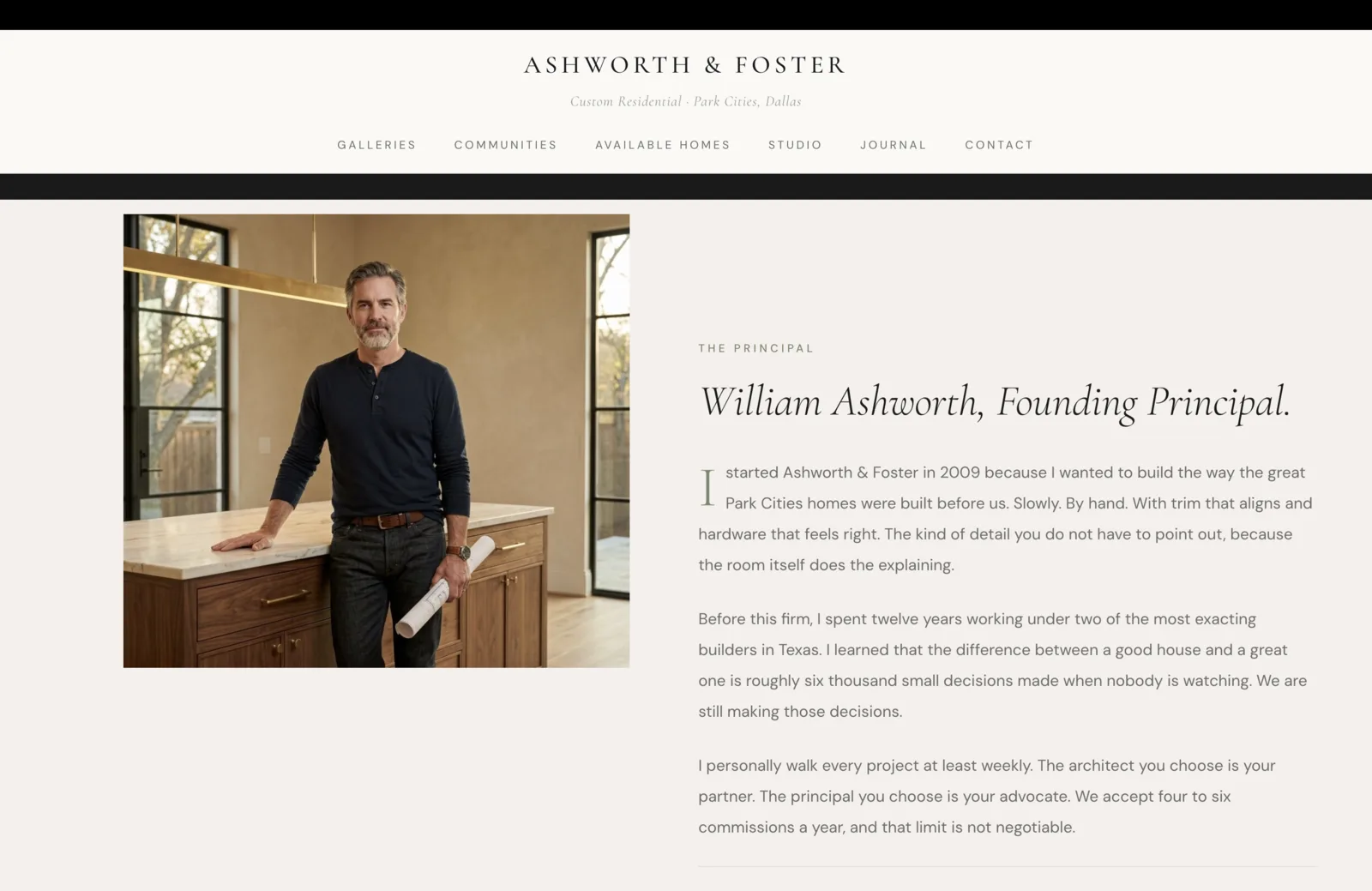
A buyer at the four-million-dollar commission level is not hiring a brand. They are hiring a person, and they want to know who that person is before they read a single project page. So the first surface inside the site is a face, a name, and a signed letter from the founder. The brand mark sits quietly above. The principal sits below it.
The portrait is intentional. A working kitchen at completion, marble island and walnut cabinetry, a brass linear chandelier, plaster walls in a warm umber, late-afternoon light through tall steel-framed windows. William stands with rolled blueprints in hand, dark henley and denim, the posture of a builder who walked the room ten minutes ago, not a CEO posed for an annual report. Everything in the frame is the work the buyer is hiring him to do.
The letter is first-person, signed, and concrete. It commits to the slow, hand-built way the great Park Cities homes were built before us. It admits to twelve years of apprenticeship under exacting builders. It names the difference between a good house and a great one as roughly six thousand small decisions made when nobody is watching. And it closes on the line that does the most work on the page: "We accept four to six commissions a year, and that limit is not negotiable." That sentence is the architecture of the entire practice in nineteen words. Selectivity, not solicitation, is the position a builder takes at this tier.
The Neighborhoods Named One by One
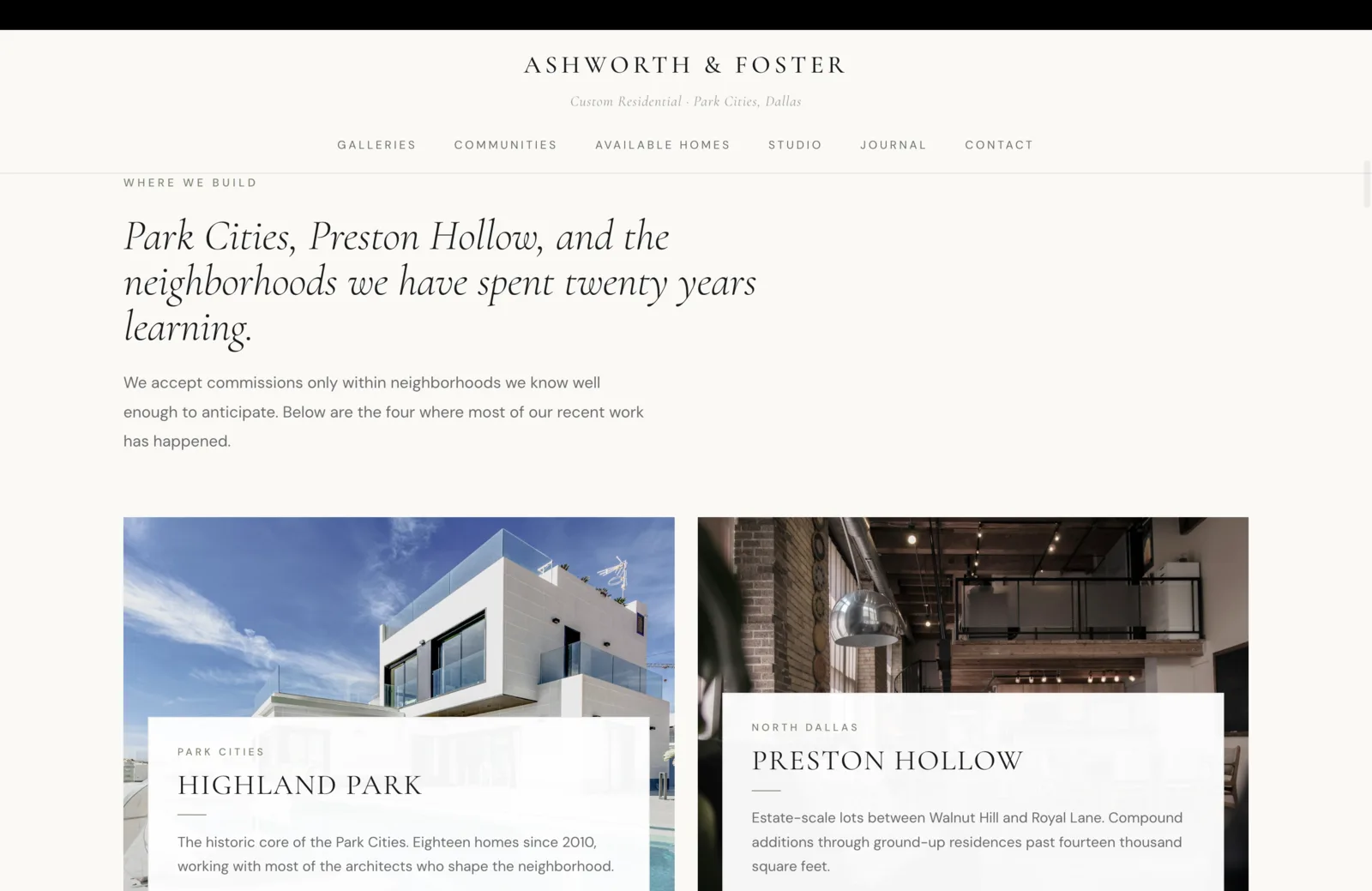
Most builder sites carry a "Service Area" page that lists every suburb in the metroplex, because someone in marketing decided that wider coverage equals more leads. At the custom tier this approach actively repels the buyer. Highland Park feels nothing like Bluffview feels nothing like Volk Estates, and a buyer in any one of those neighborhoods reads a service-area dragnet as a builder who does not know any of them well.
So I replaced the service-area page with a Communities surface that names the four neighborhoods where most of the work has happened, gives each one its own card, and credits each with a short editorial note. Park Cities, Highland Park: the historic core, eighteen homes since 2010, working with most of the architects who shape the neighborhood. North Dallas, Preston Hollow: estate-scale lots between Walnut Hill and Royal Lane, compound additions through ground-up residences past fourteen thousand square feet. The other two cards continue the same form, each grounded in a real number and a real geography.
The italic serif headline frames the surface honestly: twenty years of learning the neighborhoods, not twenty years of working in them. A buyer who has lived on Beverly Drive for a decade reads that line and understands that the builder talking to them has been studying the same lots, the same setbacks, the same alley access patterns, the same architects, for the same length of time. That is the credential that matters in the Park Cities. It is the credential a service-area page actively obscures.
Projects Organized by Residence
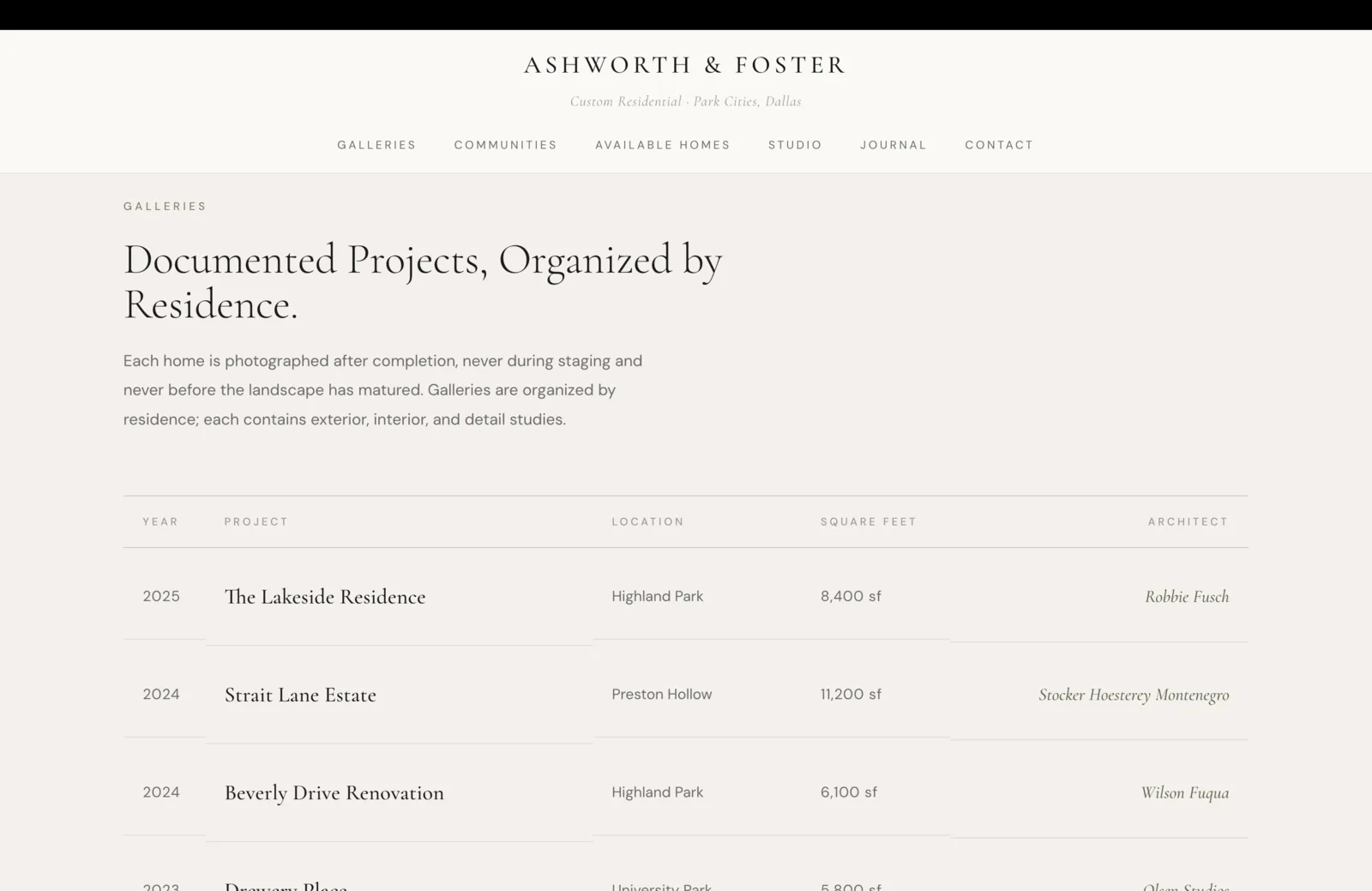
The default gallery on a builder site is a masonry grid of unlabeled photographs, all roughly the same size, all without dates, all without architect credits. A buyer who is reviewing the portfolio cannot tell the 2014 work from the 2024 work, cannot tell the spec from the commission, and cannot tell whether the builder has worked with the architect they have already retained. The grid looks busy. It tells the buyer almost nothing.
So the index is a table, not a grid. Year on the left, project name in formal serif, location, square footage, and architect on the right. The table reads as a documented record of the practice, fifteen years deep, with each entry verifiable by anyone who picks up the phone. The architect column is the column most builder sites refuse to publish, and it is the column that does the most work for the buyer. Robbie Fusch, Wilson Fuqua, Stocker Hoesterey Montenegro, Olsen Studios. A buyer in Highland Park reads those names and knows immediately whether this builder runs in the company they keep.
The supporting line above the table is a quiet rule that earns the buyer's trust before the first photograph loads: every home is photographed after completion, never during staging, and never before the landscape has matured. Builders who shoot a house the week the cabinets go in are showing a job site, not a finished home. The line is short, but it announces a standard the buyer can hold the rest of the gallery against.
Three Featured Galleries Above the Full Catalogue
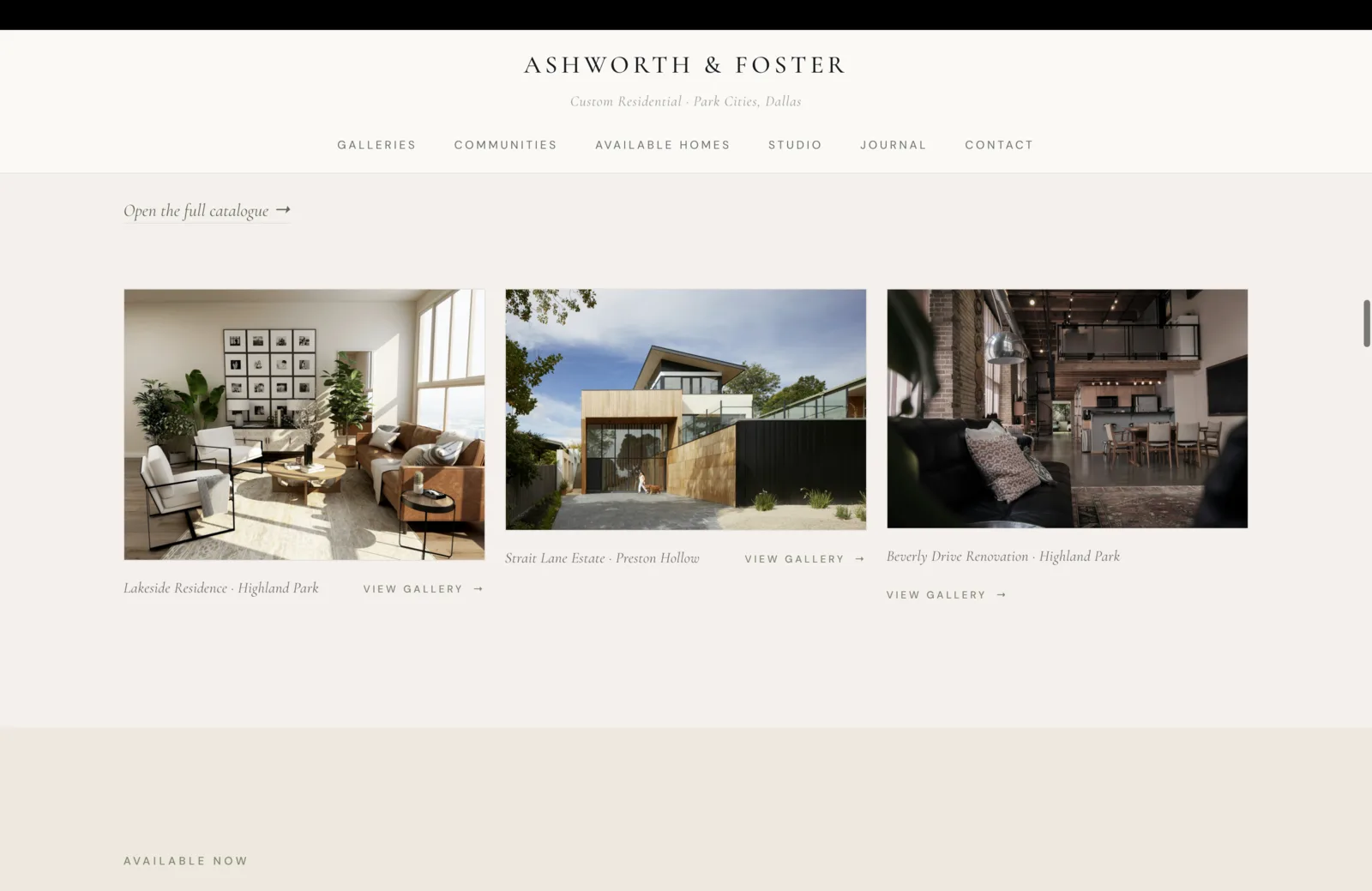
Above the table, three featured galleries do the front-of-house work. Three is the right number for the homepage. More than three turns the surface into a feed and trains the buyer to scroll. Fewer than three signals that the practice is too small to vary. Three is the count that says "here is the range of the work" while leaving the rest of the catalogue one click away.
The choices are deliberate. The Lakeside Residence is a sunlit Highland Park interior, a clean modern living room with a leather sofa, a gallery wall, and houseplants. Strait Lane Estate is the cedar-and-steel exterior of a Preston Hollow ground-up under mature canopy. Beverly Drive Renovation is the brick-and-steel interior of an industrial loft renovation in Highland Park. Three projects, three architects, three photographic registers. A buyer reads that variety as range, not inconsistency, and learns in five seconds that this is a builder who builds across the spectrum of what the Park Cities buyer actually wants.
The italic "Open the full catalogue" link sits above the row, before any image loads. That single affordance does the heaviest lift on the page. It tells the buyer immediately that what they are seeing is a sample, not the inventory, and that the documented record they need to vet a builder is one click away. The "Available Now" eyebrow visible below the row begins the next surface, where any spec home in build sits with its current status.
A Building Journal Posted Quarterly
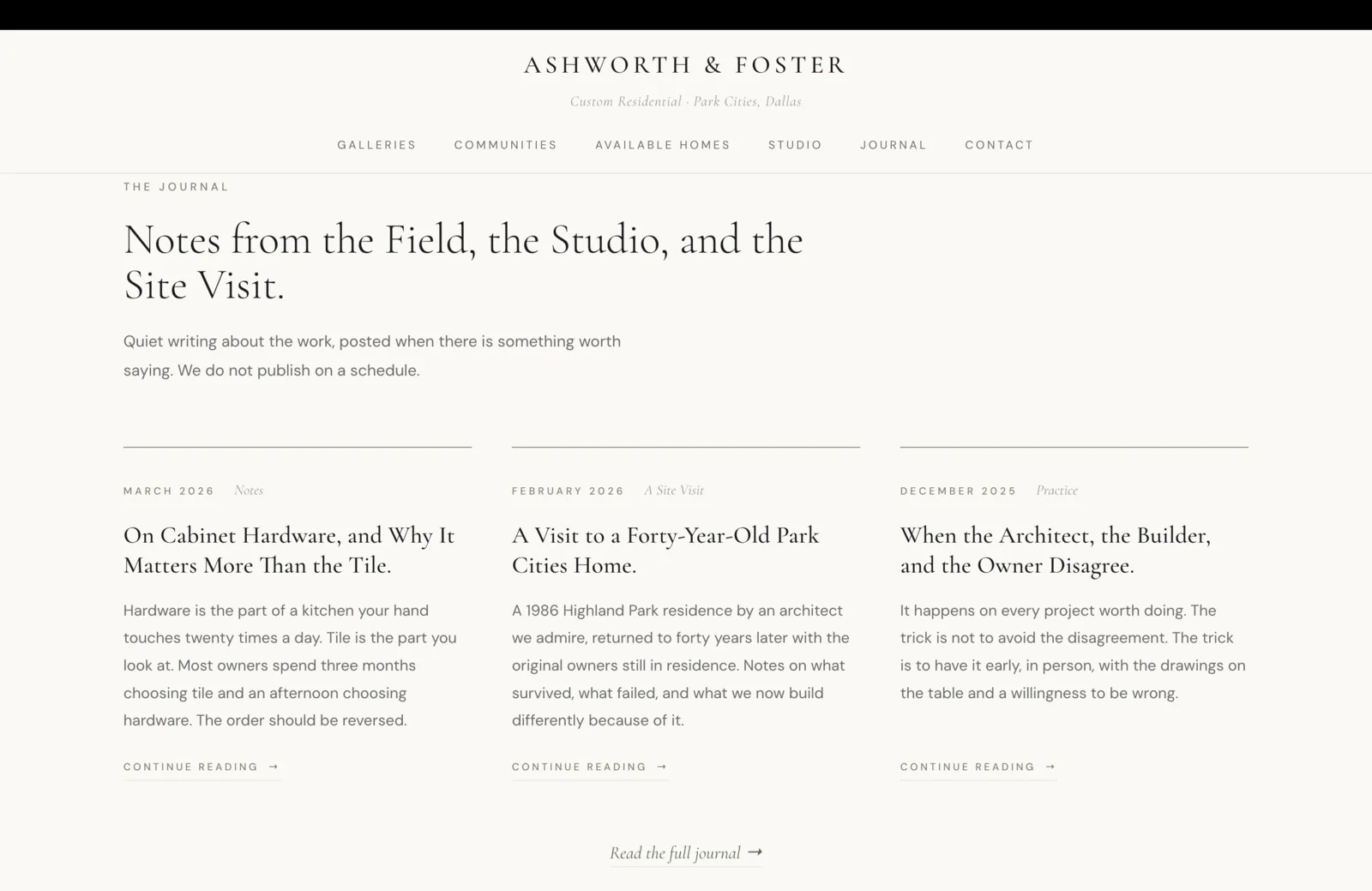
Most builder sites carry a "Blog" that has not been updated in eleven months and a top post titled "Top 5 Tips for Choosing a Custom Home Builder." The buyer reads that page as a marketing artifact, not as the voice of the firm. So the journal is the surface that, when it is done well, does the most quiet work on the entire site. It is the place a buyer goes after the gallery, after the principal letter, when they want to know whether the builder thinks.
The headline is editorial. Notes from the field, the studio, and the site visit. Three categories that map onto three real moments in the practice. The supporting line is the structural commitment that makes the section credible: quiet writing about the work, posted when there is something worth saying. We do not publish on a schedule. A builder who promises four posts a quarter and writes filler in month three has lost the buyer. A builder who promises nothing and writes well twice a year has earned them.
The three article topics on the page are chosen on purpose. "On Cabinet Hardware, and Why It Matters More Than the Tile" signals craft, the contrarian opinion, the specific over the general. "A Visit to a Forty-Year-Old Park Cities Home" signals longevity, returning to a 1986 residence by an architect we admire to study what survived and what failed. "When the Architect, the Builder, and the Owner Disagree" signals process, an honest essay about a tension every project worth doing carries. A buyer who reads any one of those three understands what kind of firm this is before they read the gallery captions.
The Three-Phase Project Handoff
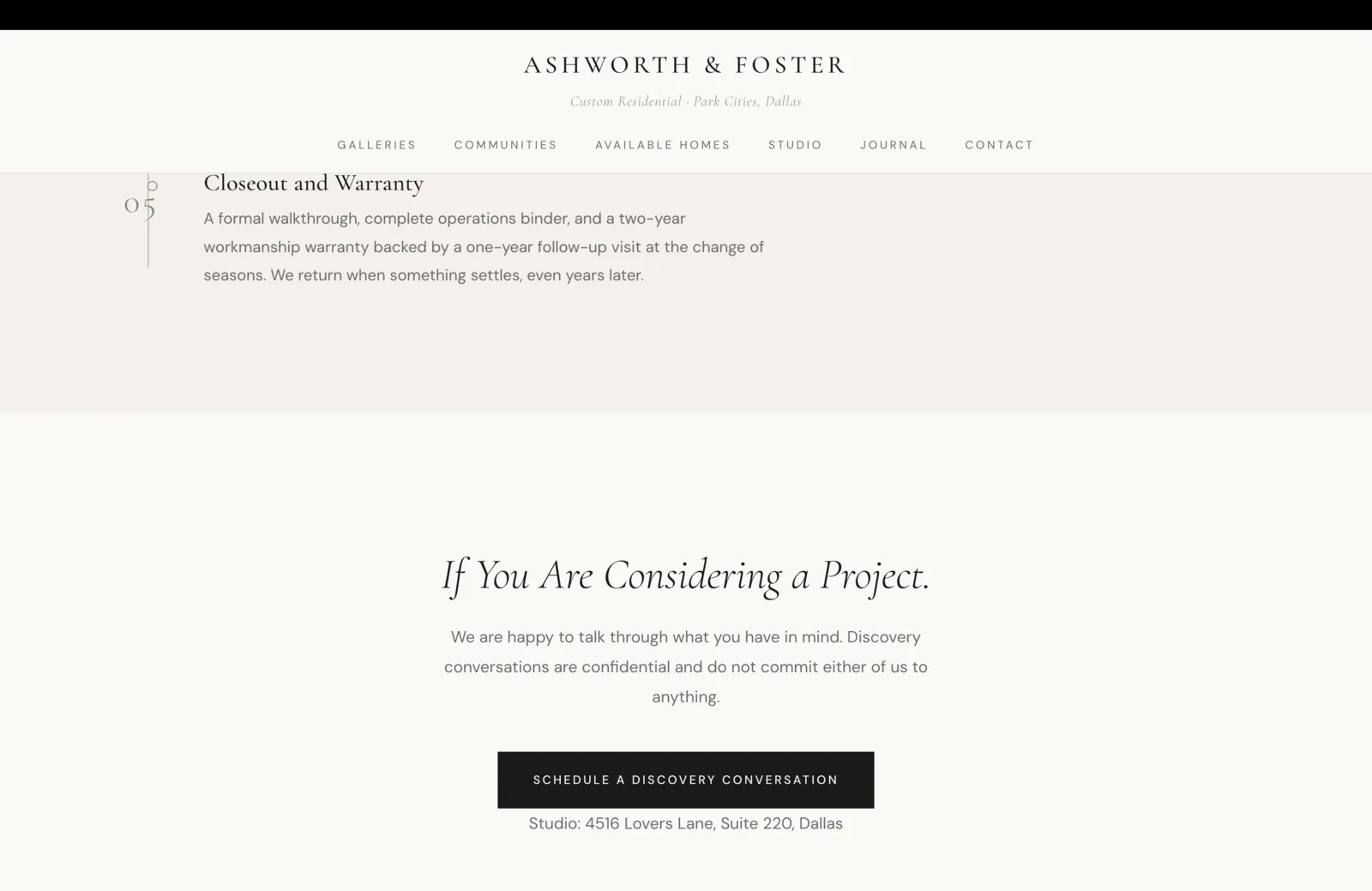
A custom build is a five-stage commitment, and a process section that hides the last stage is a process section that has not earned the buyer's trust. Most builder sites end the process page on "Construction" or "Handover," because that is the moment the contract closes. I end this one on Closeout and Warranty, because that is the moment the relationship begins.
Step 05 reads as a closing surface, not an afterthought. A formal walkthrough. A complete operations binder, the kind a building department auditor could hand to a new owner ten years later. A two-year workmanship warranty backed by a one-year follow-up visit at the change of seasons. And the line that earns the section: we return when something settles, even years later. A house at this price point will move. Plaster will hairline at the corner of a door frame. A floor will pop in the third winter. The builder who answers that call without invoice is the builder the buyer's neighbors recommend.
Below the process, the contact surface refuses the most common builder-site mistake. There is no "Get a Quote" button anywhere on the site, and there is no contact form here. The italic serif headline reads "If You Are Considering a Project." The subhead frames the first call as a discovery conversation, confidential and non-binding for either party. The button is a single black rectangle that schedules the conversation directly. The line below the button is the studio address, in the open, so the buyer knows where the firm actually works before they pick up the phone.
Builder License and Insurance Disclosures
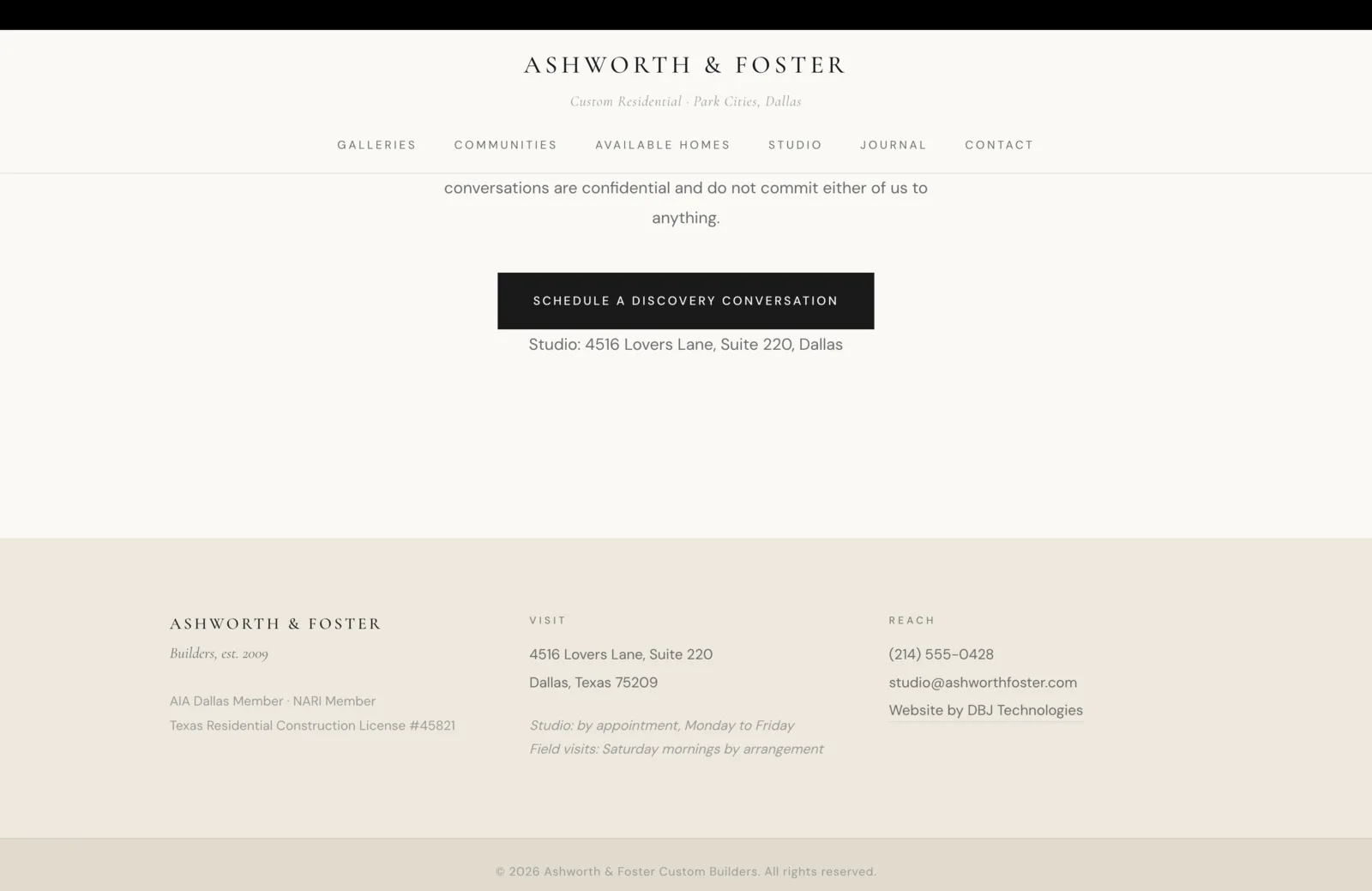
The footer is a credibility surface. A buyer does not read every line, but the regulator, the auditor, and the sophisticated buyer who knows what to look for will find every required item exactly where they expect it.
Three columns, set on a calm dune-cream field that reads as continuation rather than fine print. The left column carries the wordmark, the founding year in italic, and the regulatory stack: AIA Dallas Member, NARI Member, Texas Residential Construction License #45821. A custom builder in Texas who does not display a TRCC license number on the site is a builder a Park Cities buyer should not call. The middle column carries the studio address, the suite number, and the operating notes that signal a working firm rather than a sales office: by appointment Monday to Friday, field visits Saturday mornings by arrangement. The right column carries the direct phone, the studio email at the firm's domain, and the quiet "Website by DBJ Technologies" credit.
The "Website by DBJ Technologies" link sits in the muted brand color so it reads as a closing seal rather than a brag. This is what a Park Cities builder running quietly at the top of the market looks like in its footer: comprehensive, calm, and unmistakably built by someone who has read the TRCC display rule, the AIA member-firm guidelines, and the NARI ethics statement in full.
Build It For Real
Want this architecture, executed for your practice?
I build the version of this that ships. Designed end to end, launched on production grade infrastructure, with the surfaces above tuned to your actual book of business.