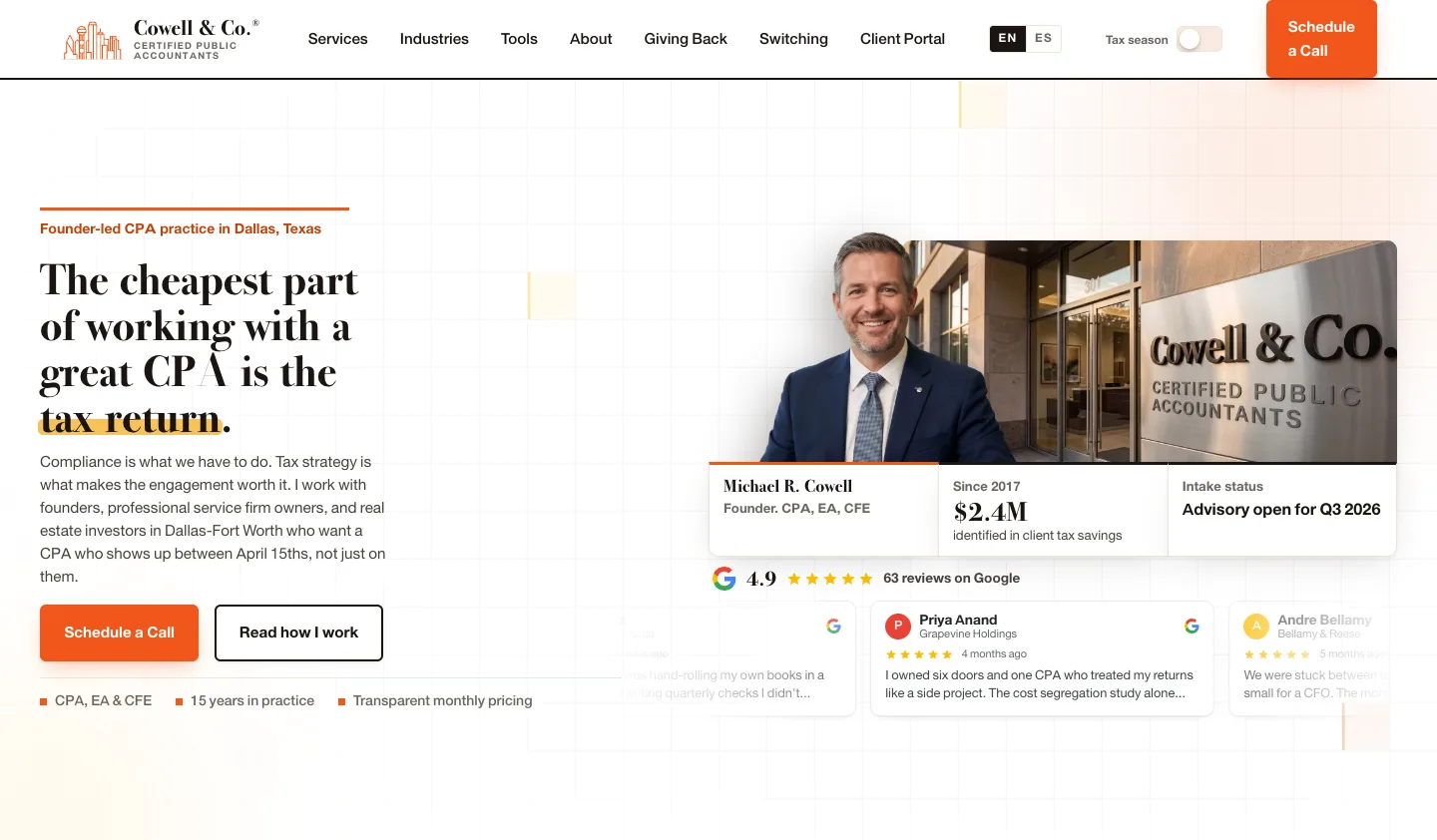
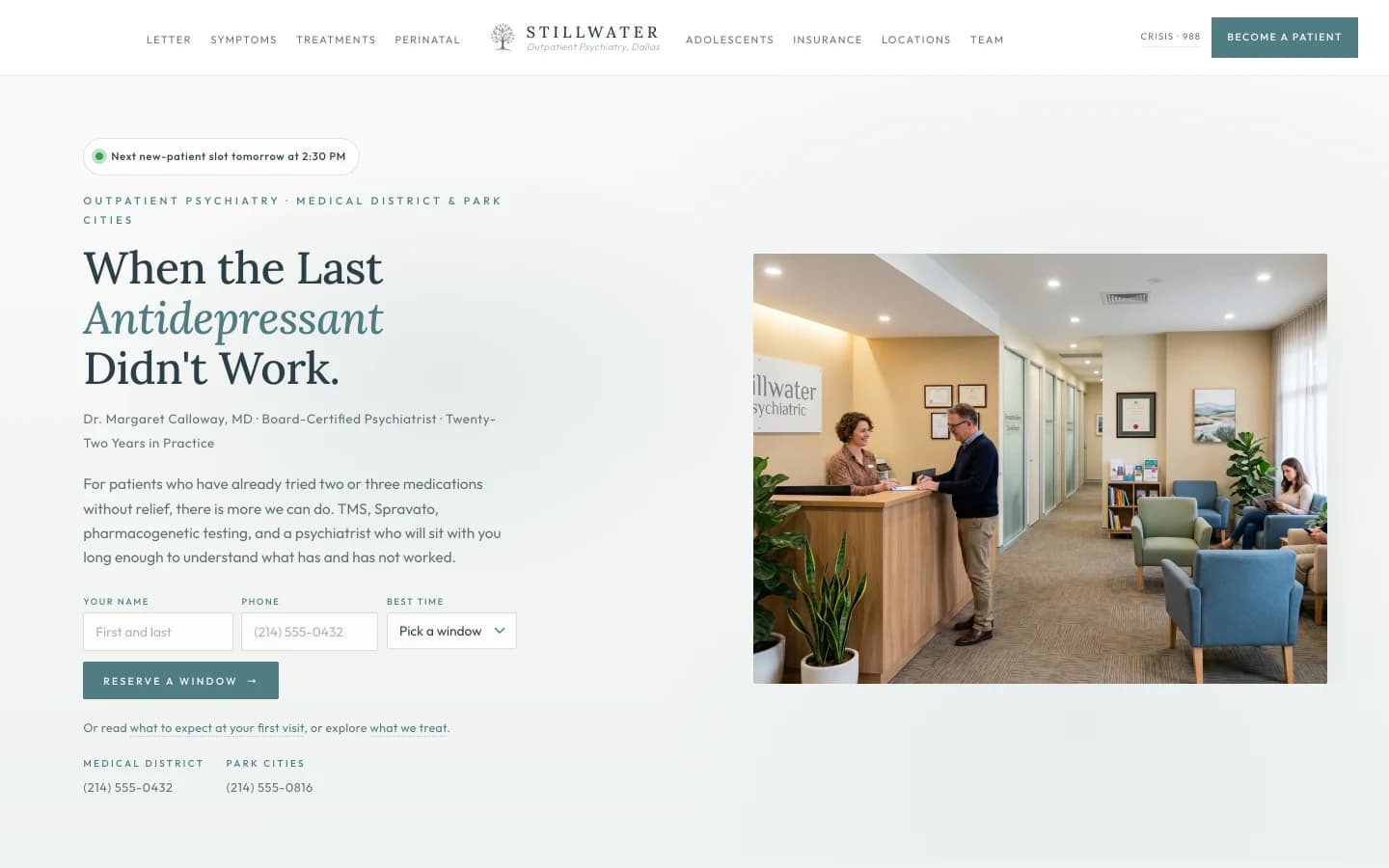
Everything Measures From Here
Every other brief in this library speaks to a consumer. This one speaks to a professional who is paid to be skeptical: the owner's rep with a prequalification checklist, and the subcontractor deciding whose bid invitation deserves a sharp number. A commercial GC's website is not a lead form, it is a prequalification the firm either survives or fails. So Datum publishes what owners actually verify, bonding capacity, EMR history, schedule outcomes, insurance limits, and treats the trades as a first-class audience in both English and Spanish, because half the people who build North Texas run their businesses in Spanish and almost no GC website acknowledges they exist.
The Buyer Holding a Checklist
Nobody impulse-buys a building. By the time a commercial owner's rep opens a general contractor's website, they are usually holding an RFQ scoring sheet: bonding capacity, EMR, comparable projects, litigation history, the resumes of the people who would actually show up. The website's job is to survive that inspection, and almost none are built for it. The typical commercial GC site is a drone photo, the word "integrity," and a portfolio of unnamed buildings with no values, no dates, and no way to check a single claim.
That gap is the whole brief. A contractor who publishes the numbers everyone else makes you request has not just saved the owner's rep an email. They have made every competitor's silence read like evasion. The site is organized around the two professionals who visit it, the owner qualifying a builder and the subcontractor qualifying a paycheck, and it gives each of them the documents they came for.
Datum Commercial Construction is the fictional firm this brief builds: a Dallas GC, founded 2006, running CM at Risk, design-build, and competitive bid work across six commercial sectors. The name is the thesis. A datum is the mark on a drawing set that every elevation measures from, and the site's entire visual language is built out of it.
The Identity: An Engineering Document You Can Walk On

Two materials alternate down every page. The field sections are dark graphite, where the jobsite lives: kinetic numbers, photography, the schedule. The document sections are warm paper, where the spec book lives: tables, tools, the fine print, with registration marks in the corners like a printed sheet. Flipping between them as you scroll feels like moving between the trailer and the drawing set, and no two adjacent sections share a material.
Safety yellow is rationed like the real thing: it marks load-bearing information only, the datum lines, the today line, the active filter, the one number you should read first. Space Grotesk carries the display voice, and IBM Plex Mono carries every piece of data on the site, station labels, dimensions, bid dates, EMR figures, so that numbers read as instrument output rather than marketing claims. Section headings are surveyor's stations, STA 01 through STA 06, each opened by the datum triangle. The mark itself is generated from a single script, the same emitter discipline as the Armadillo shield and the Stillwater tree.
The Signature: One Building, Told as Its Schedule
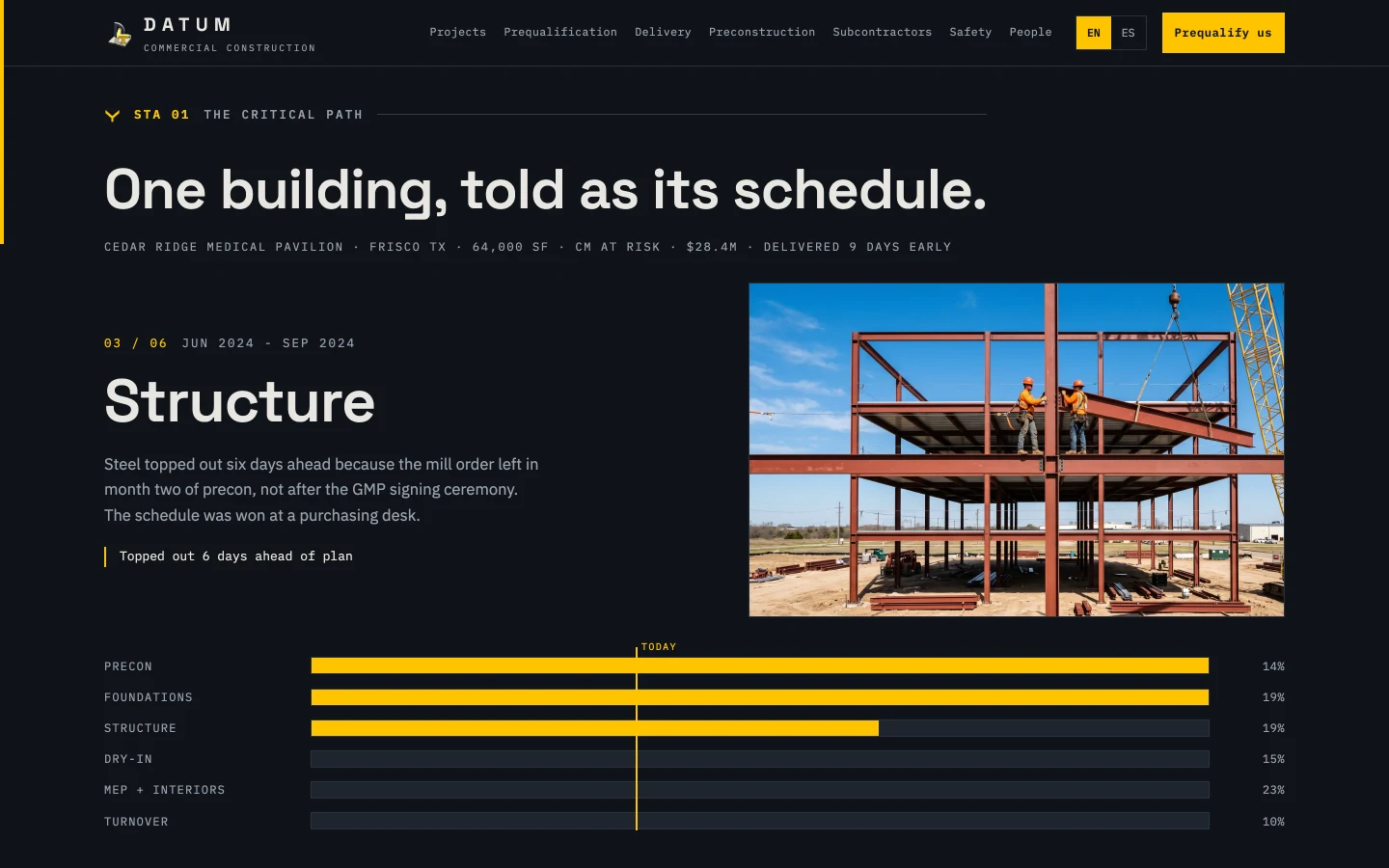
Ask an owner what they actually bought from their best general contractor and the answer is almost never the building. It is the schedule that held. So the homepage's signature scroll piece is a schedule: one real project, the Cedar Ridge Medical Pavilion, told phase by phase as a pinned sequence. As you scroll, a gantt chart draws itself activity by activity, a yellow today line tracks your position, and each phase states one operational fact with a number attached: the GMP that landed within 1.8% of final cost, the 4,100 self-performed yards of concrete, the 212 RFIs closed at a 2.1-day median, the delivery nine days early.
Scroll is the right medium for this the same way it was for the car-wash tunnel: a schedule is genuinely linear, so scroll-as-sequence is the structure of the product, not a gimmick. Under reduced motion the sequence renders complete and static, every bar full, the final phase shown, because the pitch cannot depend on the animation.
The Prequal Room Is the Sales Pitch

Most contractors treat prequalification like an interrogation to survive. Datum treats it as the pitch, because for an eight-figure buyer it is. The prequal page publishes what every RFQ asks for: single and aggregate bonding through a Treasury-listed surety, the full insurance schedule with per-occurrence and aggregate limits in a table a risk manager can scan, the litigation record stated as a sentence a lawyer would sign ("one arbitration in twenty years, disclosed in full"), and a nine-line inventory of the packet itself, from the surety letter to the E-Verify MOU. The request form promises the packet same business day, and the FAQ answers the questions owners save for the interview, including the one that wins projects: the named superintendent and PM are contractually committed, and swapping them requires the owner's written consent.
A Ledger, Not a Portfolio
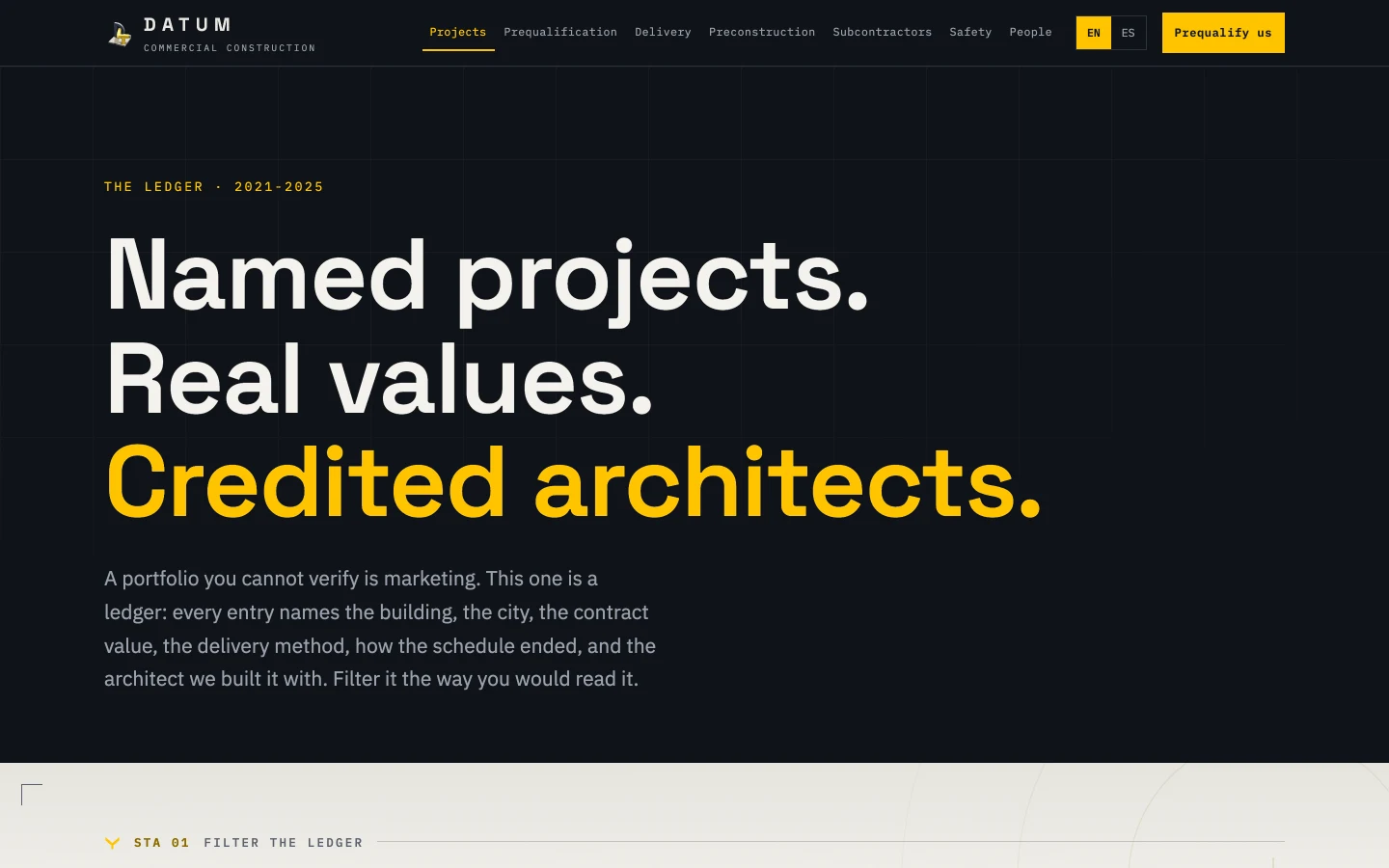
The projects page refuses the anonymous photo grid. It is a ledger: eighteen named projects, each carrying its city, contract value, square footage, delivery method, completion year, credited architect, and how the schedule actually ended, delivered nine days early, zero tenant days lost, occupied by first bell. Filters work the way an owner's rep reads a portfolio, by sector, by delivery method, by value band, and the summary line recomputes the visible count and combined value live, so "show me your CMAR healthcare work over $15M" is a three-click question. Expanding a row reveals the operational arc in two sentences and the reference policy: every entry's owner and architect agreed in writing to take the call.
The Advisor That Shows Its Math
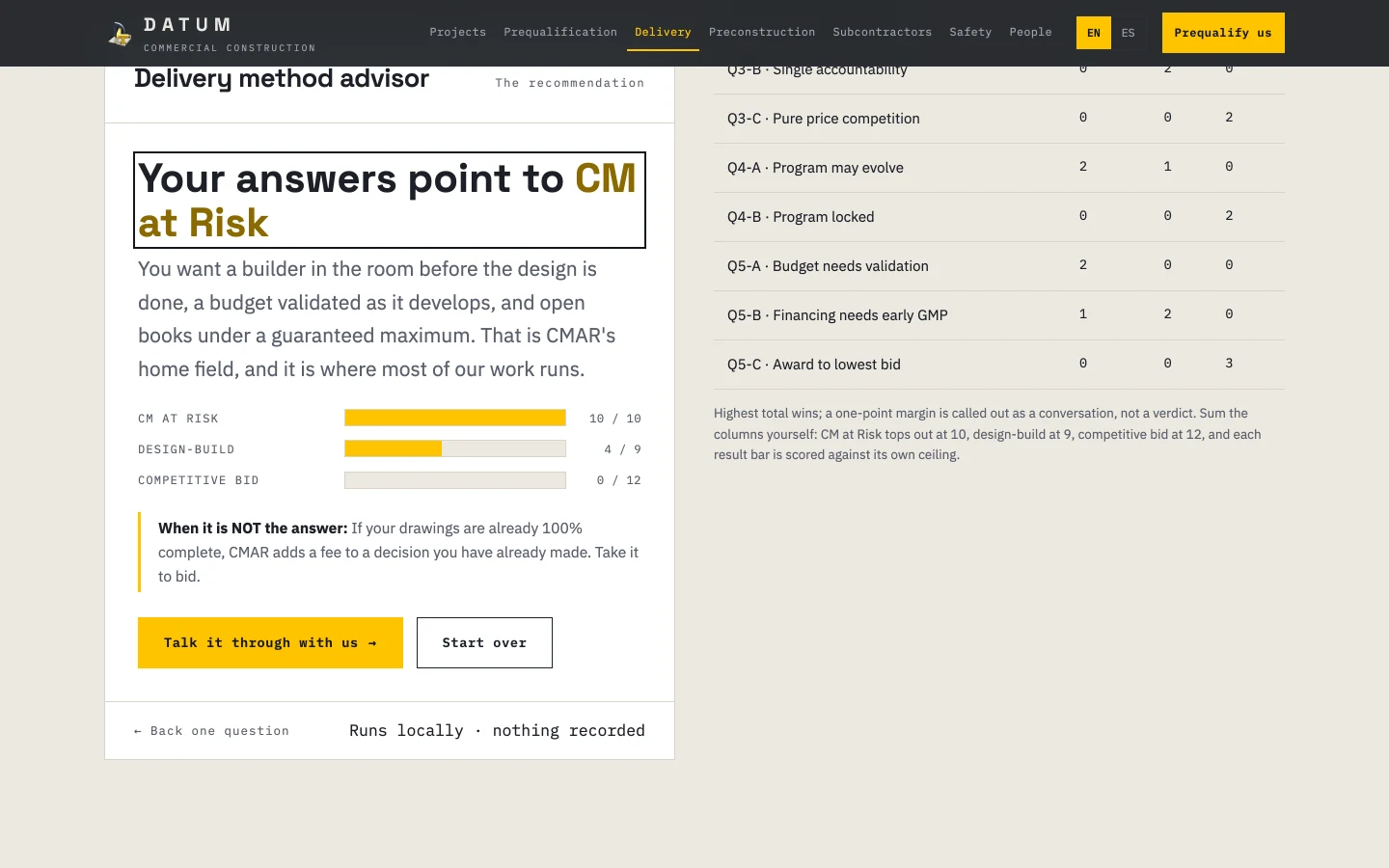
The biggest decision an owner makes before hiring anyone is the delivery method, and most GC websites will not touch it because the honest answer is sometimes not the firm's preferred contract. Datum's advisor asks five questions, design status, what you would guarantee first, how you want to work, program stability, funding, and recommends CM at Risk, design-build, or competitive bid. The scoring table is printed on the page next to the tool, points per answer, so a committee can check the arithmetic by hand; the tool states that it runs locally and records nothing; and every recommendation ships with a "when it is NOT the answer" paragraph, including the one that costs Datum work: if your documents are done, take it to bid. A one-point margin is called out as a conversation rather than a verdict. The whole tool, questions, results, and tradeoffs, runs in both languages.
The Second Audience: Se Habla la Obra
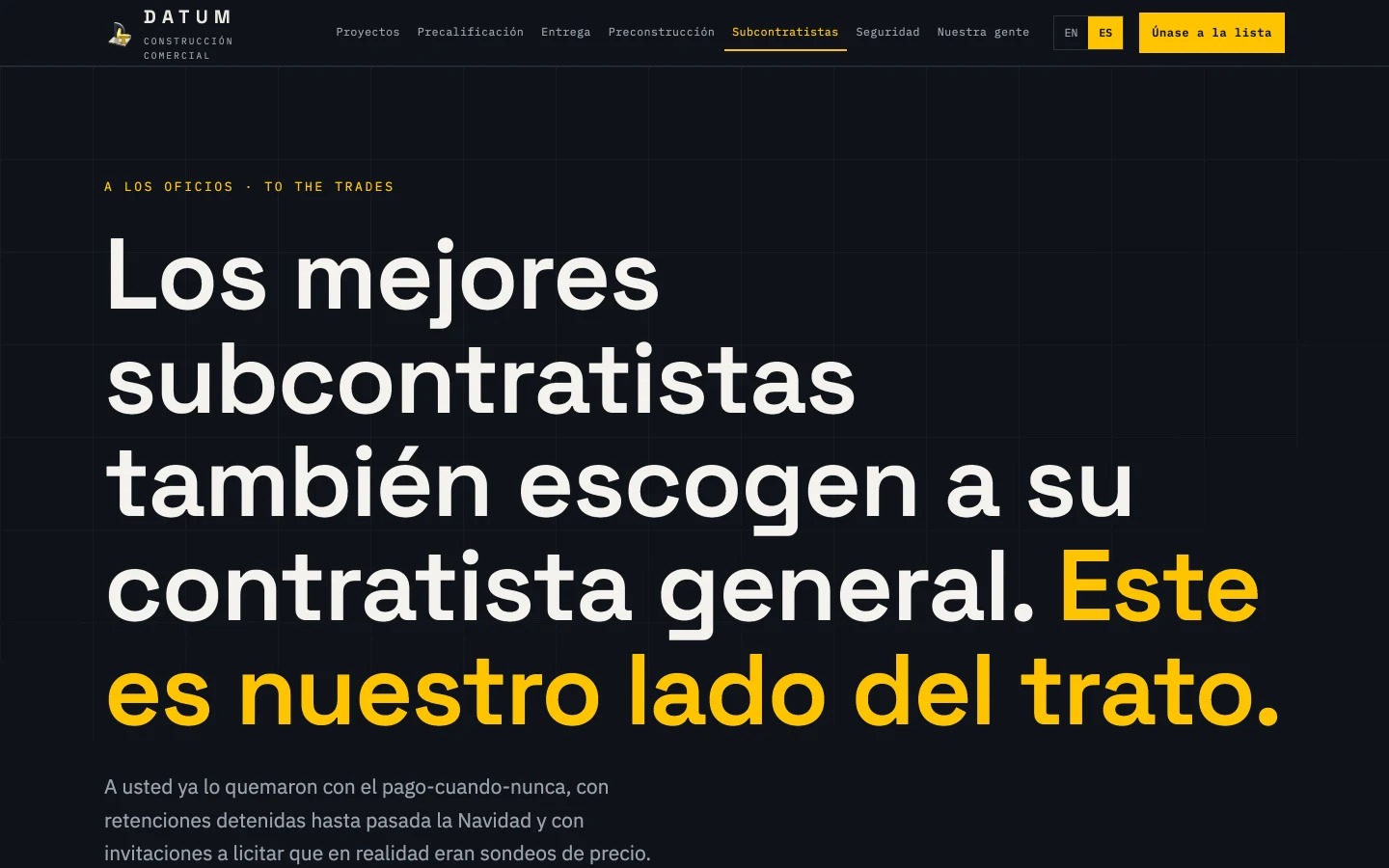
Every brief in this library picks one structural move the vertical refuses to make. This one makes two, and the second is the trades. A GC's real product is built by subcontractors, yet sub-facing content on GC websites is a phone number at best. Datum gives the trades a full surface: payment terms published as commitments, paid within ten business days of owner payment, retainage released by trade at trade completion, a public bid board listing every open invitation with its due date, and a prequalification intake that promises an answer in five business days with a reason.
And the entire site runs in Spanish. Not a translated brochure page, every surface, the advisor, the ledger, the bid board, the forms, through a persistent toggle in the nav, written in the professional construction register a bilingual DFW field office actually uses, fianzas, retención, licitación, plática de seguridad. The subcontractor band on the homepage leads with "Hablamos español" and means it structurally: orientation runs Mondays at 6:30 in English and 7:15 in Spanish, and the site says so in both. For a vertical whose workforce is majority Hispanic and whose websites are monolingual almost without exception, the toggle is not a feature. It is the loudest possible signal about who is welcome on the jobsite.
Safety Is a Falling Chart
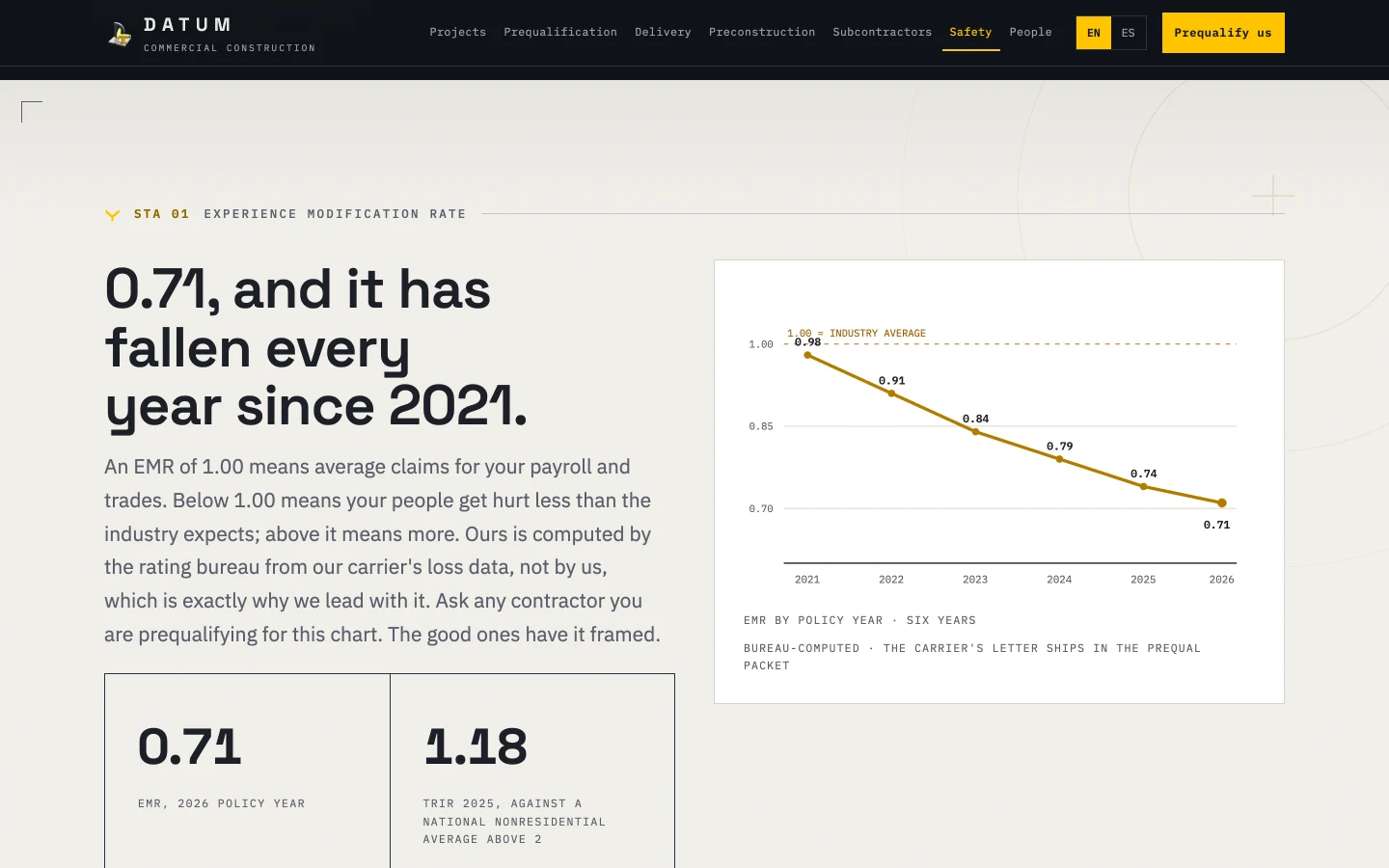
Every contractor claims safety; Datum charts it. The EMR, the one safety number an owner can independently verify because the rating bureau computes it, is drawn as a line falling every year since 2021, under a dashed industry-average line at 1.00, with the annotation that the carrier's letter ships in the packet. The practices behind the number are stated as verifiable specifics rather than values language: bilingual toolbox talks led by bilingual supervision, a stop-work authority any worker can exercise in any language, fourteen exercises of it in three years, all fourteen right, and the deliberate absence of a "days without incident" scoreboard at the gate, because a scoreboard pressures crews not to report. That last detail is the page in miniature: the honest version of the claim is more impressive than the inflated one.
Why This Wins the Room
The library's other briefs argue that consumer verticals win by publishing what competitors hide, prices, availability, real menus. This brief extends the argument to the hardest audience there is: buyers whose entire job is not believing contractors. The answer is the same discipline at a higher altitude. Publish the bonding. Chart the EMR. Name the projects and their outcomes. Print the scoring math of your own sales tool, including the paths that send work elsewhere. Put the second language on equal structural footing because the industry's workforce already lives there.
A commercial GC that shipped this site would walk into shortlist interviews where the committee had already read the packet, already checked the ledger, already run the advisor against their own project, and already noticed that every claim came with a way to verify it. In a procurement built on skepticism, being the firm with nothing to request is not a website win. It is a bid-day advantage that compounds for twenty years.
Build It For Real
Want this architecture, executed for your practice?
I build the version of this that ships. Designed end to end, launched on production grade infrastructure, with the surfaces above tuned to your actual book of business.